Sterling Crispin is a conceptual artist and software engineer whose work includes generative art, machine intelligence and technological sculpture. He builds software both as a creative tool and as a way to examine how computational systems shape human experience.[1][4]
Start with Data-Masks →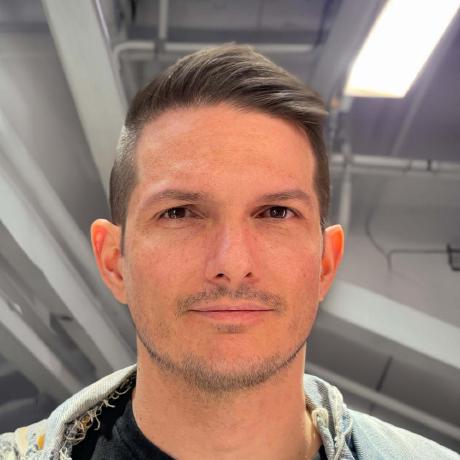
Education

Links
Artist site CV GitHub
 X · sterlingcrispin
Background
Crispin earned a BFA in painting and drawing at Rocky Mountain College of Art and Design, followed by an MFA and an MS in multimedia engineering at the University of California, Santa Barbara. His work moves between images, physical objects and programs. Exhibitions include ZKM Karlsruhe and the Seoul Museum of Art, placing his computational experiments in an art context as well as a software one.[1][2]
Contributions
A face seen by a recognition system
Data-Masks uses facial-recognition and detection algorithms to guide an evolving system toward forms that the software reads as faces. Crispin then 3D-prints those forms as masks. The work makes an algorithm’s representation of identity tangible. He explicitly frames the objective as revealing what the system seeks, rather than creating a disguise that evades detection.[3]
Painting with an evolving tool
For Cyber Paint, Crispin created a virtual-reality application and used it to make digital prints on canvas. The software explores algorithmic mark-making beyond a simulation of ordinary paint. New paintings prompt changes to the application, creating a feedback loop between the artist, the tool and the resulting work.[4]
An experiment in automated markets
His Nothing Ever Happens repository contains a Python bot that scans standalone non-sports prediction markets for configured No-side entries. It tracks positions and exposes a dashboard, with separate behavior when live order transmission is enabled. Its paper-exchange mode separates experimentation from live order execution.[5]
Tools, writing & talks
Writing, research & talks
Start here
Data-Maskssterlingcrispin.comAlgorithmically evolved and 3D-printed masks that reveal how facial-analysis software represents a face.
Begin with the installation images and overview, then read the explanation of how the masks were generated. No programming background is needed to understand the artistic question; the thesis supplies technical detail.
Artist and researcher[3]Sterling Crispin on NVIDIA's framework representing agents as Python objects: actions are functions, state is fields, prompts are docstrings, and non-deterministic gaps are code the agent writes and returns a value for.
Catalog workOriginal source- Cyber Paintsterlingcrispin.com
A VR mark-making application and a series of paintings developed through the same evolving creative process.
Creator and artist[4]
Tools
- Nothing Ever Happensgithub.com
An experimental prediction-market bot with position tracking, a dashboard and configurable live-order behavior.
Creator and repository owner[5]Original source