Thariq's deep dive: how effort levels shape Claude Code's behavior
- Source
- x.com
- Author
- Thariq
- Date
Context
Thariq reports in an X article that raising the effort setting in Anthropic's Claude Code mostly changes how much verification and edge-case testing the does. On an HTML-sanitizer task from Terminal-Bench 3.0, low-effort attempts took about two minutes and tested one hand-written page. A traced high-effort run took about 33 minutes: it reviewed its first draft adversarially, read the parser's source, ran a standard XSS test suite and wrote a random-document fuzzer. Across attempts on that task, Fable 5.1 went from 1 of 5 successes at low effort to 5 of 5 at xhigh.
The proposed workflow follows from that difference: have the model interview you and implement at low or medium effort, review the result, then verify at high effort. The evidence is the author's own runs plus toy examples. The article says higher effort tends to reduce failures from missed edge cases but not from choosing the wrong approach, and that low effort suits quick iteration while the user stays in the loop.
- Thariq finds that raising effort mostly buys verification: across Terminal-Bench 3.0 results, more effort tended to cut failures from missed edge cases but did not fix runs where the model took the wrong approach.
- On the html-js-filter sanitizer task, Fable 5.1 went from 1/5 at low to 5/5 at xhigh. Low runs took about 2 minutes and tested one page; the traced high run took about 33 minutes and added an XSS suite and a fuzzer.
- His suggested feature loop: have Claude interview you on a spec, implement and iterate on low effort, review the gist, then run verification and testing on high effort.
- With a detailed interview-derived spec, models and effort levels produced similar builds. On an underspecified prompt, higher effort built far more and made more product choices on the user's behalf.
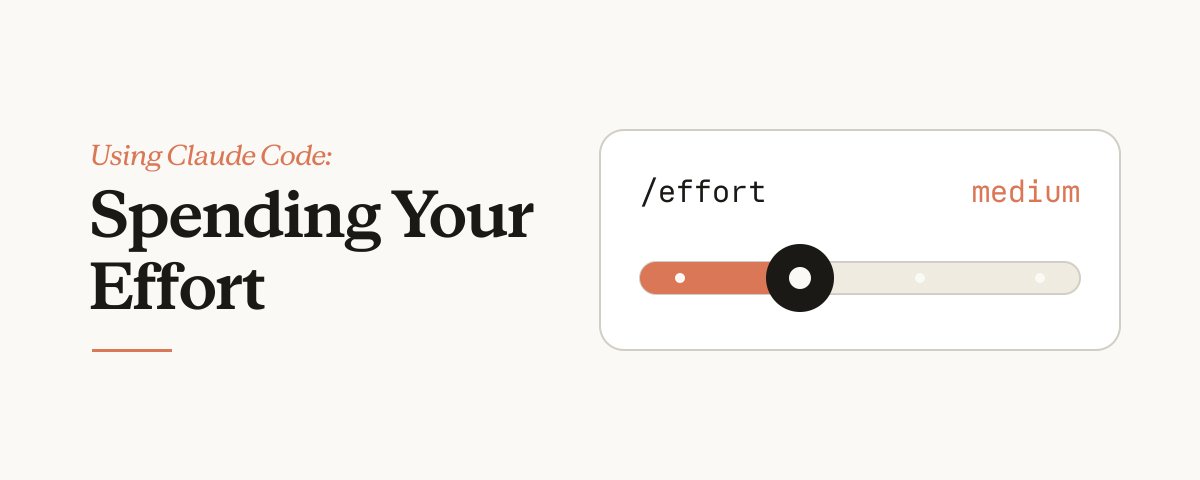
- His rule of thumb: low for brainstorming and easy edits, medium for most feature work, high for brownfield bug fixes and edge-case-heavy work, max for fully autonomous build-and-verify or security hunting.
- AI agent — An AI system that doesn't just answer once but works toward a goal in a loop — taking actions, reading the results, and deciding what to do next.


Checking sign-in…
Loading comments…