Claude Code cloud sessions: a field guide to parallel VM tasks
- Source
- claude.dev
- Author
- ClaudeDevs
- Date
Context
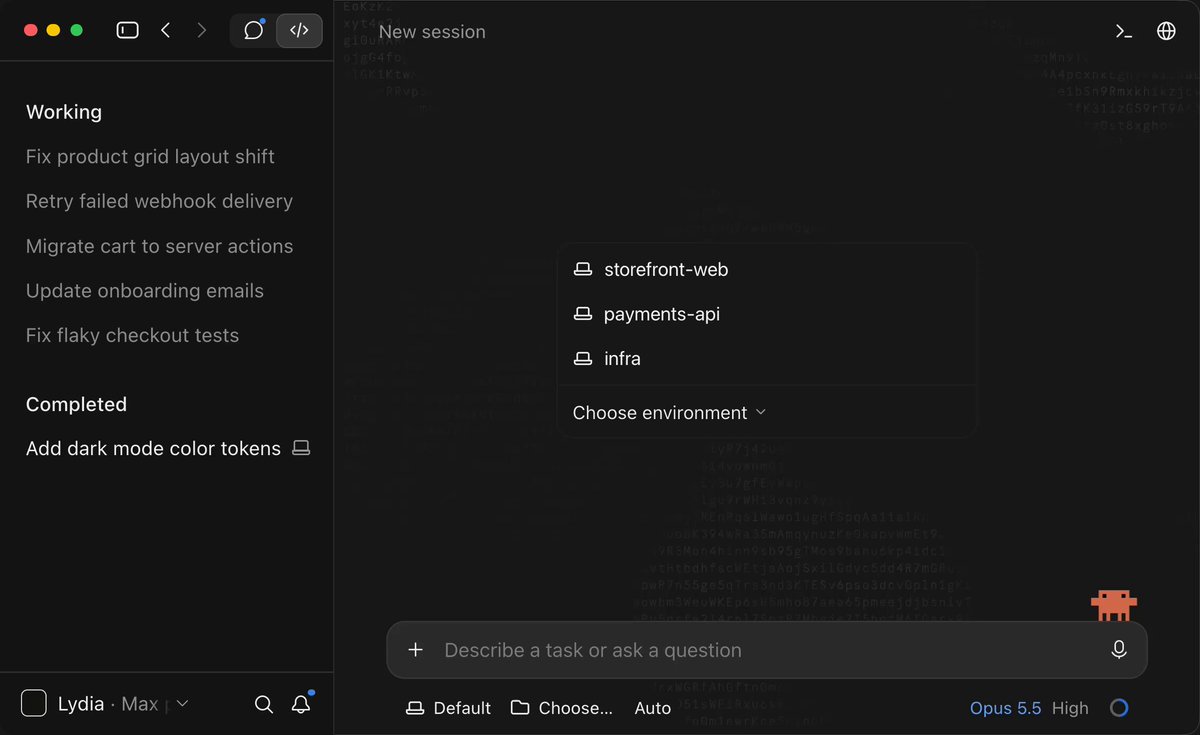
A Claude Code cloud session gives each task its own fresh virtual machine, with the repository cloned onto a new branch, instead of running the in a terminal on the user's laptop. Addy Osmani's field guide on Anthropic's developer blog uses four real sessions on a small sample Node API to show when that pays off. He started three of them within 16 seconds, one to fix a test that failed about one run in four, one to rewrite stale API docs and one to switch the logger to JSON output. They ran for 61, 65 and 72 seconds and were all done 87 seconds after the first began. The test session traced the failure to a race in a cache and ran the suite 40 times without a failure; the docs and logger sessions each started their own copy of the server without colliding. The same isolation meant the logger session hit the flaky test, could not see the fix being made next door, and reported that the suite was not clean, which is why the guide advises splitting parallel work along file boundaries.
The guide is just as specific about what the VM can and cannot reach. The user's GitHub stays in a proxy outside the machine, and the session gets a short-lived credential that can push only to its own branch. The repository's CLAUDE.md, skills and commands travel with it, while personal settings in ~/.claude stay behind, so test commands the agent needs have to be written into the repository. That separation is also the case for running code you have not read, such as a contributor's pull request, in a disposable VM away from your SSH keys and cloud logins, though even with network access set to None the session still talks to the Anthropic API and can push to its branch. Work that needs something only the laptop has, such as real local data, a VPN-only service or a GPU, belongs in a local session, as does any organization using Zero Data Retention, which turns cloud sessions off. Idle VMs are reclaimed, so long tasks should commit as they go.
Most first-run trouble, the guide says, comes from GitHub needing two separate permissions. Signing in with GitHub identifies the user, while installing the Claude GitHub App on an account or organization decides which private repositories Claude can see there. A private repository missing from the picker usually means the App is not installed on the account that owns it, and an organization's repositories can vanish if its single sign-on step was skipped. Running /web-setup to hand over an existing gh token is an alternative, but Auto-fix for pull requests, GitHub-triggered routines and projects still need the App. Because claude --cloud clones from GitHub, local commits have to be pushed first.
Cloud sessions carry no separate compute charge but draw on the same plan limits as local use, so five parallel sessions use them about five times as fast as one. The announcement thread also reminded people who were on a Pro or Max plan on September 23 that they could still claim the one-time bonus credit offered with the earlier general-availability announcement, which the support page puts at 100 dollars on Pro and 250 dollars on Max. The claim deadline was October 7 at 11:59 PM PT; cloud sessions spend the credit first, and it expires November 4.


Checking sign-in…
Loading comments…