Ultramarine 1 Flash
- Source
- paperinstruments.com
- Author
- i_rush_carriers
- Date
Context
Ultramarine 1 Flash is a model from Paper Instruments aimed at professional knowledge work in finance, law, consulting and operations. It is not trained from scratch: the company took GLM-5.3 Flash, an model from Z.ai, and applied large-scale reinforcement learning, a training method in which the model attempts tasks and is pushed toward the attempts that score best (paperinstruments.com). The launch page calls it an open model, but at publication it was offered through the company's API, with the weights marked as coming soon (paperinstruments.com).
The technical report's central problem is how to score such work. Reinforcement learning for coding usually relies on answers that can be checked automatically, such as passing unit tests, but a diligence memo or a board pre-read has no single correct answer. Paper Instruments instead generates synthetic tasks across 88 types of simulated workplace, each with realistic documents, live business systems such as CRM and ERP software, and a rubric of separate criteria that an AI grader marks as met or unmet. The report argues each criterion must be specific enough not to reward plausible-sounding errors and broad enough not to reject valid alternative answers. Training runs inside the company's own , Feather, which it designed around conventions shared by widely used coding harnesses such as Claude Code and Codex.
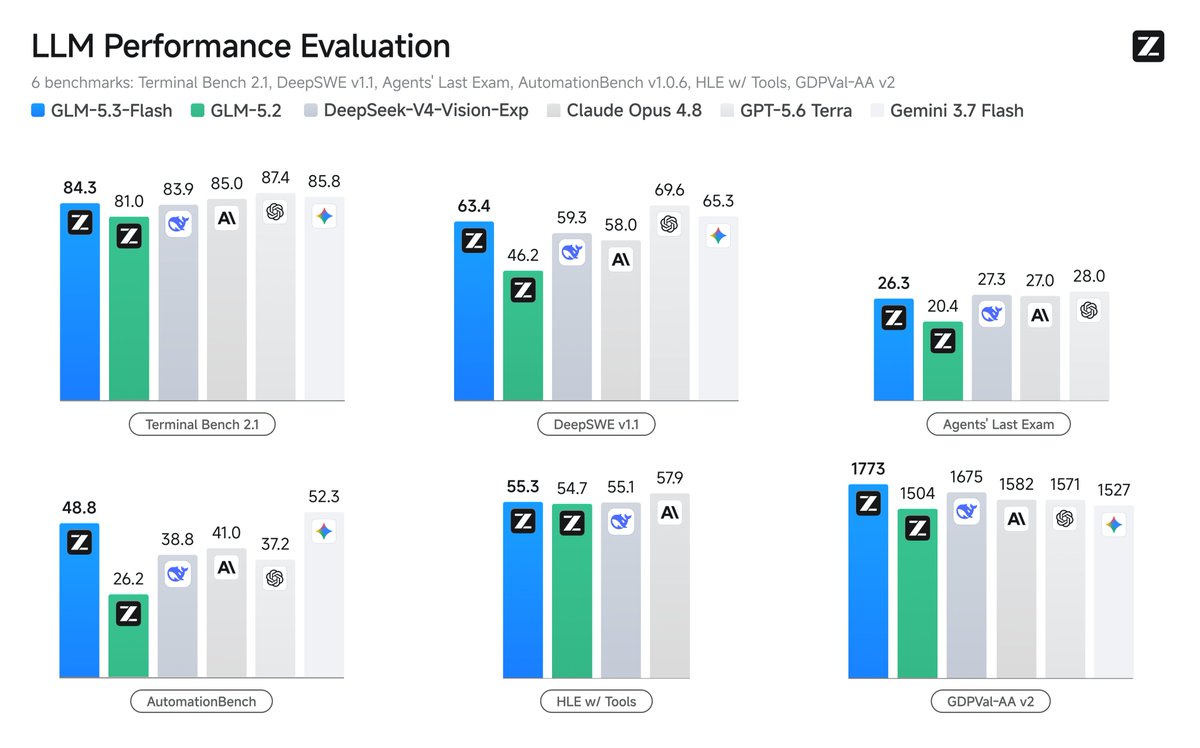
By the company's numbers, Ultramarine beats its base model on all six knowledge-work benchmarks it reports, by 4.1 points on average, while generating 6.5% fewer . The price claim rests on PI Knowledge Work, an internal : there it scores 59.3 at $0.13 per task, ahead of Claude Fable 5 at $8.19 and GPT-5.6 Sol at $2.09 on maximum reasoning, and within three points of Claude Opus 5.5 and GPT-6 Sol. On the outside benchmarks the picture is mixed. It leads on JobBench and FrontierFinance, but Gemini 3.8 Flash and Claude Fable 5 score higher on DiligenceBench and APEX-Agents 1.1, DeepSeek V4.1 Flash edges it on AutomationBench, and on the two coding benchmarks it reports it scores slightly below GLM-5.3 Flash. Its per-token API price is the same as GLM-5.3 Flash's (see the earlier GLM-5.3 Flash launch), and on PI Knowledge Work the base model itself costs $0.10 per task for a score of 52.0, so what the extra training buys is a higher score at a slightly higher cost per task, not a lower one.
- open weights — A model whose trained parameters are published for anyone to download and run — unlike API-only models you can access but never possess.
- agent harness — The scaffolding around a model that turns it into a working agent — the loop, the tools it can call, and the rules for when to stop.
- token — The chunk of text a model reads and writes in — roughly three-quarters of a word — and the unit AI usage is billed in.
- benchmark — A standard public test set for comparing AI models — the shared scoreboards behind every "model X beats model Y" claim.
Checking sign-in…
Loading comments…