GLM-5.3-Flash lands under MIT at $0.15 per million input tokens
- Source
- x.com
- Date

Introducing GLM-5.3-Flash - Leading capabilities at a highly competitive price - Natively multimodal with a 1M-token context window - A 320B-A18B model released under the MIT License - Previously previewed as Ox Alpha, running entirely on Chinese AI chips Blog: https://t.co/tzOmB7gdZP Available now across all official platforms: Weights: https://t.co/9LRMahY9Wa API: https://t.co/VcaQnzYmS9 Coding Plan: https://t.co/Nk8Y98HNhU ZCode: https://t.co/Peepqv4XSx Chat: https://t.co/WCqWT0qCQb AutoClaw:

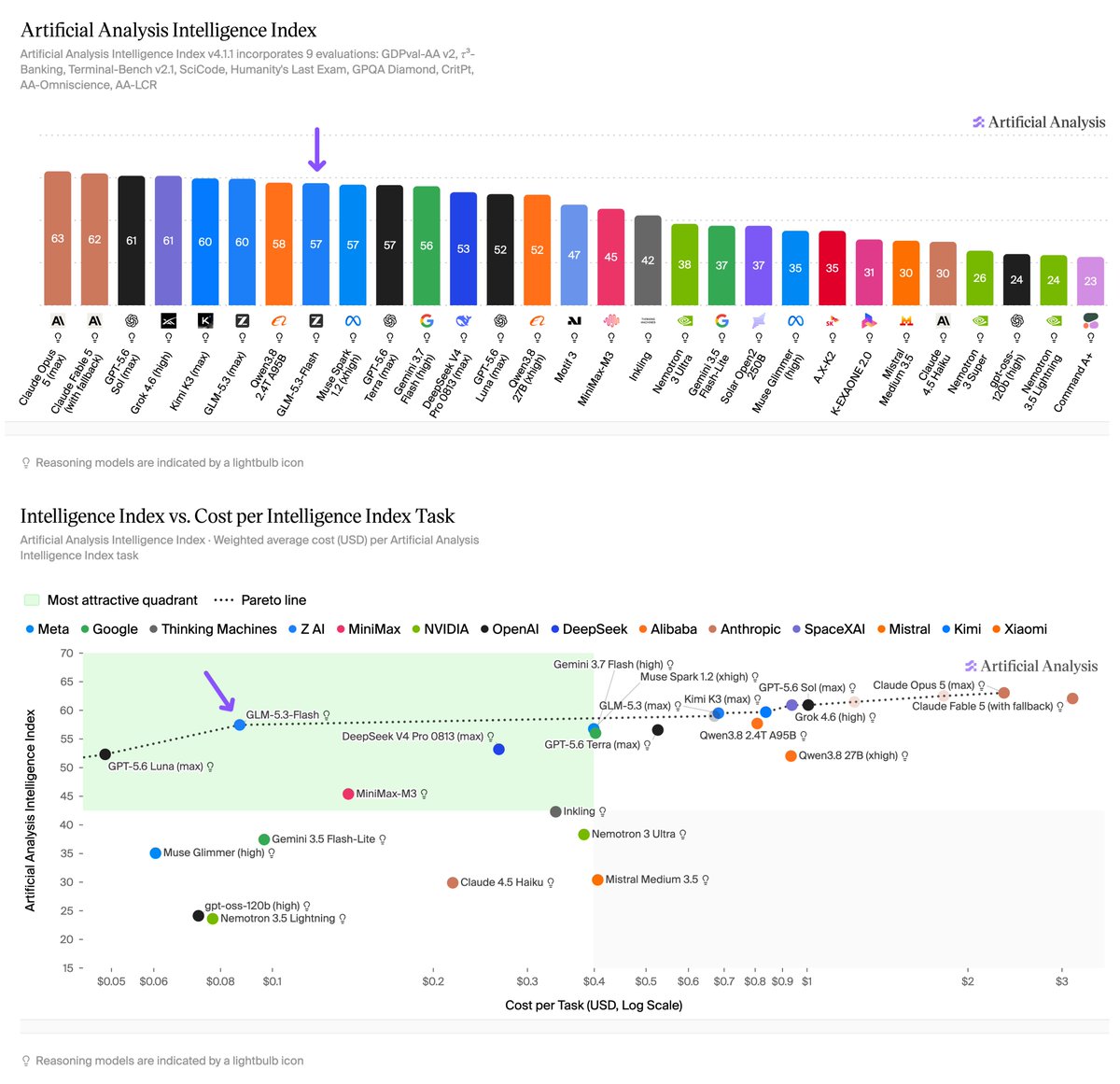
Standard API Pricing for GLM-5.3-Flash (per 1M tokens) - Input: $0.15 - Output: $0.50 - Cached input: $0.03
On the https://t.co/w8mHB85z4n Code Bench, which measures real-world coding performance, GLM-5.3-Flash clearly outperforms GLM-5.2 at every effort level and performs on par with Claude Opus 4.8.

Architectural enhancements, combined with an optimized pre-training corpus, enable GLM-5.3-Flash to deliver greater intelligence with less compute.

Context
Z.ai released GLM-5.3-Flash, a 320-billion-parameter model that activates only 18 billion parameters per , under the permissive MIT license, with weights, API access and a coding subscription plan live the same day according to its own thread. It handles text and images natively and accepts up to 1 million tokens of in one request. Z.ai's listed pricing is $0.15 per million input tokens and $0.50 per million output tokens, with cached input at $0.03, cheap enough to make self-hosting or high-volume API use practical for a large context window without frontier pricing.
Z.ai's announcement says the model performs on par with Claude Opus 4.8 on its own coding , which is a vendor's measurement of its own model, not an outcome checked by an outside party. The same thread reveals GLM-5.3-Flash previously ran under the name Ox Alpha, and SemiAnalysis reported separately that Ox Alpha's roughly 100 trillion tokens of daily free serving ran entirely on domestic Chinese chips rather than Nvidia hardware, at efficiency it says was comparable to mainstream Nvidia accelerators, a relevant data point for anyone assessing how dependent large-scale Chinese model serving still is on Nvidia.
- token — The chunk of text a model reads and writes in — roughly three-quarters of a word — and the unit AI usage is billed in.
- context window — The maximum amount of text a model can consider at once — its working memory for the current conversation or task.
- benchmark — A standard public test set for comparing AI models — the shared scoreboards behind every "model X beats model Y" claim.
- multimodal — A model that works with more than text — reading images, audio, or video, and sometimes generating them too.
 postWe’re sharing how GLM-5.3 helped build and optimize the inference infrastructure serving GLM-5.3-Flash.
- postGLM-5 lands in Zhipu's Coding Plan Pro as pricing shifts
 articleZ.ai details GLM-5.3's leap in exploit analysis and staged release
 postGLM-5.3 API launches for coding and cybersecurity agentic tasks

Checking sign-in…
Loading comments…