Simplifying Model Serving Across Multiple GPUs with NVIDIA TensorRT Multi-Device Integration in NVIDIA Dynamo-Triton
- Source
- developer.nvidia.com
- Author
- Tanya Lenz
- Date
Context
NVIDIA's multi-device serving integration lets an application request through one endpoint while the server coordinates several GPUs. The model must first be compiled for distributed execution; switching the server configuration does not automatically split an ordinary single-GPU model.
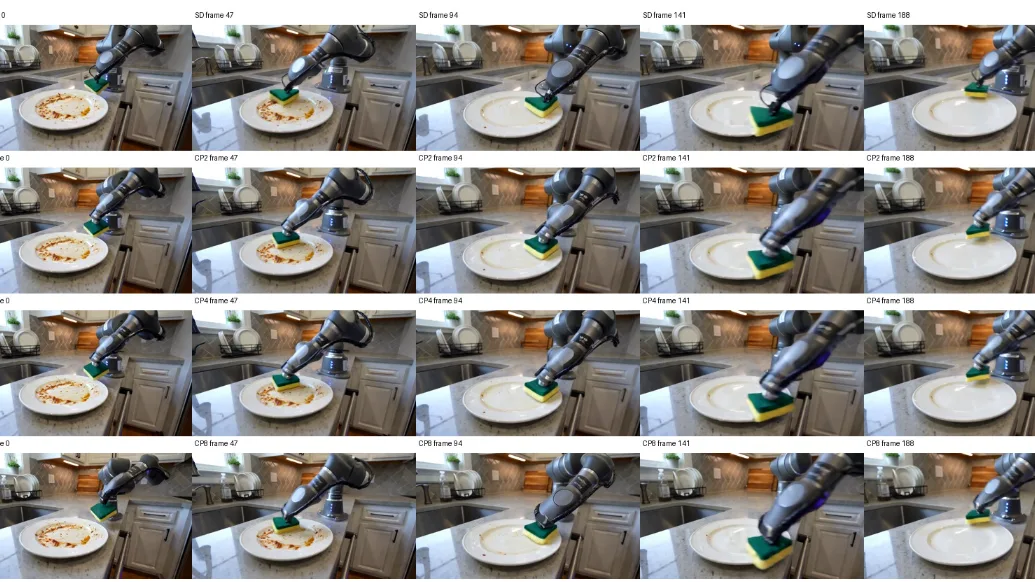
In NVIDIA's Cosmos 3 Nano video-generation example, mean generation time fell from 156.6 seconds on one GPU to 34.2 seconds on eight. Each configuration had five measured generations after warm-up, excluding model loading and video-file encoding. This demonstrates a way to reduce waiting by assigning more hardware to a request. The benchmark did not measure concurrent throughput or cost per video, so the speedup cannot establish a cost saving.
- Demonstrated on Cosmos 3 Nano video generation: Ulysses parallelism splits 44,160 video tokens across up to 8 GPUs, with each CP8 rank handling 5,520 tokens outside while the 2,992-token text path stays replicated.
- RPC speedup reached 6.09x at 8-way parallelism, but end-to-end latency only improved 4.58x, because roughly 10.2-10.5 seconds of fixed overhead (prompt work, scheduling, VAE decode, postprocessing) stays constant and becomes a bigger share of a much shorter total.
- On one GPU the transformer accounts for 93.4% of generation time; at 8-way parallelism that share falls to 70.2%, quantifying how much of the remaining latency now sits outside the accelerated path.
- Output isn't pixel-identical to the single-GPU baseline: CP8 measured MAE 16.316 / PSNR 19.400 dB against validation thresholds of MAE <=25 / PSNR >=18dB, while CP2 and CP4 stayed closer (MAE 12.759 / PSNR 21.111 dB).
- The distributed graph is compiled into each TensorRT plan before deployment rather than converted at runtime; the CP8 plan's topology alone contains two initial reduce-scatters, 108 all-to-alls across 36 transformer layers, and one final all-gather.
- inference — Running a trained model to get answers — the phase where AI is actually used, as opposed to trained.
- context window — The maximum amount of text a model can consider at once — its working memory for the current conversation or task.
- attention — The mechanism that lets a model weigh which earlier words matter for the word it's currently processing — the core operation of a transformer.
- transformer — The neural network architecture behind modern AI models, built on attention — letting every word directly consider every other word in parallel.
 articleScaling NVIDIA TensorRT Performance Optimization Beyond a Single Build Route with the Global Performance Tuner, Part 2
 articleAccelerating Mamba-2 with High-Performance Forward Pass Kernels in NVIDIA CUDA Tile
 articleScale Agentic Coding Workflows with Meta’s Muse Spark Open on NVIDIA GB300 NVL72
 articleOptimizing Agent Reliability and Tool Calling Efficiency for Chip Design Using NVIDIA NeMo Gym
Checking sign-in…
Loading comments…