Agent Harness Memory Control · article
- Source
- x.com
- Author
- Harrison Chase
- Date
Context
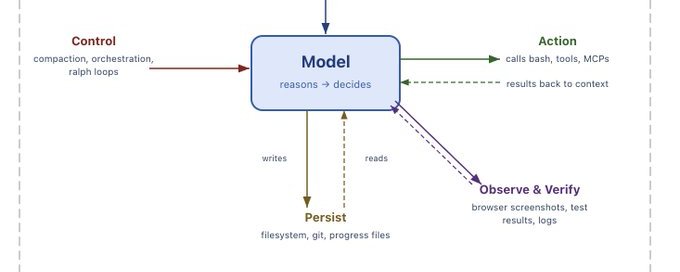
An 's accumulated memory can make switching providers far harder than swapping stateless model APIs. Harrison Chase's essay on agent memory argues that the , the software around the model, decides which memories are saved, what survives when a long conversation is compacted and what loads next time. If those mechanisms and records sit in a closed product or behind a provider's API, another system may struggle to reproduce the personalized behavior.
Chase's own example: an internal email assistant was accidentally deleted, and a replacement built from the same template had to be retaught Chase's preferences and tone. The proposed remedy is an open harness. Chase's team builds one, Deep Agents, which the essay describes as open source, model-agnostic and able to store memories in databases the developer controls, so the argument is also a product pitch.
- Built-in web search in the OpenAI and Anthropic APIs is not a model capability. It is a small harness sitting behind the API that calls a search tool for you — the same architecture you would write yourself, just hidden.
- Storing conversation state on a provider's server (stateful APIs, server-side ) quietly welds you to that model. You cannot switch providers and resume an old thread, because the thread lives in their format.
- Scaffolding did not shrink as models improved, it moved. Simple retrieval chains gave way to graph-shaped flows, which gave way to harnesses. An agent is an touching tools and data, so something always has to sit between them.
- Standalone memory services do not fit yet because the industry has no shared abstractions for memory. Long-term memory rarely makes the first version of a product: teams get the agent working, then worry about personalization.
- AI agent — An AI system that doesn't just answer once but works toward a goal in a loop — taking actions, reading the results, and deciding what to do next.
- agent harness — The scaffolding around a model that turns it into a working agent — the loop, the tools it can call, and the rules for when to stop.
- context compaction — Summarizing an agent's earlier conversation to free room in the context window so a long session can keep going.
- LLM — A large language model — the neural network behind tools like Claude and ChatGPT, trained on huge amounts of text to predict what comes next.
“When Claude Code’s source code was leaked, there was 512k lines of code. That code is the harness.”
“Asking to plug memory into an agent harness is like asking to plug driving into a car.”
Sarah Wooders
“If you use a closed harness, especially if its behind an API, you don’t own your memory.”
 videoMemory Harnesses for Long-Running Research Agents — Stefania Druga, Sakana.aiAI Engineer
 postThe Harness Is Everything: What Cursor, Claude Code, and Perplexity Actually BuiltRohit
 articleHarness or Model? Isolating the Harness Effect in Agentic Coding with a Contamination-Controlled Private SuiteMohsen Arjmandi
Checking sign-in…
Loading comments…