Introducing Muse Code and Muse Spark 1.2
- Source
- simonwillison.net
- Author
- Simon Willison
- Date

Context
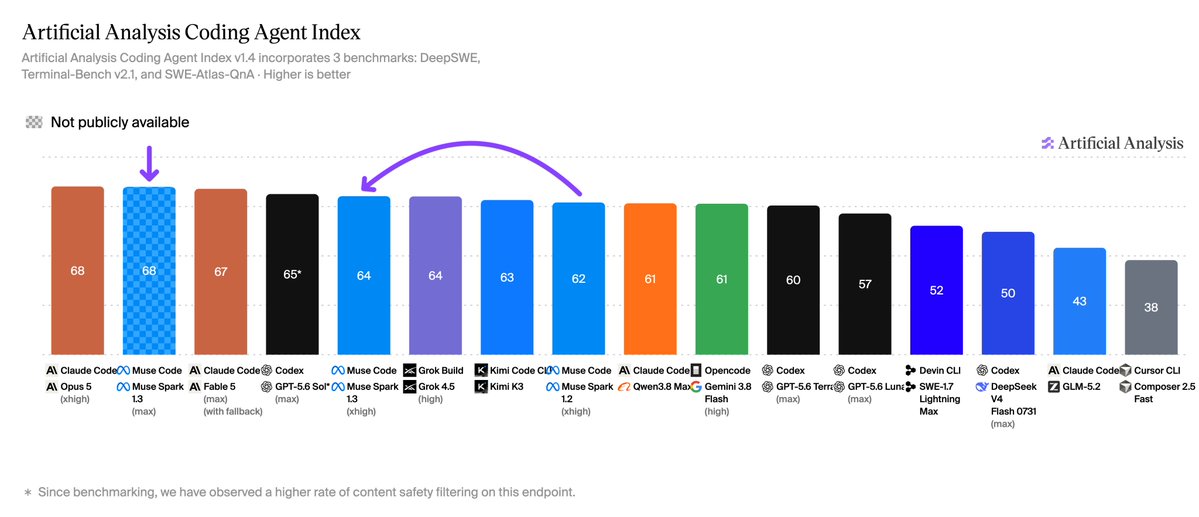
Meta trained Muse Spark 1.2 together with the coding environment that uses it. Its release explanation says training included selected sequences of actions from Muse Code, its toolset, and refinements involving goals, and helper agents.
That connects model training to the practical work of maintaining direction over a long programming task. Context compaction reduces the accumulated material a model must carry forward, while retaining information needed for continued work. The stated aim is better compatibility between the model and its coding environment.
- context compaction — Summarizing an agent's earlier conversation to free room in the context window so a long session can keep going.
- tool use — A model's ability to call external functions — run code, search the web, edit files — instead of only generating text.
“Yet more evidence that the most important characteristic of any model these days is long-sequence agentic tool calling.”
“We co-trained Muse Spark 1.2 with Muse Code to ensure the model exhibits its best performance and coding usability when paired together.”
“muse-spark-1.2 is priced at $1.25/million input and $4.25/million output - close to Gemini 3.6 Flash ($1.50/$7.50) - but if you agree to let Meta use your data "to improve our products" you can use muse-spark-1.2-contributor which is $0.10/$0.20 - a huge discount, closer to GPT-5.6 Luna ($0.20/$1.20) and Gemini 3.1 Flash-Lite ($0.25/$1.50).”
“I think the 1.2 pelican is a small but material improvement.”

Checking sign-in…
Loading comments…