Time Horizon 1.1
- Source
- metr.org
- Date
Context
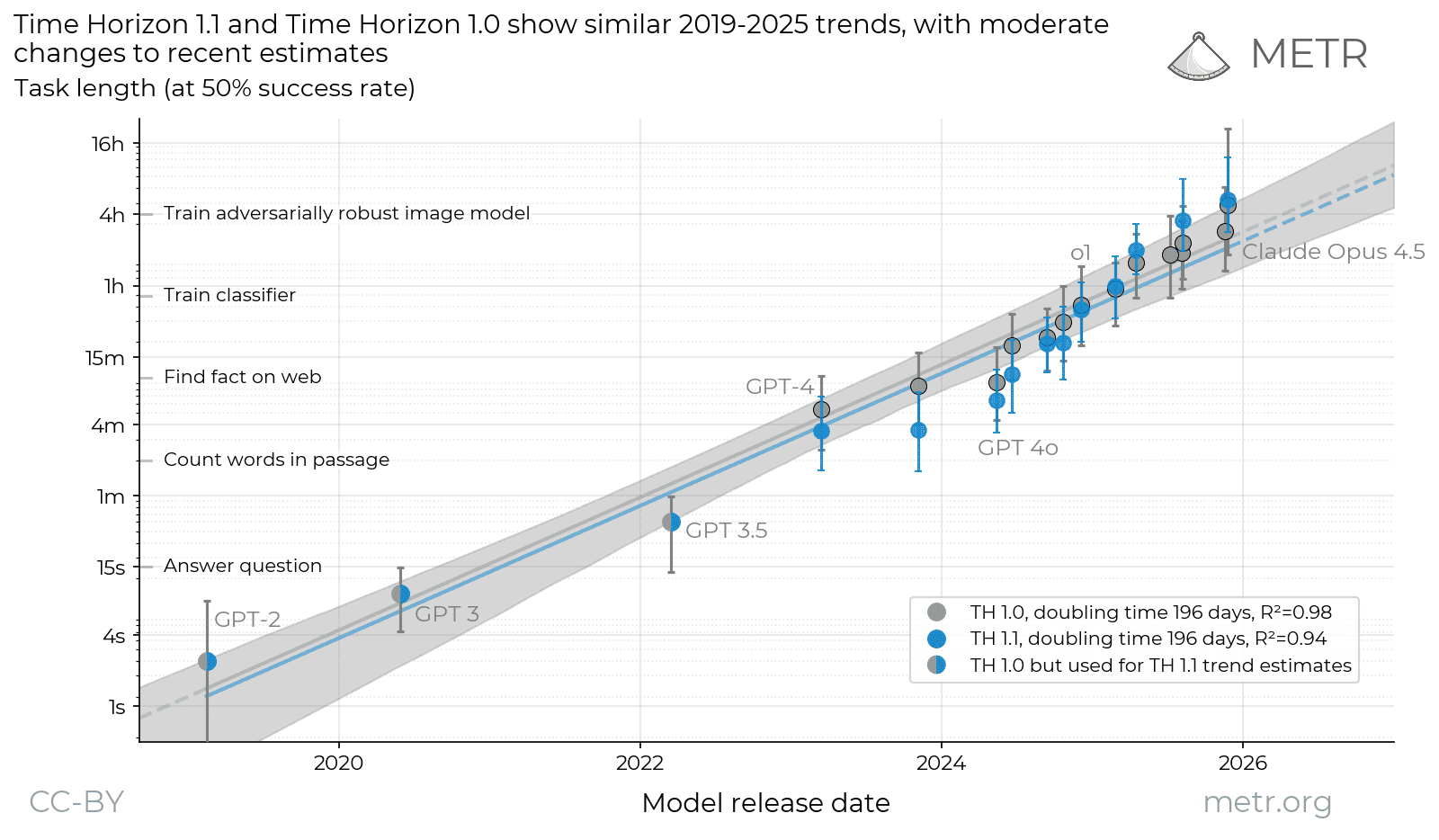
METR's time horizon expresses an AI model's capability as a length of task, measured by how long the task takes skilled humans, that the model completes with a 50% success rate. Thomas Kwa, one of the main authors of METR's time horizon paper, stressed a week before this update that it is the amount of human labor a model can replace, not how long it can work unattended, and that the estimates carry wide error bars (his note on the measure's limitations, metr.org). In this January 2026 update, METR re-estimates those horizons with a revised task suite and new software (metr.org). Individual estimates moved, but generally stayed within the confidence intervals of the original version.
The suite grew from 170 to 228 tasks: 73 were added, 15 removed and 53 revised, mostly where a description was confusing, a task was easy to game, or scoring had errors. Tasks estimated to take humans 8 hours or more went from 14 to 31, which narrows the uncertainty at the top end; for Claude Opus 4.5, the upper bound fell from 4.4 times the point estimate to 2.3 times. METR says the intervals are still very wide, that only 5 of the 31 long tasks have measured human times rather than estimates, and that even this suite has relatively few tasks the latest models cannot do. It also moved from its in-house Vivaria to Inspect, the open-source framework from the UK AI Security Institute, and re-estimated 14 of the 33 models it had measured before.
The long-run trend is unchanged. Filling in the oldest models with their original estimates, the frontier horizon still doubles every 196 days, about 7 months. Since 2023, though, the doubling time shortens from 165 days to 131, which METR describes as 20% faster progress, and since 2024 from 109 to 89 days. That happened because older models' estimates fell, two GPT-4 versions by 35% and 57%, while recent ones rose, GPT-5 by 55% and Opus 4.5 by 11%. METR attributes most changes to the new tasks and run-to-run noise, with the infrastructure switch a relatively small share, though two of five models it compared, GPT-4o and o3, scored significantly higher under Vivaria. Its reading is that the new tasks come from a slightly different difficulty mix and so measure a slightly different quantity, a change it considers worth making for a better suite.
- Under TH1.1, METR's post-2023 frontier time-horizon doubling time is 131 days, versus 165 days under TH1, so progress reads about 20% faster; measured since 2024 it falls from 109 to 89 days.
- The trend shift comes from older models moving down and newer ones up: two GPT-4 versions fall 35% and 57%, while GPT-5 rises 55% and Claude Opus 4.5 rises 11% to a 320-minute estimate.
- More long tasks tightened the top end: Opus 4.5's upper bound was 4.4x its point estimate under TH1 and is 2.3x under TH1.1. METR says intervals remain very wide, and only 5 of its 31 tasks over eight hours have measured human baselines.
- Moving from METR's in-house Vivaria harness to UK AISI's open-source Inspect changed estimates little overall, but GPT-4o and o3 scored significantly higher under Vivaria, which METR reads as sensitivity to scaffold and prompting.
- METR re-estimated only 14 of 33 models, skipping ones no longer available, needing major scaffold changes, or far from the frontier, and says even TH1.1 has few tasks the newest models fail, so harder evaluations are its priority.
- eval — A repeatable test for AI quality — a set of tasks plus scoring — used the way software teams use test suites, because model output is too variable to judge by eyeballing.
- agent harness — The scaffolding around a model that turns it into a working agent — the loop, the tools it can call, and the rules for when to stop.

Checking sign-in…
Loading comments…