Trinity-Large-Thinking hits second on PinchBench at a fraction of Opus pricing
- Source
- x.com
- Date

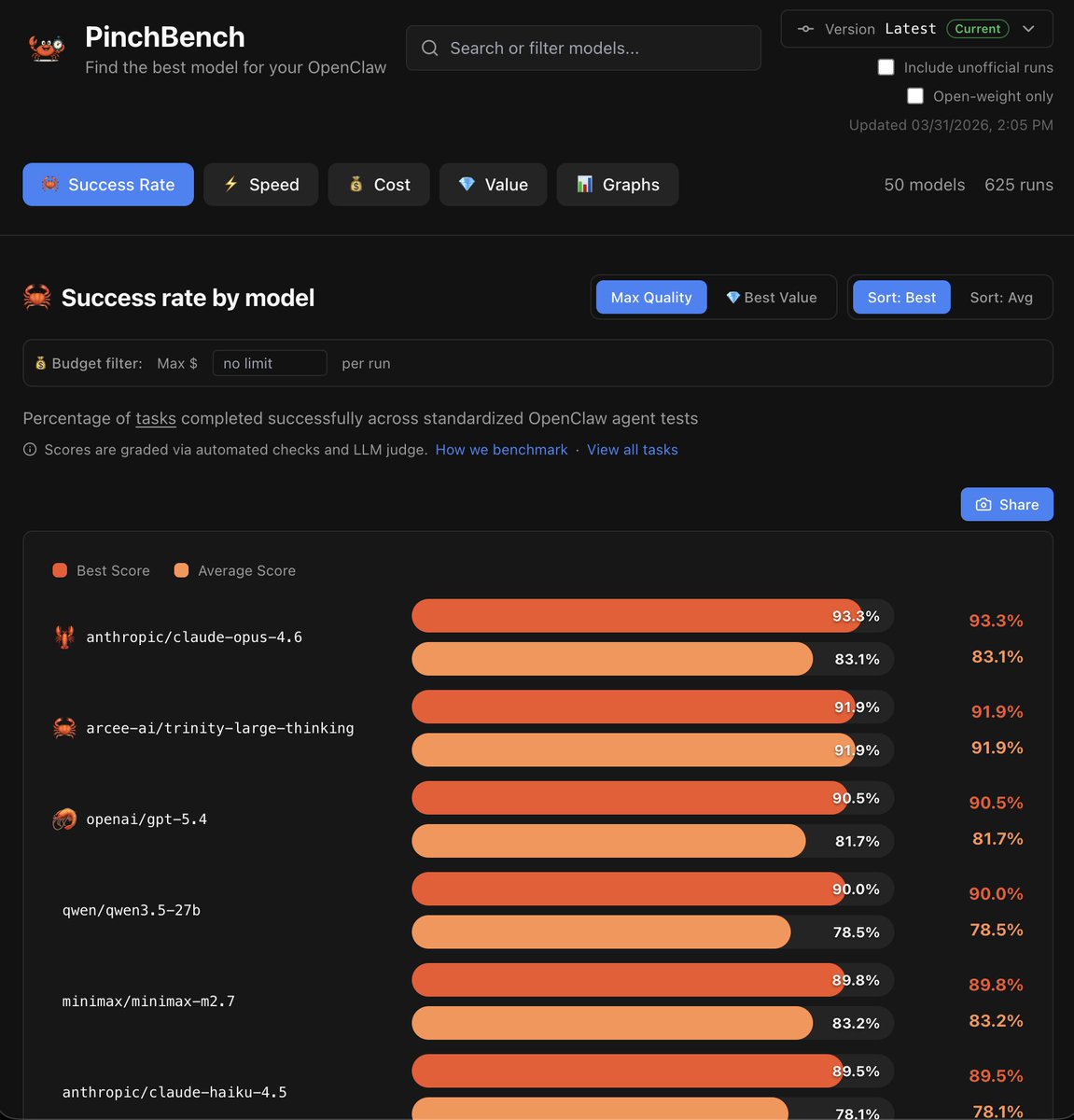
Jensen showcased PinchBench (by @kilocode) on stage at NVIDIA GTC as the new standard for evaluating @openclaw agent capability. Trinity-Large-Thinking just hit #2 on @pinchbench globally (91.9%) behind only Claude Opus 4.6 (93.3%), which costs ~20x more per token. That's an expensive percentage point... To celebrate the ongoing Trinity partnership, @OpenRouter is running a promotion to make Trinity-Large-Thinking free to use for OpenClaw until Sunday, April 5th. Even when the promo ends, the Trinity economics are pretty incredible. Trinity is $0.25/m input tokens (OpenClaw uses A LOT of input tokens), but with a 60%-90% cache hit rate at $0.06/m cache tokens the average input cost nets out to $0.087/m. You no longer have to compromise on logic to keep your agent infrastructure affordable. We're excited to see what you build.
Context
Arcee says PinchBench, a built by Kilocode for evaluating tool-use capability, was shown on stage at NVIDIA's GTC conference as a standard for measuring capability in agent harnesses such as OpenClaw; that appearance is Arcee's own account and was not independently checked here.
On that benchmark, Arcee reports Trinity-Large-Thinking, the it had released the day before, scored 91.9%, second only to Claude Opus 4.6's 93.3%, while costing roughly a twentieth as much per . For agent workloads that send unusually large volumes of input tokens, Arcee says a 60% to 90% cache hit rate lowers the effective input cost from $0.25 to about $0.087 per million tokens, with cached tokens billed at $0.06 per million.
To mark the result, OpenRouter made Trinity-Large-Thinking free to use for OpenClaw until April 5, 2026, with normal per-token pricing applying afterward.
- benchmark — A standard public test set for comparing AI models — the shared scoreboards behind every "model X beats model Y" claim.
- AI agent — An AI system that doesn't just answer once but works toward a goal in a loop — taking actions, reading the results, and deciding what to do next.
- reasoning model — A model trained to think — generating extended internal reasoning before answering — trading time and tokens for accuracy on hard problems.
- token — The chunk of text a model reads and writes in — roughly three-quarters of a word — and the unit AI usage is billed in.

Checking sign-in…
Loading comments…