Transplanting tokenizers between models without retraining
- Source
- x.com
- Date

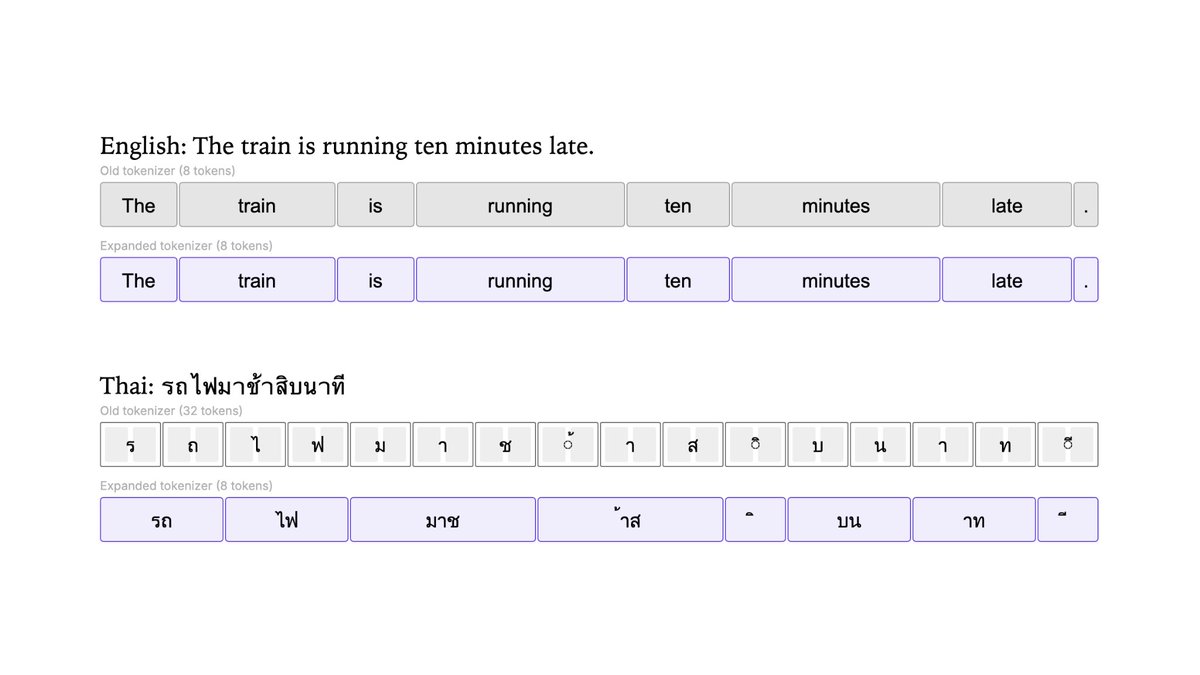
Different models have different vocabularies, making it difficult to efficiently combine them for merging, distillation, or speculative decoding In this new paper, @arcee_ai researchers Charles Goddard and Fernando Fernandes Neto introduce a revolutionary approach called "tokenizer transplantation," utilizing a technique known as Orthogonal Matching Pursuit (OMP). Think of it as a sophisticated translation system that can convert between different model vocabularies without any retraining. Here's the key insight: even though different models use different vocabularies, the concepts they represent often align in predictable ways. Our method finds these alignments and uses them to transplant one model's vocabulary into another. If you'd like to learn more, please read our high-level blog post (https://t.co/iUbXxjTVsV), or dive into the research paper (https://t.co/sQHHBjNt8a). Learn more about model merging and get expert support at https://t.co/ut82Ns22GE.

Context
Every is built around a fixed vocabulary, the list of text fragments ('tokens') it was trained to recognize, and different model families almost never share the same one. That mismatch is normally why merging two models' weights, distilling one into another, or using a small model to speed up a larger one through is so difficult, as Arcee researchers Charles Goddard and Fernando Fernandes Neto describe it, since token identifiers do not correspond to the same text across models.
Their method, detailed in an accompanying blog post, uses Orthogonal Matching Pursuit to find which tokens in two different vocabularies represent similar concepts, then reconstructs one model's missing vocabulary entries as combinations of the other's, without retraining the underlying model. Arcee's post reports three separate results for the technique rather than one combined test: a transplant between Llama and Mistral NeMo that preserved 96% of the original model's performance on language understanding tasks, a case where the technique bridged models whose vocabularies overlapped by only 54%, and transplants completing in under two minutes rather than the hours, days, or added compute a retraining-based approach would require. The post does not state whether the 54%-overlap and under-two-minute figures came from that same Llama-to-Mistral NeMo transplant or a different one.
- LLM — A large language model — the neural network behind tools like Claude and ChatGPT, trained on huge amounts of text to predict what comes next.
- speculative decoding — A speed trick where a small model drafts several tokens ahead and the big model verifies them in one pass, often doubling generation speed.
- embedding — A list of numbers representing a piece of text's meaning, so that similar meanings end up numerically close and can be searched.
- distillation — Training a small, cheap model to imitate a big one's outputs, keeping much of the capability at a fraction of the cost.



Checking sign-in…
Loading comments…