
- Category
- AI Agents
- Rank
- No. 275Tools index
- Listed in
- #12 Run models locally
- Pricing
- Freemium
- Type
- APP
- Use case
- Data, Retrieval & Knowledge · Agent Building
- Interfaces
- Web · Desktop · Mobile · API · CLI
- GitHub
- 66.7k stars
- Latest release
- v1.17.0
- Date
About
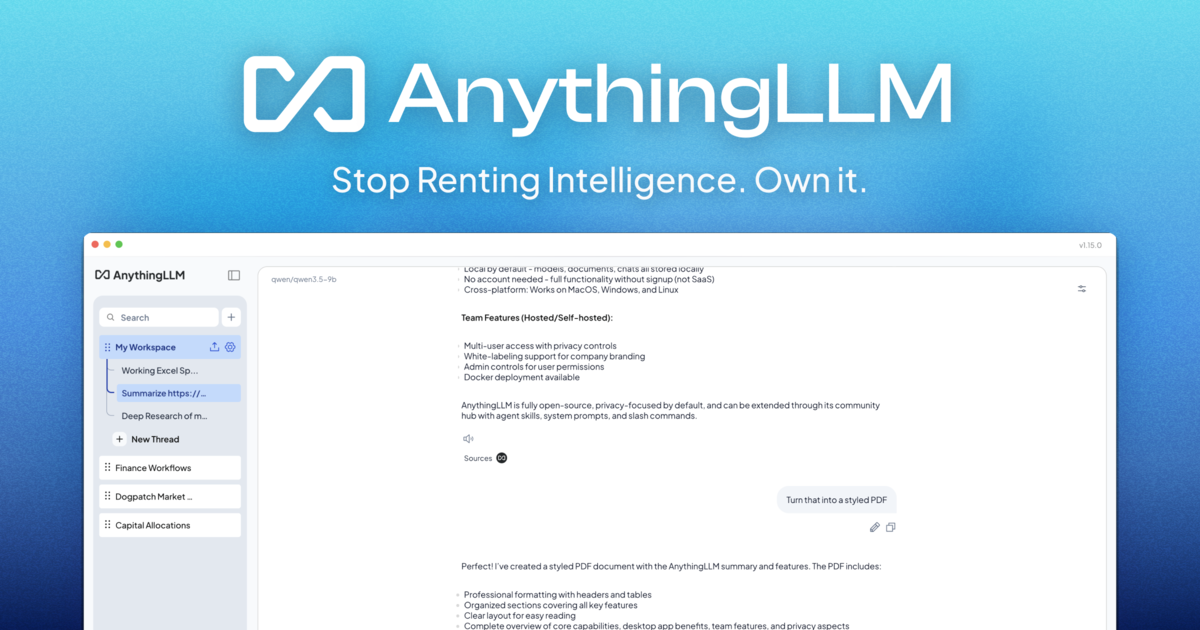
An open-source, all-in-one AI application that lets users chat with their documents, build custom AI agents, and run everything locally without cloud APIs or token limits. It supports multi-user deployments, dozens of LLM/embedding providers, MCP compatibility, scheduled agent tasks, and a built-in local meeting transcription assistant.
What it does
AnythingLLM splits into three cooperating services: a document processor that extracts text from uploads, a server that stores vectors and chat history per workspace, and a browser interface. Conversations route through whichever model backend an administrator wires up, chosen from a long roster of hosted and self-run options. Its own agent runtime lets a workspace call saved no-code automations, outside tool servers reached over a standard protocol, or packaged skills, and administrators decide which people can see which workspaces.
Why it's ranked here
MIT licensed, with a public security policy that spells out exactly which attack classes count as bugs and which are accepted trust boundaries rather than leaving that judgment implicit. The provider list runs past thirty chat backends and nine vector databases, so a deployment is not locked to one vendor. Agent behavior runs through an internal orchestration layer rather than bolted-on prompt tricks, and no-code flows are blocked from carrying unsupported step types across platforms. That combination of license clarity, provider breadth, and a written threat model is unusual for a project this size.
What's good
The codebase separates concerns cleanly: a dedicated collector process isolates untrusted document parsing and web scraping from the main server, and the agent runtime treats every external tool the same way, whether it is a locally defined skill, a saved no-code flow, or a call out to an external tool server over a standard protocol. The security policy is unusually specific about intended behavior, spelling out which admin-configured capabilities are deliberate rather than bugs, which keeps the threat model honest instead of vague. Per-provider credential checks run before an agent session is even allowed to start.
Tradeoffs
Multi-user support and the embeddable chat widget are called out in the documentation as available only through the Docker deployment, so running from source or on bare metal narrows what an instance can actually do. The bare-metal path itself carries an explicit warning that the core team will not support or answer issues raised against it. The security policy also states plainly that skipping password or multi-user setup leaves an instance reachable by anyone who has the address, which is a real operational risk if an administrator forgets that step during setup.
How to use it well
Run it in Docker if more than one person needs access: several features, including multi-user permissioning and the embeddable widget, do not exist outside that path. Before turning on admin-only agent tools such as database or filesystem access, scope the underlying credentials narrowly yourself, a read-only database account, a limited file path, since the application will not stop an enabled tool from doing whatever that credential allows. Skip it if you need a vendor-backed support agreement: the self-hosted terms explicitly rule out a service-level guarantee outside a separate enterprise contract.
Technical notes+
server/index.js wires more than twenty endpoint groups (chat, admin, MCP servers, agent flows, scheduled jobs, telegram, mobile, web push) onto a single Express router behind a 3GB body-size limit, and falls back to a custom MetaGenerator for serving the built frontend outside development mode. collector/index.js runs as a separate Express process dedicated to file parsing, link scraping and audio conversion, guarded by a verifyPayloadIntegrity middleware and normalizing filenames to strip directory-traversal sequences before they reach disk. server/utils/agents/index.js funnels every agent tool call through a single handler class whose checkSetup switch enumerates a provider-key requirement for each of dozens of backends before a session can start. server/utils/agentFlows/index.js persists no-code flows as JSON files keyed by UUID under a flows directory, validates every step's type against FLOW_TYPES before saving or executing it, and exposes each flow to the model as a sanitized, schema-bound tool with required-argument enforcement done in code rather than trusted to the model. server/utils/MCP/index.js is a singleton wrapper that turns each connected MCP server's tool list into the same plugin shape used for native tools, with per-tool suppression and JSON-safe result serialization for circular references and bigints. server/utils/DocumentManager/index.js reads pinned workspace documents from a flat JSON store on disk and stops adding them once a configured token budget is exceeded. server/utils/chats/index.js implements slash-command replacement using regex word-boundary checks so a preset command cannot be shadowed by, or accidentally shadow, a longer command sharing its prefix. server/endpoints/api/index.js is the entry point for the versioned developer API, composed from separate admin, auth, document, workspace, thread, user-management, OpenAI-compatible and embed endpoint modules. BARE_METAL.md documents an unsupported non-Docker deployment path, and SECURITY.md together with TERMS_SELF_HOSTED.md define the trust model: admin-configured outbound connections and unauthenticated instances are declared intentional rather than vulnerabilities, and the MIT LICENSE covers the core.
Observed
- License
- MIT (LICENSE).
- Architecture
- Server and collector run as two separate Express processes; the frontend is a separate build served statically in production (server/index.js, collector/index.js, frontend/index.html).
- Interfaces
- A browser UI, a versioned HTTP developer API (server/endpoints/api/index.js), and an MCP client layer that converts external MCP servers into callable agent tools (server/utils/MCP/index.js).
- Deployment
- Primary supported deployment is Docker; a bare-metal Node.js deployment path is documented but explicitly marked unsupported by the core team (BARE_METAL.md).
- Platform support
- Desktop builds are distributed for Mac, Windows and Linux in addition to the server-based deployment (README).
- Agent flows
- No-code agent flows are stored as individual JSON files and validated against a fixed set of supported step types before they can run (server/utils/agentFlows/index.js).
- Security posture
- The published security policy documents intended trust boundaries rather than a defect list: admin-configured outbound connections and unauthenticated instances are declared by-design (SECURITY.md).
Read from README.md, package.json, server/index.js, collector/index.js, frontend/index.html, server/utils/agents/index.js, server/utils/agentFlows/index.js, server/utils/chats/index.js, server/utils/MCP/index.js, server/utils/DocumentManager/index.js, server/endpoints/api/index.js, BARE_METAL.md, SECURITY.md, LICENSE, TERMS_SELF_HOSTED.md.
What it can do
Chat with uploaded documents
Documents → Chat responses
Transcribe meetings locally
Meeting audio → Transcript
Tags
Tech Stack
Media
Comments (0)
No comments yet
Editorially curated, with community endorsements as a secondary signal. Corrections welcome.