Memanto
memanto.ai- Category
- AI Agents
- Rank
- No. 972Tools index
Previous survey · No. 961 ·
- Pricing
- Open Source
- Type
- TOOL
- Use case
- Data, Retrieval & Knowledge
- Interfaces
- CLI · API
- GitHub
- 2.4k stars
- Latest release
- integrations/mcp/v0.1.5
- Date
About
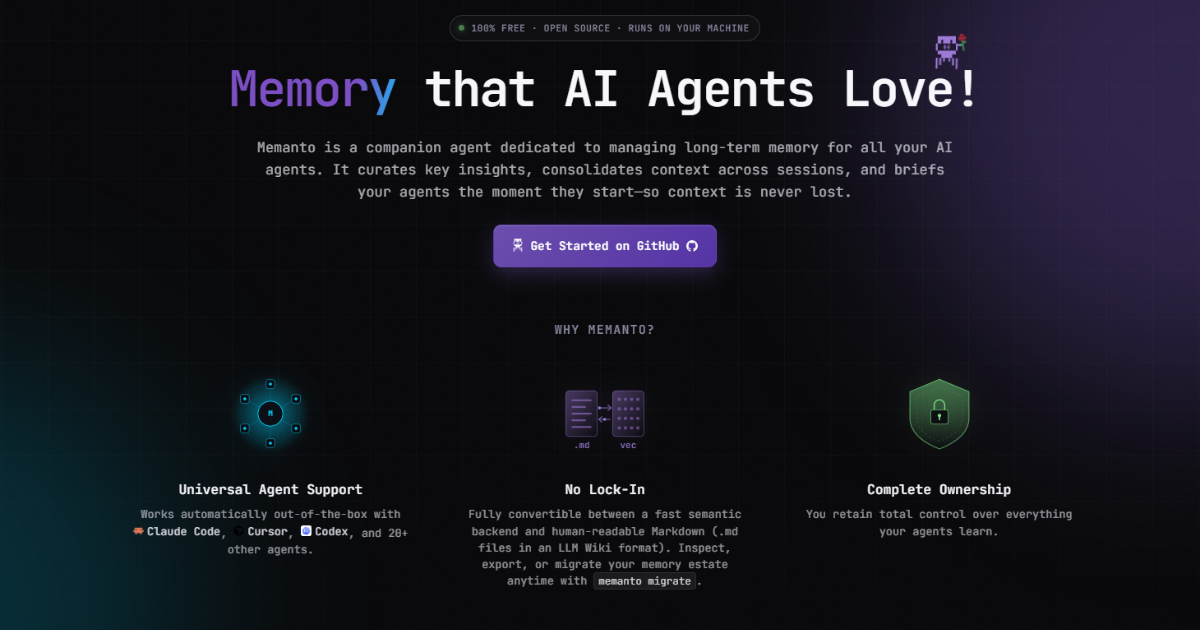
Memanto is a companion agent that manages long-term memory for AI coding agents such as Claude Code, Cursor, and Codex, consolidating context across sessions and briefing agents when they start so prior context isn't lost. It runs locally via a pip-installed CLI, stores memory as either a semantic vector backend or human-readable Markdown files, and gives users full ownership and export control over what agents learn.
What it does
A memory service that sits beside the assistants you already run and decides what each one should know. Agents write typed notes (decisions, facts, preferences, errors and nine other categories), a scheduled job merges duplicates and flags contradictions, and expiry rules retire stale entries without deleting them. Recall is semantic search, a grounded question-answer mode sits on top, and point-in-time queries show what was believed on a given date. Search runs on Moorcheh, the authors' own vector engine, either as a hosted API or a local Docker server.
Why it's ranked here
MIT licensed, with a Python package, a TypeScript package, a Go SDK and an MCP server in one repository, plus a one-command hookup for Claude Code, Cursor, Codex, Windsurf, Cline and others. The expiry model is more careful than most memory tools: retirement is policy-driven, stamped with the rule that fired, reversible, and previews in a dry run. The honest caveat is that every path runs through Moorcheh, so the portability story rests on the plain-text export rather than on swappable storage.
What's good
Retention policies are declarative: a per-type table (context for 7 days, events for 30, preferences never) plus named rules evaluated first-match-wins, so a pinned tag can override the table. Hard deletion of expired items is off by default. The HTTP server ships with sensible guards: interactive docs and the schema are disabled unless switched on, a wildcard origin combined with credentials is refused at startup, and the container runs as a non-root user. The MCP server routes all logging away from the protocol channel so stdio clients do not break.
Tradeoffs
The storage engine is a dependency on the authors' company: startup fails fast without either a valid Moorcheh API key or a reachable on-prem Moorcheh server. The docs disagree with each other in places. The packaging requires Python 3.10 or newer while two guides still say 3.8, one guide clones from a placeholder organisation, and the README security section still carries an unfilled author note. Session tokens auto-renew after expiry by default, which the architecture notes concede weakens expiry as a bound on a leaked token.
How to use it well
Fits a developer running several coding assistants on one codebase who wants decisions and corrections to carry between them. Start on the local Docker mode if data must stay in-house, apply a preset retention policy, and dry-run it before enabling the nightly job. Have agents pass type, confidence and source on every write so recall filters stay useful. Turn off session auto-renewal on any server reachable beyond localhost. It is not a general document store or a transcript archive; it is built to keep curated notes.
Technical notes+
Package metadata in pyproject.toml declares MIT, requires-python >=3.10,<4, a hatchling build with VCS versioning, and a single console entry point (memanto = memanto.cli.main:app) built on Typer, with FastAPI, uvicorn and moorcheh-sdk as core dependencies. memanto/app/main.py validates the backend in its lifespan hook (on-prem health probe or an auth ping against a sentinel namespace), gates /docs, /redoc and /openapi.json behind MEMANTO_ENABLE_DOCS, rejects wildcard CORS with credentials, and attributes callers via the X-Memanto-Client header. integrations/mcp/memanto_mcp/server.py builds a FastMCP server over stdio, SSE or streamable HTTP and logs to stderr only. The Dockerfile uses python:3.12-slim, uv, a uid 1001 user and a /ready healthcheck. docs/SESSION_ARCHITECTURE.md describes HMAC-signed JWT sessions with a six-hour default and per-agent namespaces.
Observed
- License
- MIT
- Language
- Python, requires 3.10 or newer
- Install surface
- PyPI package, npm package, Go module
- Interfaces
- CLI, Python library, HTTP API, MCP server, local web dashboard
- MCP transports
- stdio, SSE, streamable HTTP
- Storage backend
- Moorcheh, hosted API key or on-prem server
- Container
- Dockerfile runs as non-root user on port 8000
- Platforms
- macOS, Linux, Windows
- Tests
- pytest configured with a tests directory included in the source distribution
Read from README.md, pyproject.toml, Dockerfile, memanto/__main__.py, memanto/app/main.py, memanto/cli/main.py, integrations/mcp/memanto_mcp/server.py, docs/SESSION_ARCHITECTURE.md, docs/GETTING_STARTED.md, docs/DEPLOYMENT_GUIDE.md, docs/AGENT_MEMORY_BEST_PRACTICES.md.
Intel on Memanto
Tags
Tech Stack
Media
Comments (0)
No comments yet
Editorially curated, with community endorsements as a secondary signal. Corrections welcome.