Why fiber attach decides the cost of co-packaged optics
- Source
- x.com
- Date

As the industry moves towards Co-Packaged and Near-Packaged Optics, the fiber attach is forced to land on the PIC itself. Fiber coupling is a very precise endeavor, with micron level precision requirements. An edge coupler wants the fiber core roughly within half a micron of the waveguide otherwise this leads to unwanted coupling losses which are unaffordable for high bandwidth throughput. This precision is brought usually with active alignment where each fiber is positioned at sub-micron accuracy (usually through signal peak calculations) and then glued down. This is however a serial process and ends up being unrealistic for high fiber count attach. More importantly, such an alignment system is inherently non-detachable. This is where passive alignment becomes a viable alternative to active alignment. In such systems, mechanical features hold the fiber within tolerance. Fiber attach thus becomes a passive, repeatable and even re-mateable operation. (1/3)🧵
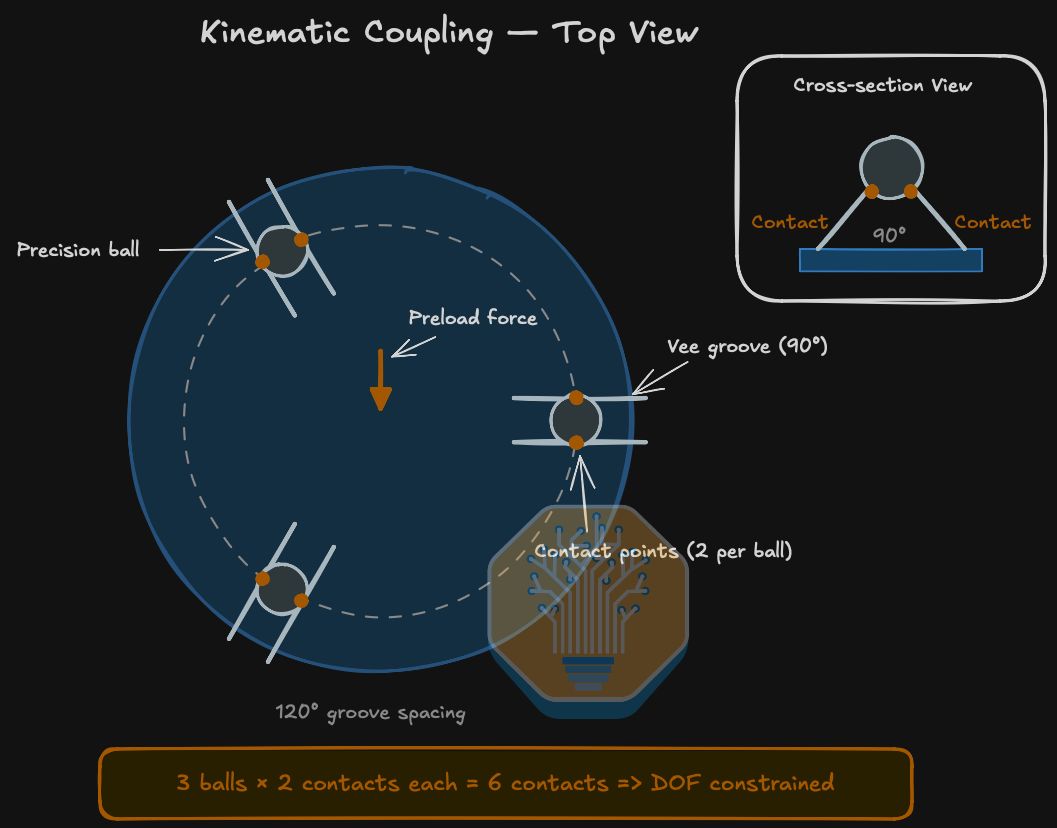
Kinematic coupling is a deterministic passive alignment method for fiber attach. This involves constraining a body with six contact points (restricting six degrees of freedom). Usually this is done using three balls in three V-grooves, with each ball contacting the groove at two points (six contact points in total). This method is deterministic and provides exceptional repeatability, while being re-mateable. Additionally, kinematic couplings do not undergo significant internal stresses which could potentially warp the mechanical parts. However, the contacts must stay clean to ensure proper alignment. Additionally, every contact feature must be manufactured accurately, otherwise even small manufacturing errors in the balls or grooves causes misalignment. With mass production of millions of connectors and optical engines with higher fiber counts, this accuracy requirement affects cost and makes high-volume manufacturing difficult. (2/3)
Elastic averaging on the other hand uses many contact points with compliance to align FAU to the OE. Each contact can have some manufacturing error which is absorbed by compliance in the coupling. In fact, it’s possible to have higher accuracy than the tolerances of the components due to canceling of the manufacturing errors. The idea of elastic averaging is that the errors end up averaging out across the whole fiber attach unit. This method is quite manufacturing friendly since molded or stamped parts can be manufactured much cheaper, and moreover tolerances are looser per feature with elastic averaging, leading to significant cost reduction compared to kinematic coupling. However, there are some tradeoffs with this approach including non-deterministic repeatability, and higher built-in stresses due to an over-constrained mechanical design. (3/3)

Context
SemiAnalysis explains that in co-packaged and near-packaged optics the fiber must attach directly to the photonic chip (PIC), and an edge coupler needs the fiber core within roughly half a micron of the waveguide or coupling losses become unaffordable for high bandwidth. Active , which positions and glues each fiber individually, is serial, unrealistic for high fiber counts, and not detachable, so it describes passive designs, where mechanical features hold the fiber within tolerance, as the alternative.
Kinematic coupling constrains the connector with six contact points, usually three balls in three V-grooves, giving repeatable, re-mateable alignment. But every contact feature must be made accurately, which SemiAnalysis says raises cost for millions of connectors. Elastic averaging uses many compliant contact points so individual manufacturing errors average out, allowing cheaper molded or stamped parts with looser per-feature tolerances. SemiAnalysis lists its tradeoffs as non-deterministic repeatability and higher built-in stress from an over-constrained design.
- alignment — The work of making AI systems actually pursue what their builders and users intend, rather than something subtly or dangerously different.




Checking sign-in…
Loading comments…