On the Navier–Stokes Millennium Prize Problem
- Source
- simonwillison.net
- Date
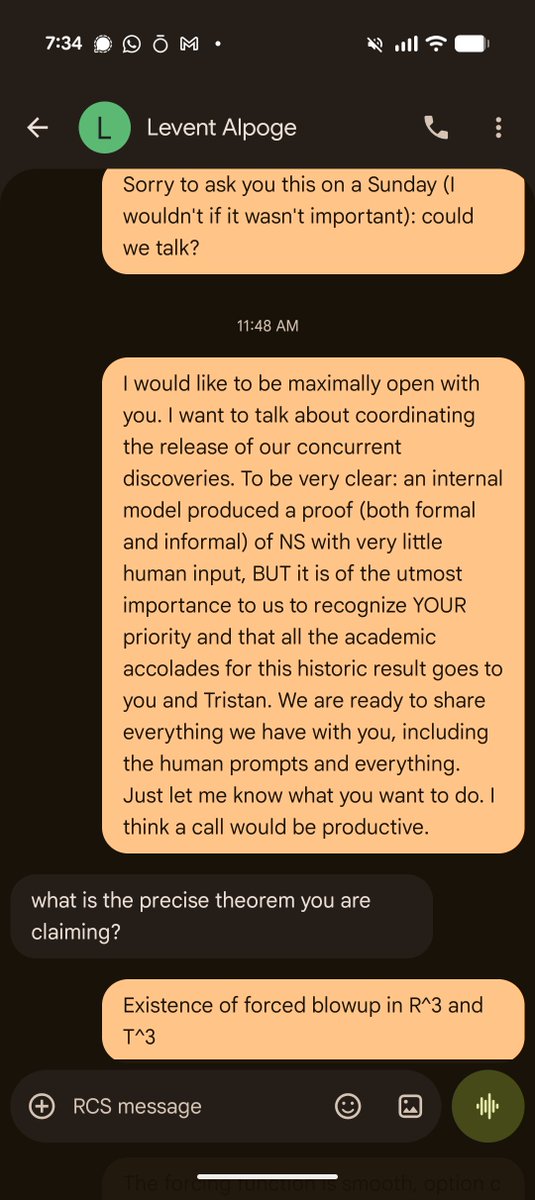
OpenAI says an unreleased model produced a resolution to the Navier-Stokes existence and smoothness problem, one of mathematics' seven Millennium Prize problems, after agents ran for about 88 hours. Simon Willison reconstructs the dispute around that announcement: mathematicians Tristan Buckmaster and Levent Alpöge had worked on a related approach for nearly a year with help from Claude and Codex, then learned that OpenAI began its effort after hearing rumors of their progress. OpenAI says its researchers and agents did not see the team's work before publication, though it could not rule out the possibility that de-identified product usage had helped improve its models. The mathematical result still requires expert scrutiny, and the competing proofs are not identical. The immediate lesson is therefore broader than whether OpenAI's proof survives review. When AI systems can turn a rumor about an unpublished result into a large parallel research run, labs need clearer rules for provenance, disclosure, priority, and the use of customer research data.
Context
Simon Willison's September 8 commentary raises a specific concern about using AI for unpublished research: could work submitted to a service influence a later model that helps another team reach the result first? The commentary presents this as an unresolved question about the mathematics announcement.
OpenAI's September 10 update subsequently said its investigation ruled out influence from Buckmaster's Codex prompts during the preceding two months, including through training. That bounded finding changes the uncertainty described in the earlier commentary; it is not a general statement about every historical interaction with the service.
Checking sign-in…
Loading comments…