Michelangelo Machine Learning Platform
- Source
- uber.com
- Author
- Uber Engineering 2
- Date
Context
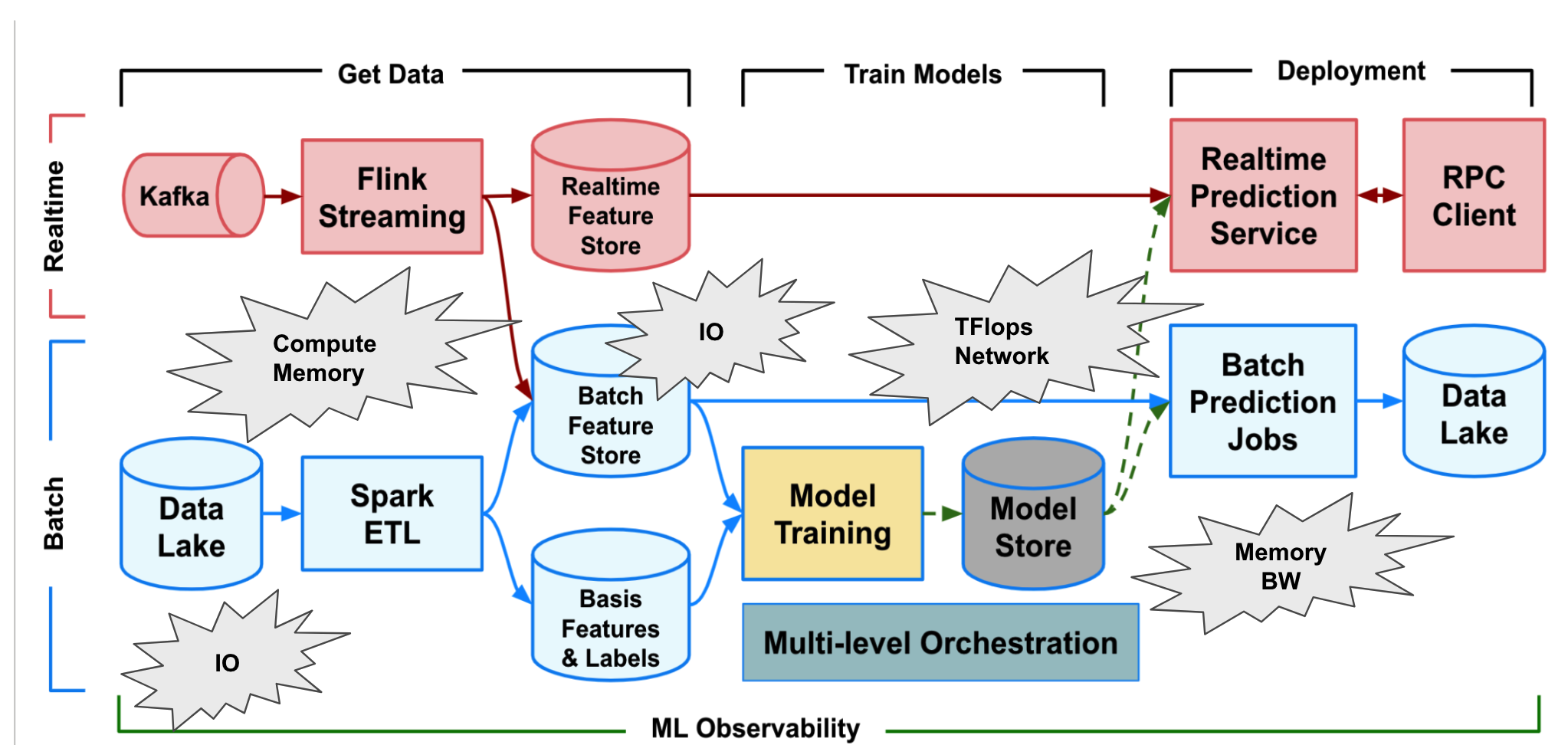
Uber Engineering's 2017 account of Michelangelo, its internal machine learning platform, shows how shared data infrastructure supports live predictions. For meal delivery estimates, models used inputs such as a restaurant's average preparation time over the last seven days or the last hour. Michelangelo precomputed these values and stored them for low-latency retrieval when an order needed a prediction. Its shared feature store let teams reuse named inputs, and Uber said that applying the same data preparation and transformation logic at training and prediction time was meant to keep a model's inputs consistent between development and production. Uber described the feature store as a way to reduce duplicated work across teams. Platform account.
- determinism — Whether the same input reliably produces the same output — something LLM systems mostly lack, which changes how you test and debug them.
 articleScaling Ai Ml Infrastructure At UberUber Engineering 1
- articleOpen Source And In House How Uber Optimizes Llm TrainingUber Engineering 1
 articleAgent Stack for ML Training Lifecycle: Generation, Validation, and OptimizationJaideep Ray, Daniel Tang, Zejun Lin, Haoyue Tang, Lijuan Zhang, Tao Huang, Tommy Li, Aditya Jain, Ankit Goyal, Harsh Jain, Zhuo Zhi, Youmin Han, Santosh Jha, Shuying Liang, Yujie Ai, Jonathan Hung, Ethan Lyu, Abi Liu, Siddharth Singh, Feng Wen, Mahesh Ravindran, Souvik Ray, Yitong Zhou, Animesh Singh
Checking sign-in…
Loading comments…