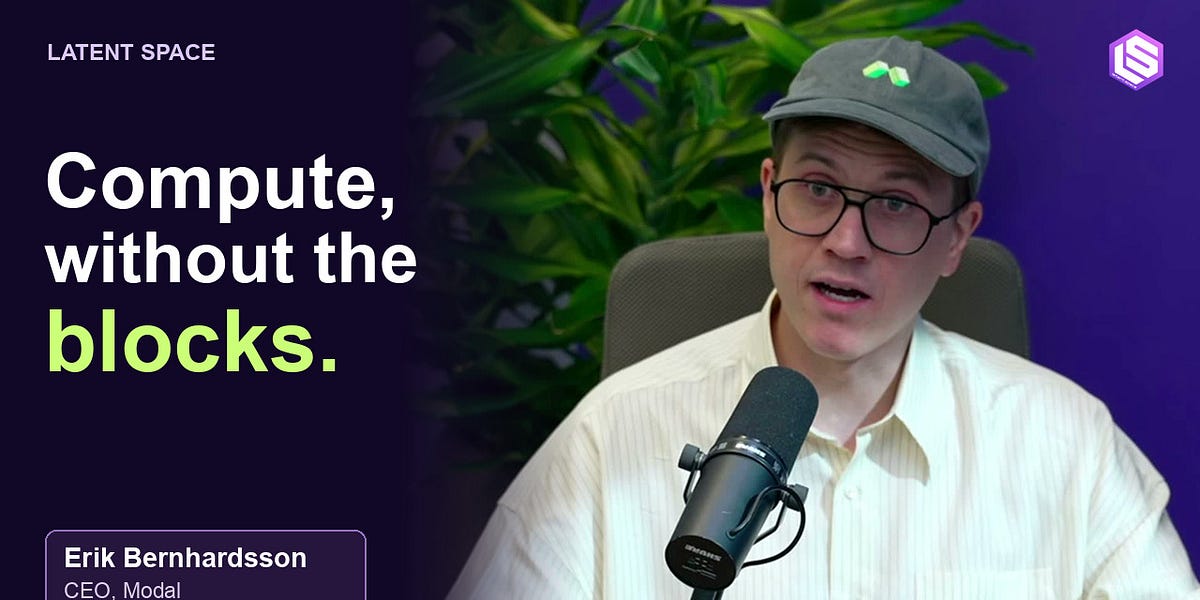
Why AI Compute Comes in Rectangles — Erik Bernhardsson, Modal CEO
- Source
- latent.space
- Author
- Basil Chatha
- Date
Context
The "rectangle" in the title is how GPU capacity is usually sold. In this Latent Space interview, Modal CEO Erik Bernhardsson says almost all capacity comes as a fixed block of GPUs for three years, often starting three to six months in the future. Plotted as GPUs against time, that contract is a flat rectangle. Real workloads rarely look like that: they rise and fall over the day, burst, and grow over time. A company that buys for its peak pays for idle hardware, and one that buys less can miss demand.
Bernhardsson's argument is that Modal's business is turning those long, rigid blocks into flexible capacity, which he calls a kind of "duration transformation." Modal secures reserved capacity underneath and lets its customers scale up and down on demand. Because it serves many thousands of customers, their combined demand is much smoother than any single customer's, so the pool can be run efficiently. He describes this capacity side, together with developer experience, as Modal's main differentiator. The episode notes pair it with Latent Space's earlier interview with SF Compute's Evan Conrad, who works on making capacity tradeable rather than slicing it up.
The model carries a risk Bernhardsson names himself. Modal has many reservations locked in at fixed rates, so he says it is effectively "long GPU prices." Rising prices don't worry him much, but a price collapse would hurt anyone holding a lot of supply bought at the top. He says he doesn't expect that soon, but wants the tail risk in view, partly because falling prices, falling utilization and a vanishing resale market could all happen at once.
The interview also explains where much of the new demand comes from. Modal launched sandboxes, isolated environments for running generated code, saw little uptake at first, and discussed shutting the product down. Vibe-coding companies, background agents and labs running reinforcement learning on Modal sandboxes then drove rapid growth, and Bernhardsson says sandboxes are now about a third of revenue, with functions, mostly , about two-thirds. The post also reports that Modal says it has crossed $1 billion in annualized run rate and raised a $750 million Series D at a $16 billion valuation. The transcript is automatic, so names and exact wording may contain errors.
- Modal reports passing $1 billion in annualized run rate and raising a $750 million Series D at a $16B valuation. CEO Erik Bernhardsson says sandboxes, which the team once discussed shutting down, now bring about a third of revenue and functions about two thirds.
- Bernhardsson's capacity argument: most GPUs are sold as fixed multi-year blocks starting months out, while real workloads grow, spike and dip. Pooling thousands of customers smooths aggregate demand, so Modal can offer the capacity it secures in elastic slices.
- Modal rents its GPUs, typically on three-year deals, across almost 25 clouds. Bernhardsson says those reservations leave Modal effectively long GPU prices, so he worries less about rising prices than about a collapse that would hurt anyone who locked in supply at the top.
- He says the median Modal runs about eight seconds and expects sandboxes to get more ephemeral, with snapshot, fork and resume, even one per command. Cheap start and stop would let CI run each test in its own cloned sandbox instead of repeating setup per shard.
- Because agents learn old API syntax from training data, Modal now deprecates features more conservatively and updates public examples. It also runs internal tests asking agents to deploy a model with any tool to see whether they pick Modal.



Checking sign-in…
Loading comments…