
- Category
- AI Tools
- Rank
- No. 1832Tools index
Previous survey · No. 1840 ·
- Pricing
- Open Source
- Type
- TOOL
- Builder
- vercel-labs
- GitHub
- 110 stars
- Date
About
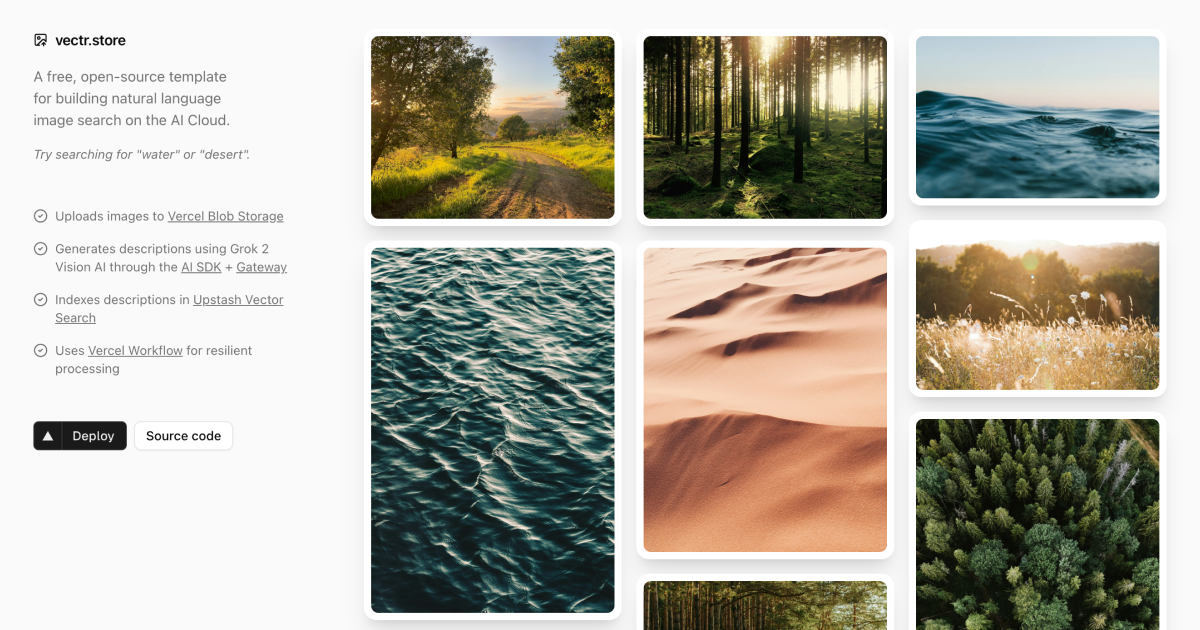
Free, open-source template for building natural language image search on the AI Cloud.
What it does
Vectr turns uploaded images into a searchable collection. It stores each file, asks a vision model for a detailed description, then indexes that description with the image metadata. Users search with ordinary phrases and receive matching images.
Why it's ranked here
The architecture is unusually legible for a complete AI search starter. Upload, description, and indexing run as isolated serverless steps with distinct retry policies. The practical UI includes batch uploads, cancellation, progress, optimistic previews, and semantic results. Its tight service dependencies make it less attractive outside Vercel and Upstash.
What's good
Failure handling receives real attention. Temporary failures trigger delayed retries, while invalid files and quota problems stop permanently. Uploads run in batches of ten, expose cancellation and progress, and reject files above 4.5 MB. Search metadata stays beside the indexed description, avoiding a separate application database.
Tradeoffs
The stack requires Vercel Blob, Upstash Search, Vercel Workflow, and a vision model reached through the AI SDK. Workflow remains a beta dependency. The hosted demo disables uploads. Configuration documentation also disagrees about some environment variable names, which can complicate local setup.
How to use it well
Use it as a working starter for teams building search over an image collection on Vercel. Replace the presentation and domain wording while retaining the upload, description, indexing, and retry pipeline. It does not cover image generation. It describes and retrieves images that users already possess.
Technical notes+
package.json defines a private TypeScript Next.js 16 application with React 19, pnpm-oriented scripts, Upstash Search, Vercel Blob, AI SDK, Zod, Tailwind CSS 4, and workflow 4.0.1-beta.2. next.config.ts wraps Next configuration with withWorkflow and permits images from Vercel Blob hosts. components/upload-button.tsx limits files to 4.5 MB, creates optimistic object URLs, processes batches of ten, and supports aborting requests. components/results.tsx lists up to 50 blobs, while components/results.client.tsx combines uploaded, searched, or default images. env.ts requires Blob and Upstash REST settings at module load, but its variable names differ from those documented in README.md; the README also alternates between an AI Gateway key and an xAI key.
Observed
- License
- MIT
- Primary language
- TypeScript
- Packaging
- Private Node.js application installed with pnpm
- Interface
- Next.js web application with an upload HTTP endpoint and server-side search action
- Platform
- Designed for Vercel deployment with Vercel Blob and Workflow
- Storage and search
- Upstash Search stores indexed descriptions and image metadata
Read from README.md, package.json, lib/utils.ts, env.ts, next.config.ts, postcss.config.mjs, app/page.tsx, app/layout.tsx, hooks/use-mobile.ts, components/deploy.tsx, components/header.tsx, components/preview.tsx, components/results.tsx, components/upload-button.tsx, components/results.client.tsx.
What it can do
Search for images using natural language queries
Text description or natural language query → Relevant images from database
Index and process images for searchability
Image files or image dataset → Searchable image index with embeddings
Generate vector embeddings from images
Image files → Vector representations of images
Build custom image search applications
Template code and configuration files → Deployable image search application
Deploy image search service to AI Cloud
Application code and image database → Live image search API endpoint
Tags
Tech Stack
Media
Comments (0)
No comments yet
Editorially curated, with community endorsements as a secondary signal. Corrections welcome.