gitcrawl
github.com/openclaw/gitcrawl- Category
- Productivity
- Rank
- No. 2650Tools index
Previous survey · No. 2509 ·
- Pricing
- Open Source
- Type
- TOOL
- Use case
- Data, Retrieval & Knowledge
- Builder
- openclaw
- GitHub
- 131 stars
- Latest release
- v0.16.0
- Date
About
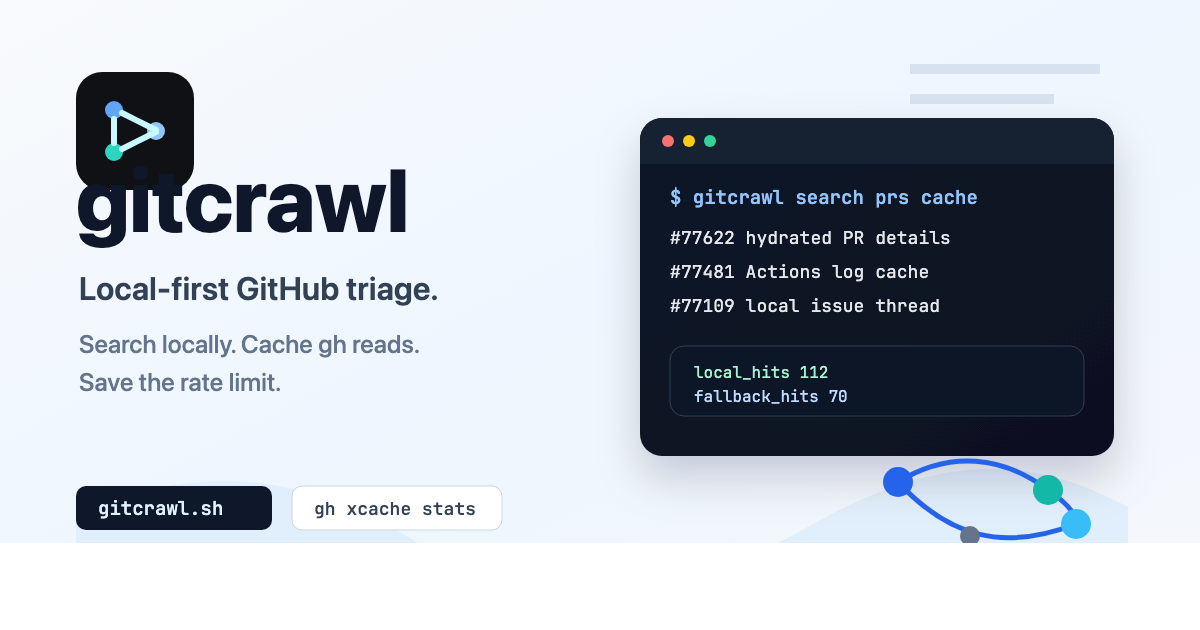
OpenClaw's local-first GitHub issue and pull request crawler for maintainer triage — pull everything into SQLite for offline review.
What it does
Gitcrawl turns a repository’s issue and pull request history into a searchable working set on your machine. It supports keyword, semantic, and hybrid queries, groups related threads using references and vector similarity, and offers both structured JSON output and an interactive terminal browser. It can also index text files from a local Git checkout.
Why it's ranked here
This is a strong maintainer tool because it joins collection, search, clustering, and hands-on triage in one command-line workflow. Its automation surface is unusually thoughtful: results stay on standard output, diagnostics go to standard error, and existing scripts can use a GitHub CLI-shaped search form. Persistent cluster decisions make repeated review more useful than disposable similarity reports.
What's good
Ordinary synchronization and keyword search avoid the OpenAI dependency. Semantic features use stored embeddings, while clustering also considers direct GitHub references. Maintainer choices, including canonical threads, exclusions, and local closures, survive later clustering runs. The terminal interface reads its database instead of making GitHub calls, and JSON output fits shell pipelines cleanly.
Tradeoffs
Synchronization still requires a GitHub token, and summaries, embeddings, semantic search, and clustering require an OpenAI key. Default synchronization does not fetch full history, comments, or detailed pull request data unless requested. Several advertised command names return a not-implemented error. The tool deliberately leaves live verification and GitHub write actions to other tools, so local triage cannot replace final upstream checks.
How to use it well
Use it when maintainers or agents repeatedly search a busy repository, investigate duplicates, or revisit triage decisions under API quota constraints. Start with a historical backfill, request comments and pull request details when needed, then refresh embeddings and clusters before opening the terminal browser. Keep the GitHub CLI or Octopool nearby for current data verification and write operations.
Technical notes+
The Go module is declared in go.mod and targets Go 1.26.5, with Kong for command parsing, Bubble Tea and Lip Gloss for the TUI, and modernc.org/sqlite for storage. internal/cli/app.go routes the broad CLI surface and explicitly rejects serve; it also marks completion, optimize, merge-clusters, split-cluster, and several other commands as unimplemented. internal/cli/code.go indexes bounded text snapshots from local Git checkouts. internal/cli/capture.go writes deterministic, code-free JSON snapshots atomically with private file permissions. internal/cli/runtime.go separates direct databases from portable runtime mirrors and includes health checks, repair, and recovery paths. internal/cli/app_test.go, internal/cli/tui_test.go, internal/cli/args_test.go, and internal/cli/code_test.go provide substantial colocated tests, while the Makefile enforces formatting, vetting, vulnerability checks, dead-code analysis, an 85 percent coverage floor, smoke tests, release tests, and snapshot builds.
Observed
- License
- MIT
- Primary language
- Go
- Install surface
- Homebrew formula, prebuilt macOS, Linux, and Windows archives, source builds, and Docker source builds
- Interfaces
- Command-line interface with JSON output and an interactive terminal UI
- Platform support
- macOS, Linux, and Windows
- Storage
- SQLite database with separate vector, cache, configuration, and log storage
Read from README.md, go.mod, Makefile, internal/cli/app.go, internal/cli/tui.go, internal/cli/args.go, internal/cli/code.go, internal/cli/errors.go, internal/cli/capture.go, internal/cli/gh_path.go, internal/cli/runtime.go, internal/cli/app_test.go, internal/cli/tui_test.go, internal/cli/args_test.go, internal/cli/code_test.go.
What it can do
Crawl GitHub issues
GitHub repository → Issues data stored in SQLite database
Crawl GitHub pull requests
GitHub repository → Pull request data stored in SQLite database
Store repository data locally
GitHub issues and pull requests → Local SQLite database file
Enable offline review of issues
Local SQLite database → Offline access to issue data
Enable offline review of pull requests
Local SQLite database → Offline access to pull request data
Support maintainer triage workflow
Crawled GitHub data in SQLite → Organized data for maintenance decisions
Tags
Tech Stack
Media
Comments (0)
No comments yet
Editorially curated, with community endorsements as a secondary signal. Corrections welcome.