How Anthropic had Claude make claude.ai 3x faster in two weeks
- Source
- claude.dev
- Author
- ClaudeDevs
- Date
Context
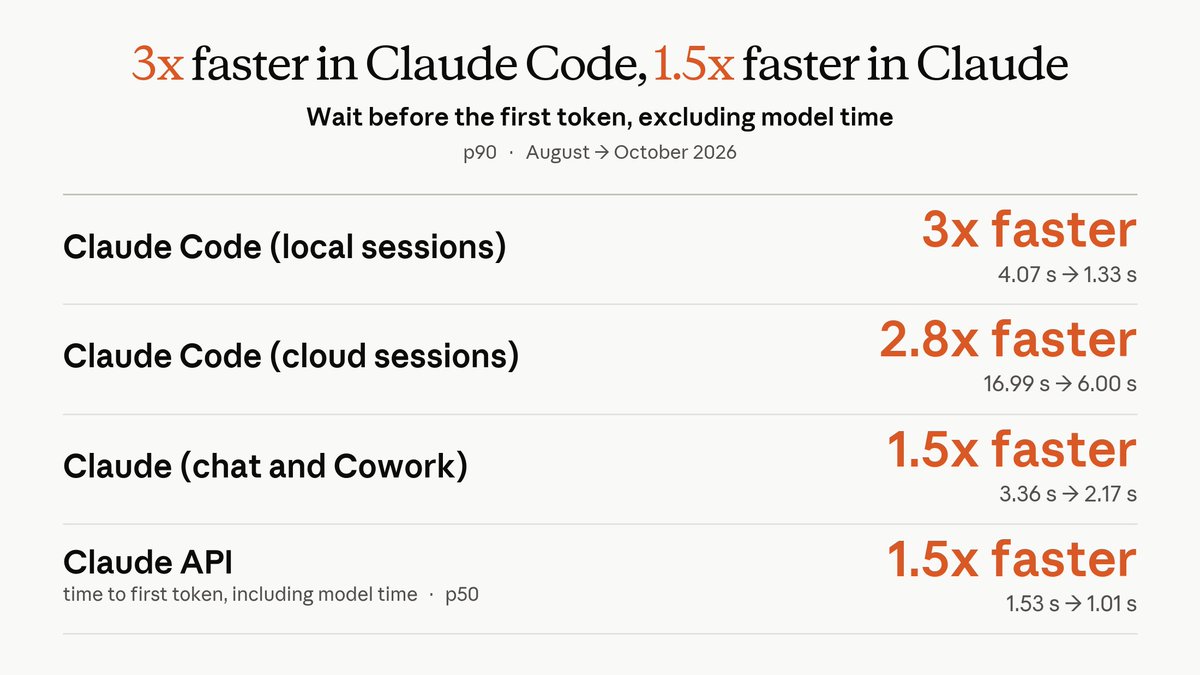
Anthropic's engineering post describes a two-week sprint in August 2026 that made claude.ai and the Claude desktop app about 3x faster. Measured at the 75th percentile, meaning three in four loads were this fast or faster, time to a typeable page on a fresh claude.ai load fell from 3.1 seconds to 0.55, starting a new Claude Code session went from 0.8 to 0.3 seconds, and loading a Claude Cowork cloud session went from 2.6 to 0.73 seconds. The work ran from one Slack channel using Claude Tag, then in beta, on an internal research model the authors call roughly comparable to Opus 5.5. The team reports merging more than three thousand changes without a customer-facing incident or rollback.
The post's central lesson is that once Claude has a number to beat, it can start optimizing, so the most valuable human work was finding more things to measure. Wall-clock time is what users feel, but it is too noisy to gate code changes on, so the team turned to deterministic counts such as CPU instructions, React commits, style recalculations and DOM mutations. Each new had to earn its place: Claude was asked to prove that driving it down produced real time savings, and benchmarks that were flaky or did not track user latency were thrown out. On two hot paths, Claude cut instruction counts by 48% and 31%, and wall-clock time fell 78% and 44%. Those counts then became ratchets: CI fails any change that raises them, and a daily job lowers the ceiling whenever the count drops.
Day to day, the work ran as a loop across Slack threads, more than 150 at a time. Someone flagged a slow spot, Claude built a benchmark that showed the problem, opened pull requests with anything user-visible behind a feature flag, watched the deploy and the field data, then ratcheted the benchmark if the change helped or switched the flag off if it did not. One planned change baked a static copy of the message composer into the page's HTML so people could type while React, the interface framework, was still starting up; Claude protected it with tests that compare the static and real versions across fourteen viewport sizes to within one pixel and fail on any lost or reordered keystroke. Other wins came from new counts: a layout-shift telemetry event showed that 31% of web page loads moved something after the page was usable, and a code-highlighting freeze of about a second traced back to em dashes, which pushed whole strings onto a slower two-byte path.
The authors stress that the loop was not autonomous. Every pull request went through automated review and at least one human approval, high-risk changes rolled out to employees first, then one percent of users, then everyone, and every thread had a named human owner who ruled on user-visible tradeoffs. Engineers also pushed Claude to be bolder, because by default it hedged on feasibility and padded its estimates. All figures are Anthropic's own measurements, and the team says the 95th percentile, other journeys and very long conversations still have room to improve.
- benchmark — A standard public test set for comparing AI models — the shared scoreboards behind every "model X beats model Y" claim.
- guardrails — The checks around a model that block bad inputs and outputs — filters, validators, and permission rules the model itself can't override.




Checking sign-in…
Loading comments…