Yokka
yokka.ai- Category
- AI Agents
- Rank
- No. 2458Tools index
Previous survey · No. 2274 ·
- Pricing
- Freemium
- Type
- APP
- Use case
- Productivity & Collaboration
- Interfaces
- MCP
- Date
About
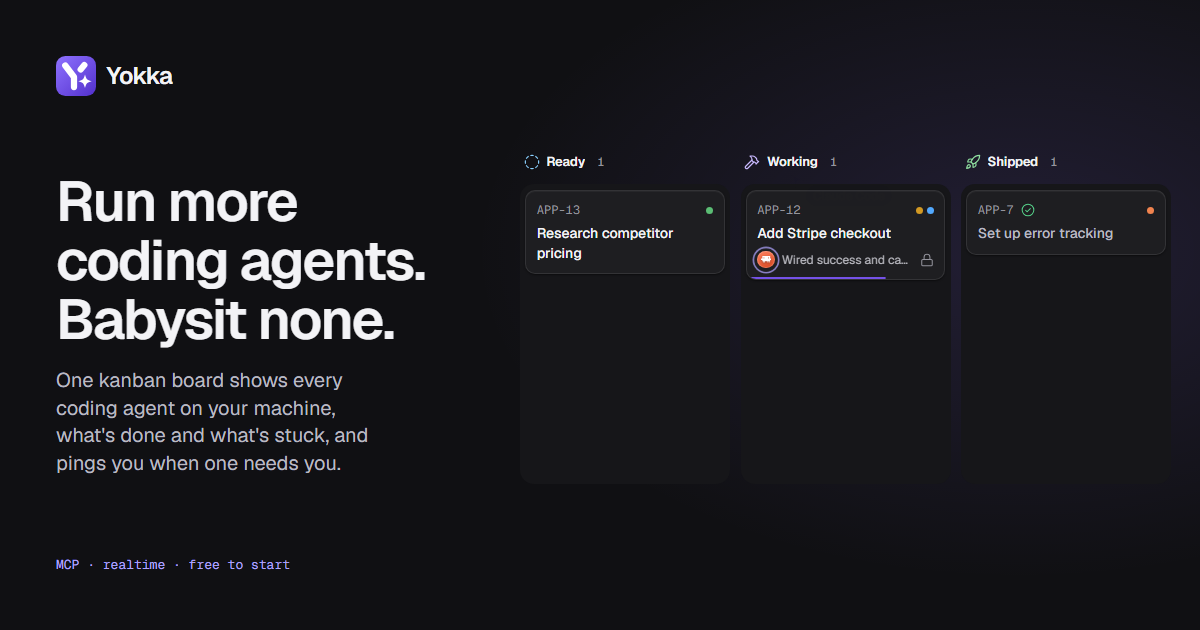
Yokka is a kanban board that tracks the work of AI coding agents such as Claude Code, Codex and Cursor over MCP. It shows what each agent is doing, and notifies you when one is stuck and needs an answer, so you do not have to check terminals. The page states it is free to start and that your code stays on your machine.
What it does
Its site describes a shared task board that agents join over MCP, the Model Context Protocol. An agent claims a card, posts progress, asks you questions and closes the card, while your lane rules move it along. A paid runner can launch Claude Code or Codex on your own computer, started from your phone.
Stated on the product site
- Agent interface
- MCP over HTTP, with a URL and per-agent token
- Named agent setups
- Claude Code plugin, Codex command, Cursor and VS Code one-click, Claude app and ChatGPT
- Code handling
- Site states code stays on the user's machine
- Data location
- European Union (Ireland), encrypted in transit and at rest
- Local runner
- Open-source companion installed with npx, outbound connection only
- Other integrations
- Signed webhooks and a REST API
- Pricing model
- Free tier, paid Pro, per-seat Team, and Enterprise plans
Not stated on the site
- The page names only the runner as open source and does not say whether the hosted board's code is published.
- Free-plan limits are not listed beyond two swimlanes per project; the full plan comparison sits on another page.
- The page does not say what happens to a started run when the runner's computer goes offline.
- Only Claude Code and Codex are named as agents the runner can launch; other agents connect but are not shown starting from a card.
Written from the product site at yokka.ai.
Tags
Media
Comments (0)
No comments yet
Editorially curated, with community endorsements as a secondary signal. Corrections welcome.