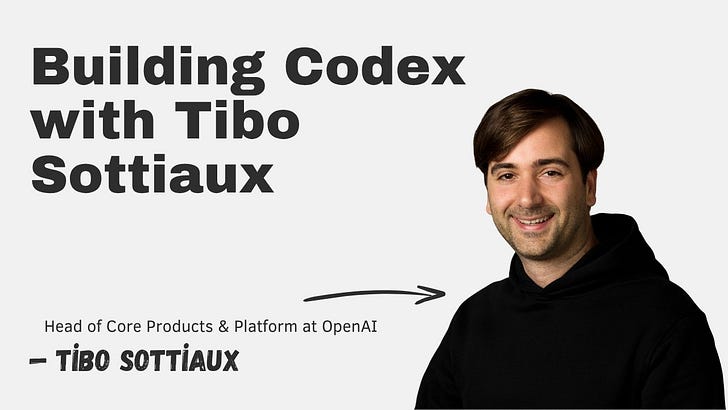
Building Codex with Tibo Sottiaux
- Source
- newsletter.pragmaticengineer.com
- Author
- Gergely Orosz
- Date
OpenAI engineer Tibo Sottiaux, who helped build the Codex CLI, walked through why the tool was rewritten in Rust, why OpenAI chose to open-source it, and how both the harness and the underlying models have changed since Codex first shipped. The conversation, recorded for Pragmatic Engineer, covers concrete engineering tradeoffs rather than marketing framing: the reasons a CLI-based coding agent benefits from a compiled, single-binary runtime over an interpreted one, and how open-sourcing the harness let external contributors fix bugs faster than OpenAI's own team could alone. Sottiaux also traces how the models running underneath Codex have iterated independently of the harness itself, meaning the same CLI has gotten meaningfully more capable without any client-side changes. For anyone building or evaluating CLI-based coding agents, the Rust rewrite rationale and the harness and model separation are the two decisions worth studying directly, since both choices are increasingly common across competing tools.
Context
Tibo Sottiaux, one of the engineers who created Codex at OpenAI, is the subject of a Pragmatic Engineer interview recap that describes the software around a coding model, often called the . According to the recap, the harness supplies , safety, efficiency, steerability and a developer message injected at the start of each turn.
The recap's account is that the harness stays slightly ahead of OpenAI's latest model, and that as models improve some of these supports are discarded and the harness shrinks. That explains why improving a coding involves revisiting the division of work between model and software, rather than assuming every new model should inherit an unchanged operating environment. The source is the host's written summary, not a transcript.
- agent harness — The scaffolding around a model that turns it into a working agent — the loop, the tools it can call, and the rules for when to stop.
- guardrails — The checks around a model that block bad inputs and outputs — filters, validators, and permission rules the model itself can't override.
- AI agent — An AI system that doesn't just answer once but works toward a goal in a loop — taking actions, reading the results, and deciding what to do next.
“have you asked Codex?”
Tibo Sottiaux
“I was part of that team. Basically ChatGPT one year before it came out. Called LMChat and then another codename.”
Tibo Sottiaux
“Google was too nervous to release it and DeepMind was blocked from shipping products that could disrupt Google.”
Tibo Sottiaux

Checking sign-in…
Loading comments…