Claude Mods: Flipping the Harness Inside Out
- Source
- latent.space
- Author
- Dan McAteer
- Date
Context
Dan McAteer's Latent Space post on Claude Mods describes a mod as a Claude Code plugin made of TypeScript or JavaScript functions that run inside Claude Code, in the CLI and Desktop. Mods respond to events such as a submitted prompt, a tool call or an interface render, and they can observe the event, change how it is drawn, or handle it instead of the default behavior. McAteer calls them middleware for the . Claude Code also ships a that teaches Claude to write mods, so a user can describe one in plain language and have Anthropic's agent build it.
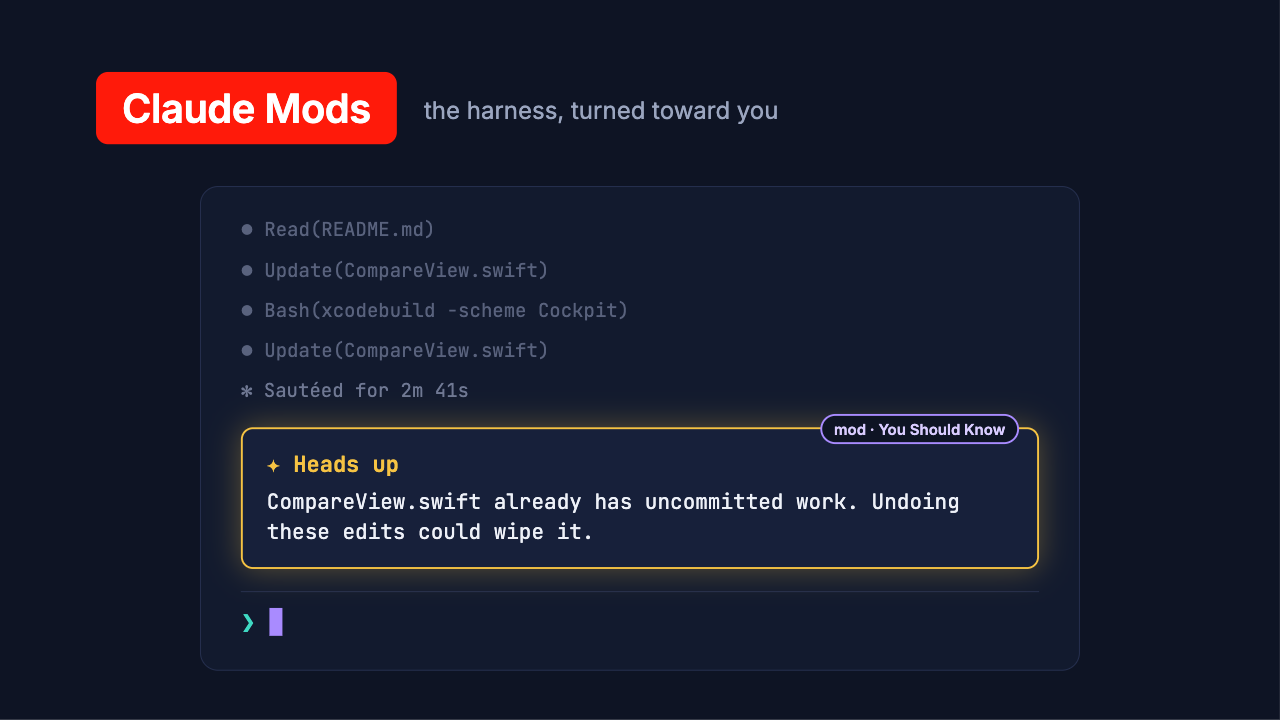
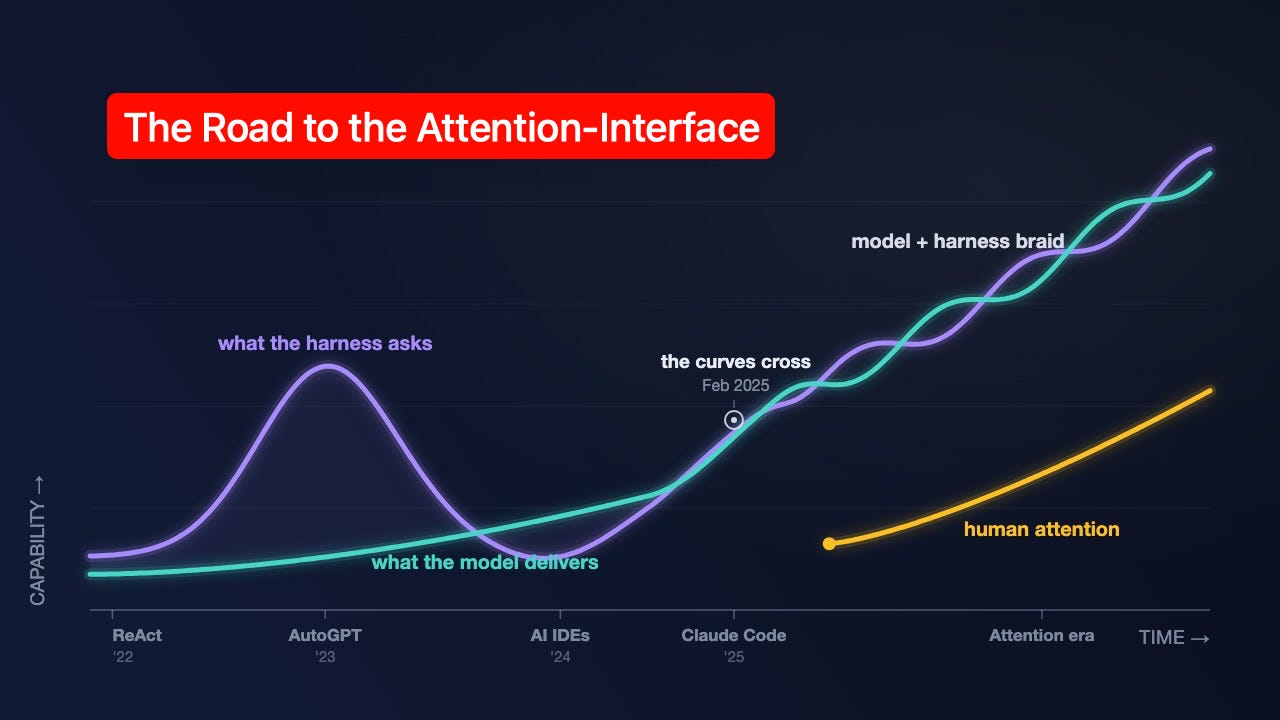
His argument, carried over from his earlier post on the evolution of the agent harness, is that as models absorb more of the harness, what is left faces the human: the layer that decides when the agent interrupts, what it shows and which decisions it hands back. Mods make that layer programmable by the person using it. Anthropic already builds some of Claude Code this way; the post lists six built-in mods, including one that takes over the diff pane and one called You Should Know, off by default, which runs a side agent that flags things buried in the trace. In McAteer's example it warned that the file being edited, and about 45 others, already held uncommitted work that discarding the demo edits would have thrown away.
He contrasts this with two other ways of shaping . In OpenAI's Intelligent UI for ChatGPT, the model generates an interface answer by answer from components the lab built. In Cursor's PR Routing and Approval, a team writes policy and a fixed workflow assigns reviewers or auto-approves low-risk pull requests, reading approval policy from the base branch so a PR cannot relax its own review. With mods, the user and Claude write the interface itself and can any point in the loop.
The tradeoff is that the user owns the result. McAteer's own Next Steps Supervisor mod, part of his open-source ModSmith plugin, ran on 99 of his 111 turns after he installed it, enough that he began skimming it. Its README, he reports, estimates about 5 to 6k input-equivalent tokens per check on a 50k-token session. And he notes that, per Anthropic's docs, mods are not sandboxed: once loaded they can read and write files, see prompts and spend usage, and built-in mods keep running under safe mode. His own rule is to read anyone else's mod before installing it.
- A Claude Mod is a Claude Code plugin of TypeScript or JavaScript functions that respond to events like prompts, tool calls and renders, and can observe them, change how they display, or replace the default handling. Anthropic already ships six built-in mods.
- The author's example: the built-in You Should Know side agent flagged that the file being edited, and about 45 others, already held uncommitted work, so discarding the demo edits would have destroyed it.
- The author's own Next Steps Supervisor mod fired on 99 of 111 turns, which made it easy to skim past, and each check costs about 5-6k input-equivalent tokens on a 50k-token session, per the mod's README.
- Mods are not sandboxed: once loaded, one can read and write files, see every prompt and spend usage, and built-in mods keep running under --safe-mode. The author reads third-party mod code before installing it.
- The piece contrasts who designs the interface: ChatGPT's Intelligent UI lets the model pick components, Cursor's PR routing enforces team policy and reads approval policy from the base branch, and Mods let the user and Claude write the interface in code.
- agent harness — The scaffolding around a model that turns it into a working agent — the loop, the tools it can call, and the rules for when to stop.
- agent skill — A reusable instruction file that teaches an agent how to do one job well — the procedure, the tools, and what counts as done.
- attention — The mechanism that lets a model weigh which earlier words matter for the word it's currently processing — the core operation of a transformer.
- agent hook — A script the harness runs automatically at a fixed point in an agent's loop — before a tool call, after an edit, on session start.



Checking sign-in…
Loading comments…