Etalon: measuring LLM streaming latency beyond TPOT averages
- Source
- x.com
- Date

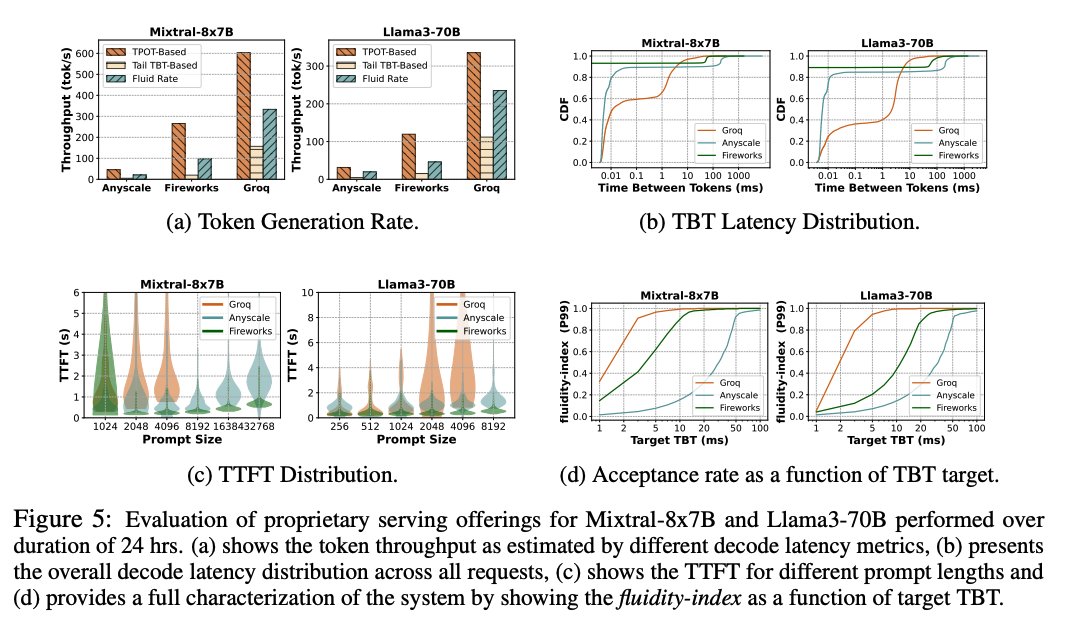
this is a must-read if you want to be a top 1% ai performance engineers follow and save to keep up with the series. links in thread 🧵 part 8: Etalon: Holistic Performance Evaluation Framework for LLM Inference Systems Amey Agrawal and coauthors explain how serving decisions shape the timing of streamed LLM responses. for AI performance engineers evaluating batching, chunked prefill, or speculative decoding, the paper provides a framework for assessing token delivery against application-specific timing targets. the authors connect scheduling behavior, token arrival traces, and service targets: - prefill and decode interference: a long prefill can delay ongoing decode work. chunked prefill divides that prompt processing across batches, so the amount of prefill work per batch can affect both first-token latency and interruptions to existing streams. - first-token latency: time to first token (TTFT) includes scheduling delay and prompt processing. the authors propose profiling isolated requests across prompt lengths and adding a scheduling allowance to set first-token deadlines. - averages and latency distributions: time per output token (TPOT) can hide generation pauses,…
Context
An AI response can have a good average generation speed and still pause frustratingly halfway through. The Etalon paper explains why dividing generation time by output length hides those interruptions. It instead evaluates when individual pieces of output arrive relative to deadlines chosen for the application.
Its fluidity index measures the fraction of deadline slots met. Output arriving early builds slack that can cover later gaps; a late arrival incurs missed slots and resets subsequent deadlines. This lets engineers compare whether a service sustains the desired reading or playback pace, rather than relying on an average that obscures stalls.
- LLM — A large language model — the neural network behind tools like Claude and ChatGPT, trained on huge amounts of text to predict what comes next.
- inference — Running a trained model to get answers — the phase where AI is actually used, as opposed to trained.
- speculative decoding — A speed trick where a small model drafts several tokens ahead and the big model verifies them in one pass, often doubling generation speed.
- token — The chunk of text a model reads and writes in — roughly three-quarters of a word — and the unit AI usage is billed in.
Checking sign-in…
Loading comments…