⚡ Faster than Fast. Designed for Agentic AI.
- Source
- x.com
- Date

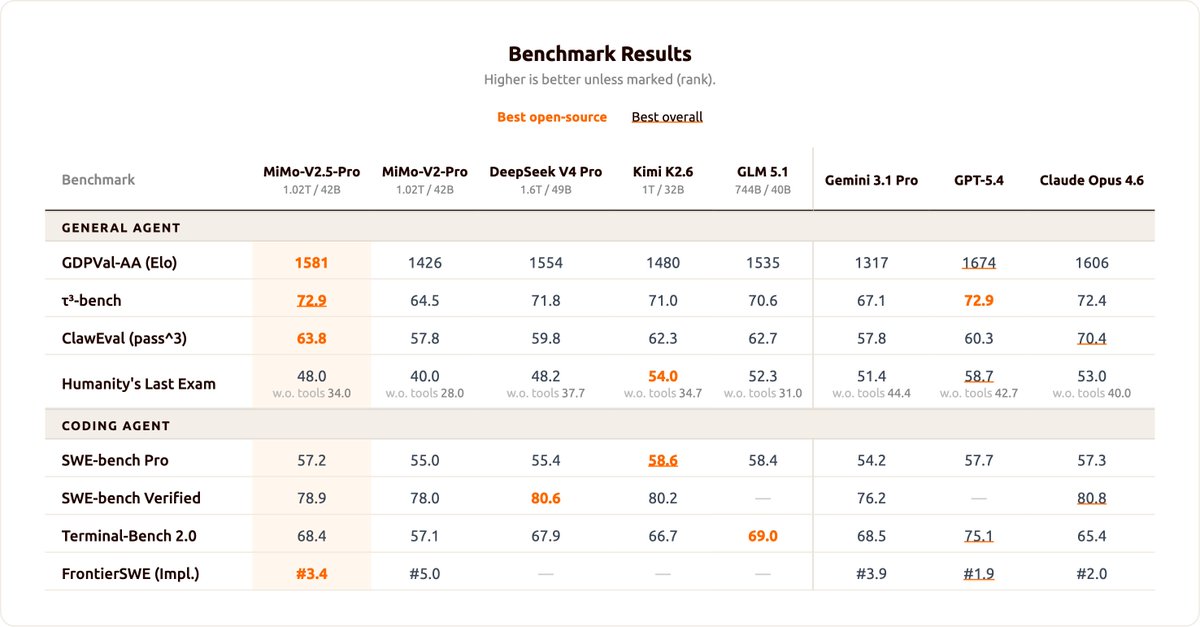
⚡ Faster than Fast. Designed for Agentic AI. Introducing Xiaomi MiMo-V2-Flash — our new open-source MoE model: 309B total params, 15B active. Blazing speed meets frontier performance. 🔥 Highlights: 🏗️ Hybrid Attention: 5:1 interleaved 128-window SWA + Global | 256K context 📈 Performance: ⚔️ Matches DeepSeek-V3.2 on general benchmarks — at a fraction of the latency 🏆 SWE-Bench Verified: 73.4% | SWE-Bench Multilingual: 71.7% — new SOTA for open-source models 🚀 Speed: 150 output tokens/s with Day-0 support from @lmsysorg🤝 🤗 Model: https://t.co/4Etm0yZKTL 📝 Blog Post: https://t.co/5zxmcDuB6o 📄 Technical Report: https://t.co/crac1YTLYl 🎨 AI Studio:

🏗️ Architecture Deep Dive MiMo-V2-Flash uses hybrid attention: Sliding Window + Global in a 5:1 ratio → 8 hybrid blocks (5 SWA layers → 1 Global) → 128-token sliding window → 256 experts, 8 active per token → Natively 32K trained, extended to 256K context support 💡 Key Findings Attention sink bias is essential. Without it, SWA performance tanks. With it, SWA matches or beats full global attention. Smaller windows win. 128 vs 512? Similar on short benchmarks. But after 256K extension, 128-token SWA pulls ahead while 512-token SWA collapses. 🤯 ⚡ MTP: Train Faster, Infer Faster 3 lightweight heads (0.33B each) double as draft models for speculative decoding. Result? 2.5× decode speedup.

🧪 Beyond arch innovation, MiMo-V2-Flash is cooked via a NEW post-training paradigm Multi-Teacher On-Policy Distillation (MOPD) ❌ Problem: Post-training's "see-saw" effect — improve math, break coding. Enhance reasoning, hurt safety. ✅ Solution: Train specialized expert teachers, then distill ALL of them into one student via on-policy RL with token-level KL rewards. 🔥 Results: → 1/50 compute vs. training specialists → On par with ALL teachers in their own domains → No capability trade-offs → Iterative: today's student → tomorrow's teacher 🧠 Why it works: Dense token-level supervision + on-policy sampling + multi-teacher guidance = no more see-saw.

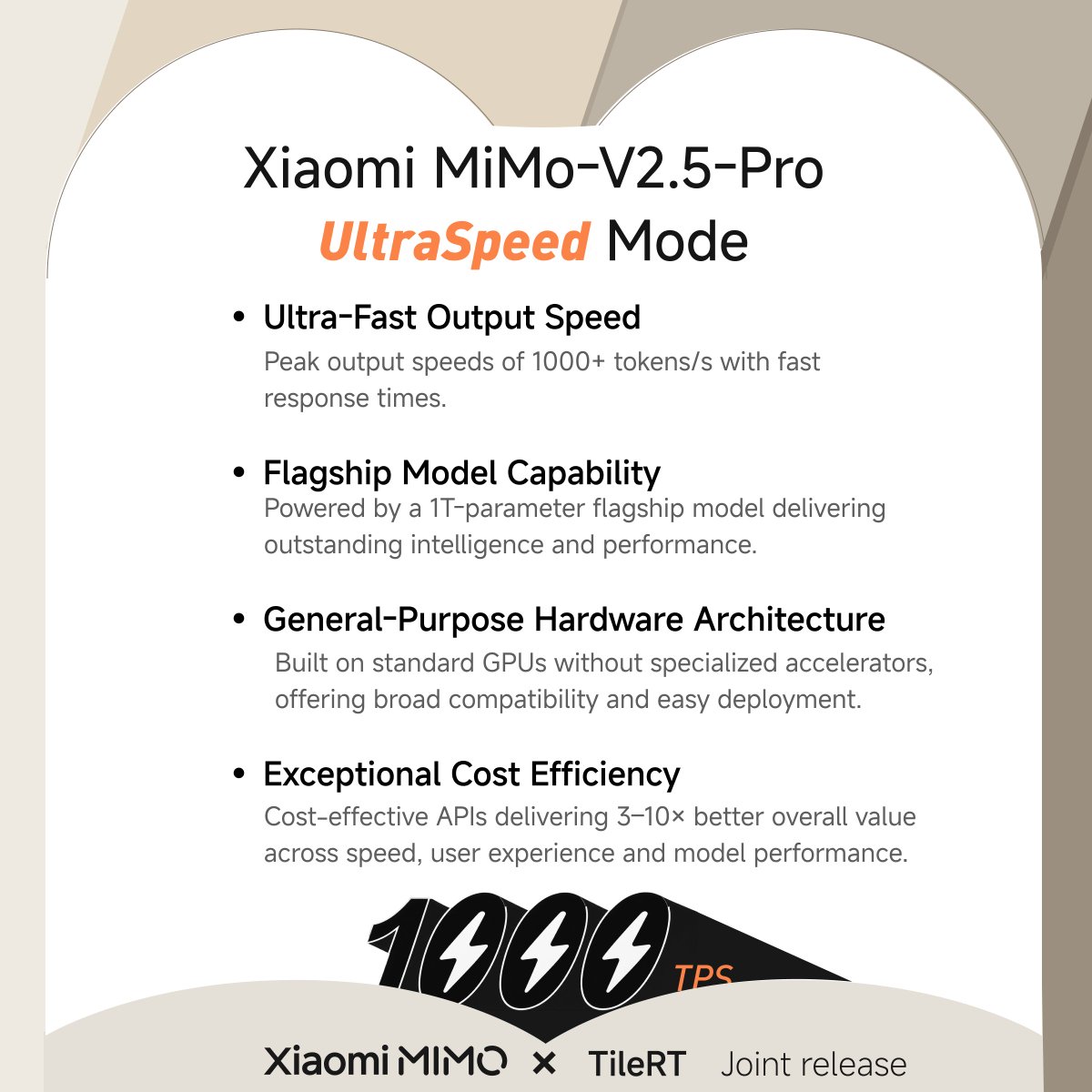
🧠 Why we built MiMo-V2-Flash with Multi-Token Prediction (MTP) — and why we're open-sourcing it? MTP unlocks speed gains at both inference and training. Here's the breakdown: 1️⃣ Faster LLM Decoding LLM decoding is memory-bound — low arithmetic intensity kills throughput. Batch parallelism helps FFN but not attention (each request has its own KV cache). MTP generates draft tokens → main model verifies in parallel → token-level parallelism without extra KV cache I/O ⚡ With 3-layer MTP: → 2.8–3.6 accepted tokens per step → 2.0–2.6x actual speedup 2️⃣ Accelerating RL Training Rollout is the #1 bottleneck in RL. MTP tackles it head-on: → Scales token-level parallelism instead of batch size — enabling stable, efficient on-policy RL with small batches → Eliminates GPU idleness from long-tail stragglers when batch sizes shrink to ~1 🎯 Faster, more stable, more efficient RL. 💡 TL;DR: MTP accelerates inference + RL training while boosting GPU efficiency. A critical unlock for agentic models — so we're open-sourcing it. Try it. Build with us. 🚀

Context
Xiaomi's MiMo lab open-sourced MiMo-V2-Flash, a model with 309 billion total parameters and 15 billion active per token, using hybrid attention: five sliding-window layers for every one global-attention layer, with a 256K-token . The company reports it matches DeepSeek-V3.2 on general benchmarks while decoding faster, and scores 73.4% on .
Xiaomi's own ablations, described in the same thread, found that sliding-window attention needs a bias toward early "sink" tokens to work at all, and that a narrower 128-token window holds up better than a 512-token window once context is stretched to 256K, where the wider window's performance drops. The model also ships three small prediction heads that draft several future tokens for the main model to verify in parallel, which Xiaomi reports roughly doubles decode speed without added memory traffic.
- mixture-of-experts — A model built from many specialist sub-networks where only a few activate per token, giving big-model capability at small-model running cost.
- context window — The maximum amount of text a model can consider at once — its working memory for the current conversation or task.
- SWE-bench — The standard benchmark for AI coding agents: real GitHub issues from real repositories, scored by whether the agent's patch passes the project's own tests.
- distillation — Training a small, cheap model to imitate a big one's outputs, keeping much of the capability at a fraction of the cost.
Checking sign-in…
Loading comments…