Xiaomi Releases Open-Weight MiMo-V2.6 With Claimed Frontier Agent Scores
- Source
- x.com
- Date
Xiaomi released MiMo-V2.6 Pro and Flash, a family of omnimodal models trained through scaled reinforcement learning, and open sourced both the weights and the RL environments used to train them, not just the checkpoints. Xiaomi claims Pro matches Claude Opus 5 and GPT 5.6 on agent benchmarks.
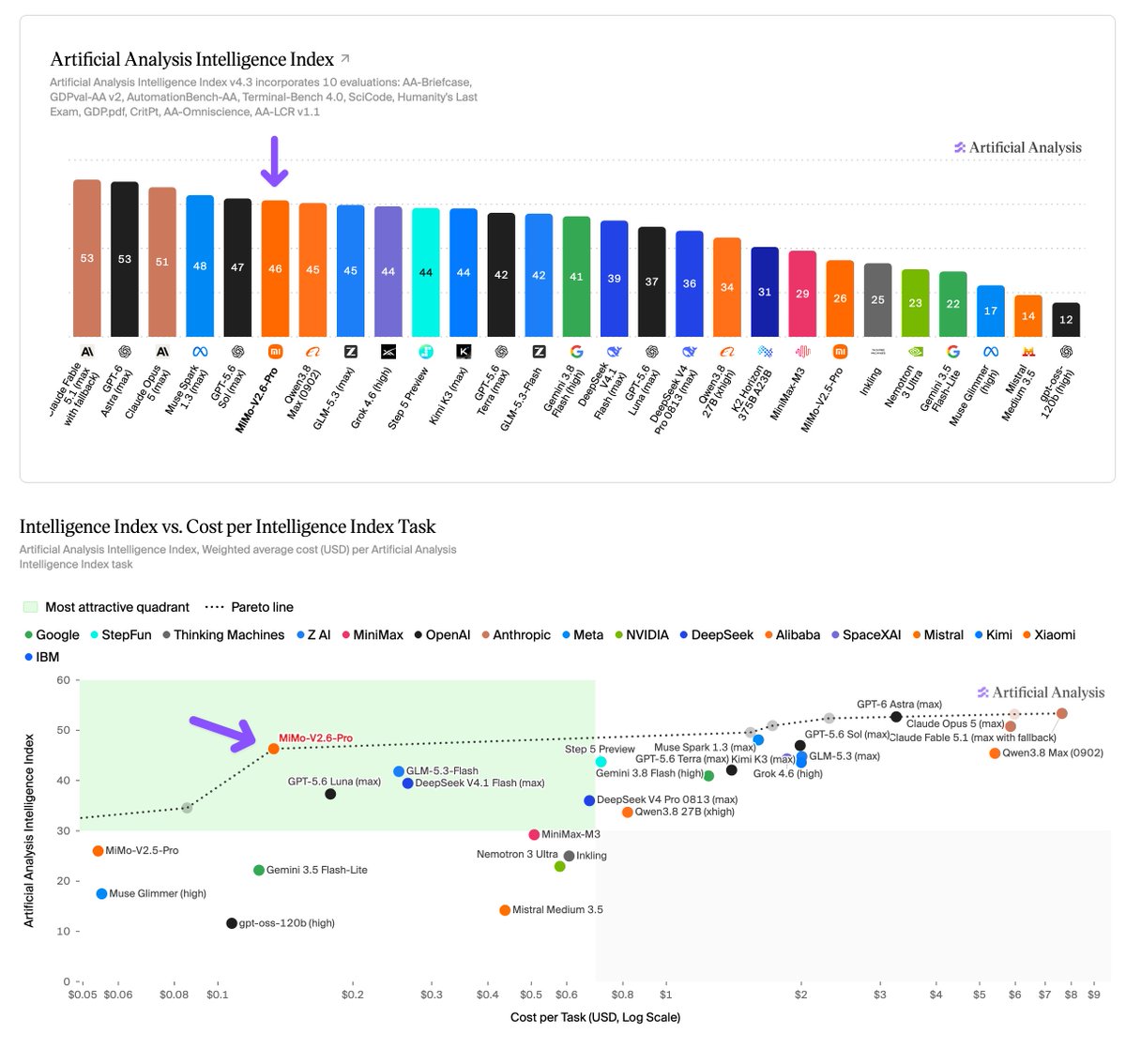
Artificial Analysis backs the headline claim. The 1.02 trillion parameter Pro variant is now the top scoring open weights model on its Intelligence Index, at roughly $0.13 per task, putting it on the cost efficiency frontier rather than just the capability frontier. OpenRouter lists the family, including a roughly 10x faster UltraSpeed variant of Pro for latency sensitive work, with support for text, image, video, and audio across a 1M token context. Xiaomi also shipped smaller siblings: a 9B distilled model tuned for tool use and agentic coding, ready to serve through vLLM, SGLang, or Transformers, and an MIT licensed Flash RL variant for lower latency multimodal inference.
For practitioners choosing an open weights model to self host, MiMo-V2.6 is now a fully inspectable alternative to closed frontier models for coding and computer use tasks, with the training method itself available to study, not only the results.

Introducing Xiaomi MiMo-V2.6 — Pro & Flash. Frontier intelligence, all the modalities, built in public. 🔹 Two omnimodal models, advancing through scaled reinforcement learning 🔹 Pro performs on par with Claude Opus 5 and GPT-5.6 Sol across most agent benchmarks 🔹 Pro scores 46 on the Artificial Analysis Intelligence Index — the highest among open-source models 🔹 Stronger coding, computer use, 3D reasoning and creative capabilities 🔹 Open model weights, technical report, RL environments and training code Blog:

Context
Xiaomi's MiMo team has released MiMo-V2.6 in two versions, Pro and Flash, and is publishing the model weights, a technical report, its reinforcement-learning training environments and training code. mean anyone can download and run the models rather than renting them only through Xiaomi. The headline claim is that Pro performs on par with Claude Opus 5 and GPT-5.6 Sol across most benchmarks, tests in which a model works through multi-step tasks with tools.
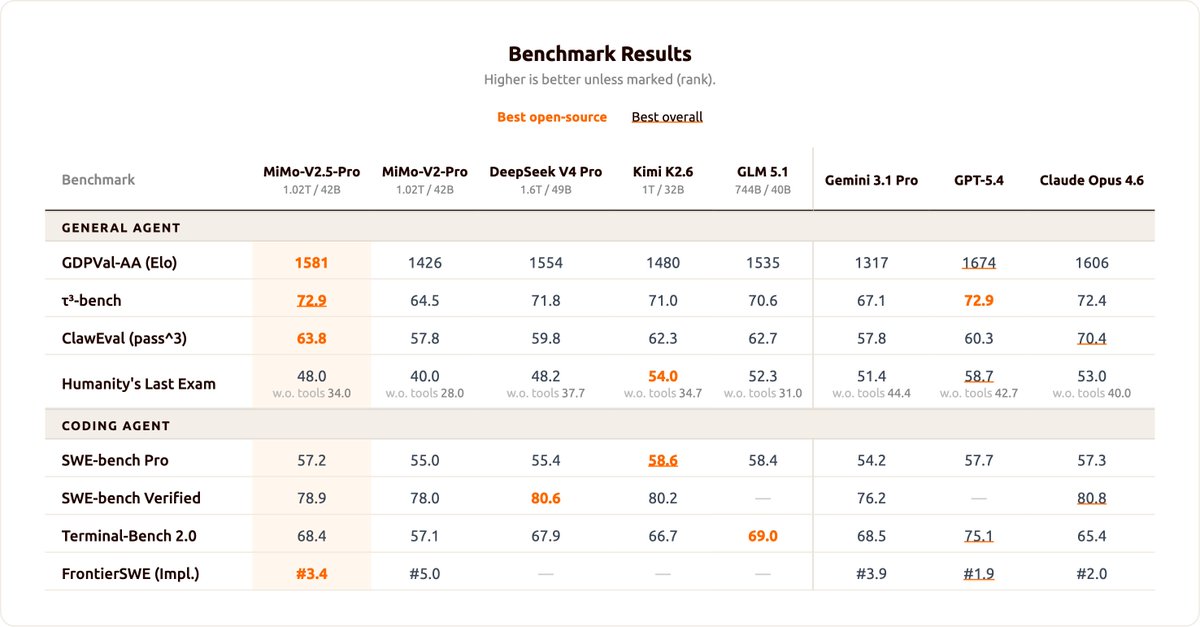
The comparison table attached to Xiaomi's post supports that claim on some tests and not others. On Terminal Bench 2.1 Pro scores 89.9 against 89.1 for Opus 5 and 88.8 for GPT-5.6 Sol, on OSWorld-Verified, which tests operating a computer, it scores 82.0 against 83.4 and 83.0, and on AutomationBench it leads both. The gaps show up elsewhere: on Terminal Bench 4.0 Pro scores 34.9 against 49.0 for Opus 5 and 39.9 for GPT-5.6 Sol, on ProgramBench 26.5 against Opus 5's 37.0, and on the ExploitBench security test 47.9 against 70.0 and 78.5. The table also shows how far Xiaomi has moved in one release, with its previous Pro model at 19.0 on the DeepSWE coding against 71.9 now. These are Xiaomi's own numbers, and the linked blog post could not be retrieved, so how the tests were run is not known here.
The part checked by an outsider is narrower. Artificial Analysis, which runs its own model evaluations, scored MiMo-V2.6-Pro at 46 on its Intelligence Index, the highest of any open-weight model and up from 26 for MiMo-V2.5-Pro. It measured the cost at about $0.13 per index task, at prices of $0.435 per million input and $0.87 per million output tokens, which puts the model among the cheapest at its level. That makes MiMo-V2.6 Pro the leading open-weight model on that independent measure, while the claim of parity with the top closed models remains Xiaomi's, and its own table shows where it falls short.
- open weights — A model whose trained parameters are published for anyone to download and run — unlike API-only models you can access but never possess.
- AI agent — An AI system that doesn't just answer once but works toward a goal in a loop — taking actions, reading the results, and deciding what to do next.
- benchmark — A standard public test set for comparing AI models — the shared scoreboards behind every "model X beats model Y" claim.
- token — The chunk of text a model reads and writes in — roughly three-quarters of a word — and the unit AI usage is billed in.
Checking sign-in…
Loading comments…