Open models recap: more on Kimi K3, Qwen 3.8, Xi's WAIC speech, distillation, the open-closed gap, and what's next
- Source
- interconnects.ai
- Author
- Nathan Lambert
- Date

Context
The gap between open and closed AI models depends on the work being assigned. In Nathan Lambert's open-model discussion, the speakers describe models that produce useful code or handle routine cleanup, yet miss edge cases that stronger models catch. They also describe response speed as a reason to use a model whose capability is sufficient for the task.
These are workflow observations, rather than a controlled ranking. Their useful implication is that a single estimate of how many months open models lag obscures separate questions: whether a model handles the relevant task, and whether its serving speed makes it practical to use.
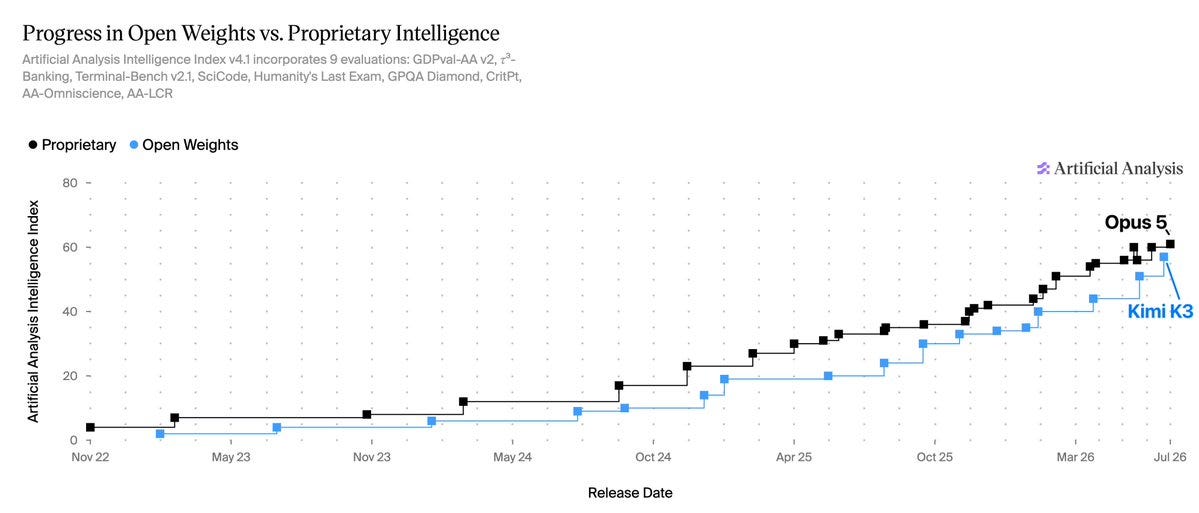
- The 'how many months behind is open source' question has no answer because each side picks its favorite . The ones that track what people actually buy are agentic coding and computer use; the rest measures long-tail robustness.
- Kimi K3 is large enough that it takes a full node of B300s just to load the weights, so the community post-training wave that followed Qwen and GLM will need serious engineering before it shows up here.
- A big scale-up usually ships with rough-edged post-training, which is exactly why fine-tuning a fresh giant open model pays off: there is performance left in it that the lab did not have time to extract.
- Speed beats marginal quality in daily use. GLM 5.2 on a fast endpoint at 200-300 per second wins grunt work because picking a model and a reasoning effort in Codex costs more time than the quality gap buys back.
- One concrete finding from their own data: Reddit discussion of a new open model leads its Hugging Face download takeoff by one to two months, making forum chatter an early indicator of which models get adopted.
- distillation — Training a small, cheap model to imitate a big one's outputs, keeping much of the capability at a fraction of the cost.
- benchmark — A standard public test set for comparing AI models — the shared scoreboards behind every "model X beats model Y" claim.
- fine-tuning — Taking a trained model and training it a bit more on your own examples so it gets better at one specific job.
- token — The chunk of text a model reads and writes in — roughly three-quarters of a word — and the unit AI usage is billed in.
“So I would say that Kimi K3 is like 54-55 level for these kind of tasks.”
Florian Brand
“And I think this is actually one of the best arguments for not doing anything.”
Nathan Lambert
“So they had to use GLM, a lesser capable model, but it had no guardrails for this kind of defensive action.”
Florian Brand
“And so I just think the argument that distillation is helping more because RL is becoming more prevalent is not grounded in literature that we have today.”
Nathan Lambert




Checking sign-in…
Loading comments…