Meta shakes up the frontiers, open and closed
- Source
- interconnects.ai
- Author
- Nathan Lambert
- Date
Context
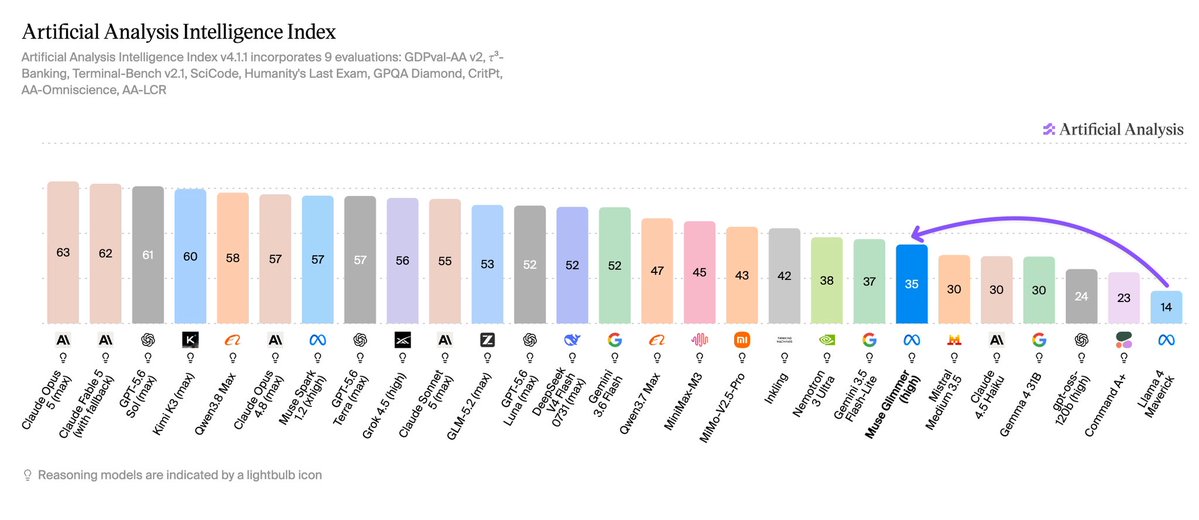
Nathan Lambert argues that Meta's Muse Spark Open has pulled American models back toward the frontier, and that its restrictive custom license is the main thing that could stop it from being widely adopted (interconnects.ai). He calls it "the strongest American-made open model by quite some margin." Without it and Reflection's first model, Beam, he counts more than 20 open-weight models from Chinese companies that would beat the best Western one. In his view the gap between the best American and Chinese open models has, in many ways, been roughly halved, moving American open models from irrelevant for users who need cutting-edge performance to "behind but relevant." He places Muse Spark Open above GLM 5.2, near DeepSeek V4.1 Flash, and behind GLM 5.3 and Kimi K3, which Chinese labs released months earlier.
According to the model card, Muse Spark Open is a model with 816 billion total parameters, of which only 42 billion are active for any given token, a 1-million-token and native , built for coding and agentic work. Lambert expects it to fit a market where demand for open models is accelerating, and notes that his group's analysis repeatedly finds Western open-weight models get far more adoption than Chinese ones with the same performance for their size. He also addresses a worry that the open version was "broken" by its extra safety training, since it arrived after Muse Spark 1.3. He thinks it is more likely a safety-tuned Muse Spark 1.2, which would cost only about a point on the Artificial Analysis index, pointing to Alexandr Wang's earlier statement that Meta was preparing to release 1.2 as open weights.
The license is the catch. Products built on the model must display "Built with Muse"; companies making more than $20 million a month across their business need a separate license from Meta; users must accept an acceptable use policy; and these terms extend to the model's outputs and derivatives, which leaves it legally unclear whether outputs can safely be used as synthetic training data. Internal research and applications are permitted. Lambert expects many builders to ignore the terms and Meta to pursue only egregious violations, but he calls complex, non-standard licenses an unnecessary strategic risk for a lab trying to win back adoption.
The open release came days after Meta's closed Muse Wonder and Muse Wonder Full, which Lambert says trail only Anthropic's Opus 5.5 on traditional benchmarks and sit alongside OpenAI's GPT-6-Astra and Google's Gemini-4-Argon. That makes Meta, in his words, the only American company with frontier open and closed models, and he ranks it roughly level with Gemini, behind Anthropic and OpenAI. He also notes that Mistral AI had announced Mistral Large 4 with strong scores but had not yet released its weights when he wrote the post.
- Nathan Lambert places Muse Spark Open, an 816B-total/42B-active multimodal model with a 1M-token context, above GLM 5.2, near DeepSeek V4.1 Flash, and behind GLM 5.3 and Kimi K3, calling it the strongest American open model.
- He argues the model is more likely a safety-tuned Muse Spark 1.2 than a version 'broken' by safety training, estimating only about a 1-point drop on the Artificial Analysis index.
- The custom license is his main concern: a 'Built with Muse' display requirement, a separate license above $20M monthly revenue, an acceptable use policy, and terms extending to outputs and derivatives, clouding synthetic-data use.
- Lambert ranks labs Anthropic > OpenAI > Meta ~ Gemini > xAI ~ Chinese open weights > US open weights, crediting Meta's closed Muse Wonder models as trailing only Opus 5.5 on traditional benchmarks.
- He argues frontier costs now run to billions per major model, narrowing serious US contenders to five labs, while 'tier 3' players like Mistral, Nemotron and Reflection struggle to move either frontier.
- open weights — A model whose trained parameters are published for anyone to download and run — unlike API-only models you can access but never possess.
- mixture-of-experts — A model built from many specialist sub-networks where only a few activate per token, giving big-model capability at small-model running cost.
- context window — The maximum amount of text a model can consider at once — its working memory for the current conversation or task.
- multimodal — A model that works with more than text — reading images, audio, or video, and sometimes generating them too.


Checking sign-in…
Loading comments…