Tencent's Hyra reports four new bounds on open math problems
- Source
- github.com
- Publisher
- Tencent
- Author
- Tencent Hy
- Date

Context
Hyra, the AI research from Tencent's Hunyuan group, is credited with tighter proven bounds on four open mathematics problems, but none of the four is solved. In each case the reported result improves the best proven bound on a quantity whose true value is still unknown. Tencent Hunyuan's X post of August 19 announced the four together. The Hyra results README on GitHub lists each one against the earlier published and links a paper for each. The README says three of them (the Beurling–Ahlfors, partial Hadamard and commutator results) come with a Lean 4 formalization of their "finite and numerical core", meaning a proof assistant checked those parts. It does not say the full proofs were formalized.
The geometry result concerns shapes of constant width, which measure the same thickness w in every direction, as a ball does. The Blaschke–Lebesgue problem asks for the smallest volume such a three-dimensional shape can have. The conjectured answer is Meissner's bodies, at about 0.419860 w³. In June 2026, Akatsuki Nishioka proved that every such shape has volume at least about 0.380799 w³. The README reports Hyra's certified bound as more than 0.411040 w³, which closes 77.4% of the gap between Nishioka's bound and Meissner's value (the X post states the same bound as 97.9% of Meissner's volume).
Two results tighten bounds in analysis. The Beurling–Ahlfors transform is a standard operator in complex analysis, and Iwaniec conjectured in 1982 that its size on the Lᵖ spaces (the largest factor by which it can enlarge a , measured by an Lᵖ average) is exactly p*−1. What has been proved is that the size is at most a constant times p*−1, where the conjecture says the constant is 1. The README says Bañuelos and Janakiraman's 2008 constant of 1.575 now drops to 1.523958. The commutator result asks about two operators D and X and the combination DX − XD. The README notes that this combination can never equal the identity operator, but it can come within a small distance ε of it if D and X are large enough. The question is how fast the product of their sizes must grow as ε shrinks. Tao showed growth on the order of log⁵(1/ε) suffices, a later refinement by Bilich brought that to log⁴, and Hyra reports log³, against a proven lower limit of log(1/ε) attributed to Popa. The X post compares Hyra's result with Tao's log⁵, but the README's own table records the previous best as log⁴, so the step over the latest record is one power of the logarithm.
The partial Hadamard result is about counting, and its scope needs the most care. A partial Hadamard matrix is a grid of +1 and −1 entries, with n rows and m columns, in which every two rows agree in exactly half of their positions. A standard formula estimates how many such matrices exist, and the question is how wide the matrix must be, relative to its number of rows, for the count to be pinned down as both grow. As Damek Davis's March 2026 paper recounts, de Launey and Levin showed that formula is accurate once the number of columns outgrows n¹², and Canfield extended this to n⁴. Davis brought it to n³: the formula holds when the columns grow faster than n³, and at a large fixed multiple of n³ he computes a correction to it, showing that the plain formula stops being accurate at that scale. His paper describes the count below n³ as open. The README reports that the count is now known whenever the column count outgrows n raised to any fixed power above 2, such as n to the power 2.1, and says the endpoint at exactly n² is not claimed. That is the "near-quadratic regime" the X post refers to. Because Davis found the plain formula already needs a correction at the cubic scale, the count across this wider range cannot be that formula alone, and the README does not say which formula Hyra's paper proves. Narrower matrices, including the square case behind the still-open Hadamard conjecture, remain outside the result.
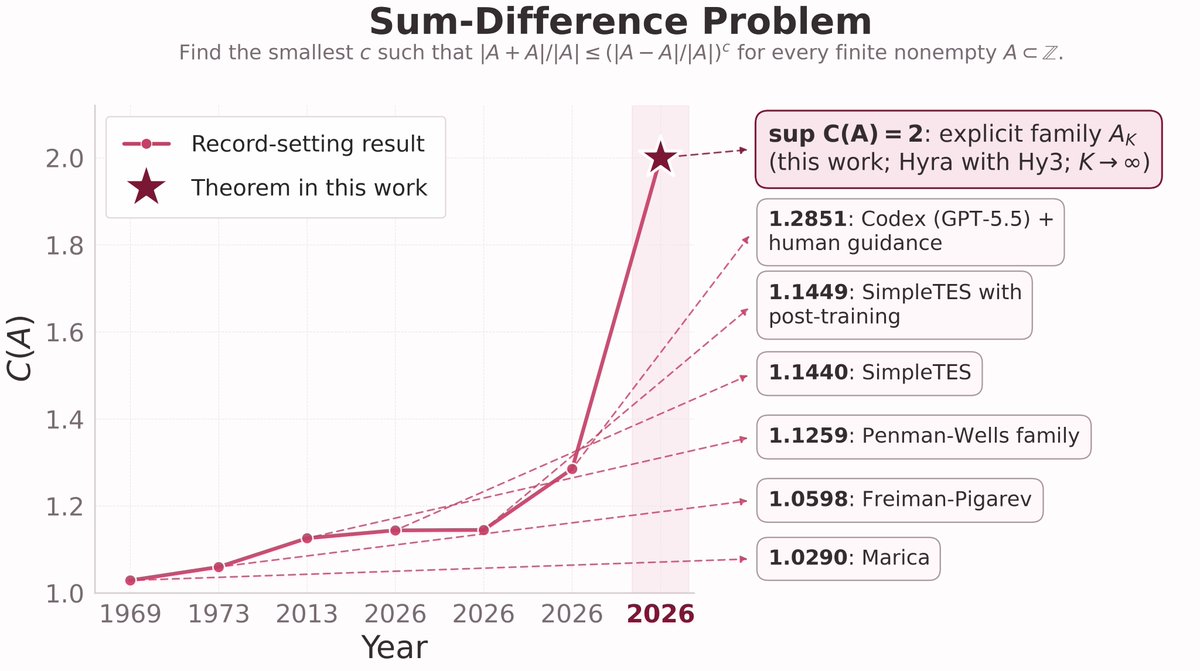
These four claims come from Tencent, written up in papers posted in its own repository, and the README does not say how much of each argument came from the agent and how much from its human team. That differs from Hyra's previous mathematics announcement, the sum-versus-difference exponent result, which settled its problem outright and whose paper described what the agent did and what the researchers checked by hand. Here the supported reading is narrower: each of four open problems has a better proven bound than before, and none of the four questions is closed.
- Agent — A system in which a model repeatedly chooses operations, a harness carries them out, and the results return to the model to inform its next choice.
- Record — One unit of data in a file or table, such as one supplier's quote; distinct from a line of text.
- Function — A named block of instructions that takes inputs, called arguments, and hands back a result, called its return value.