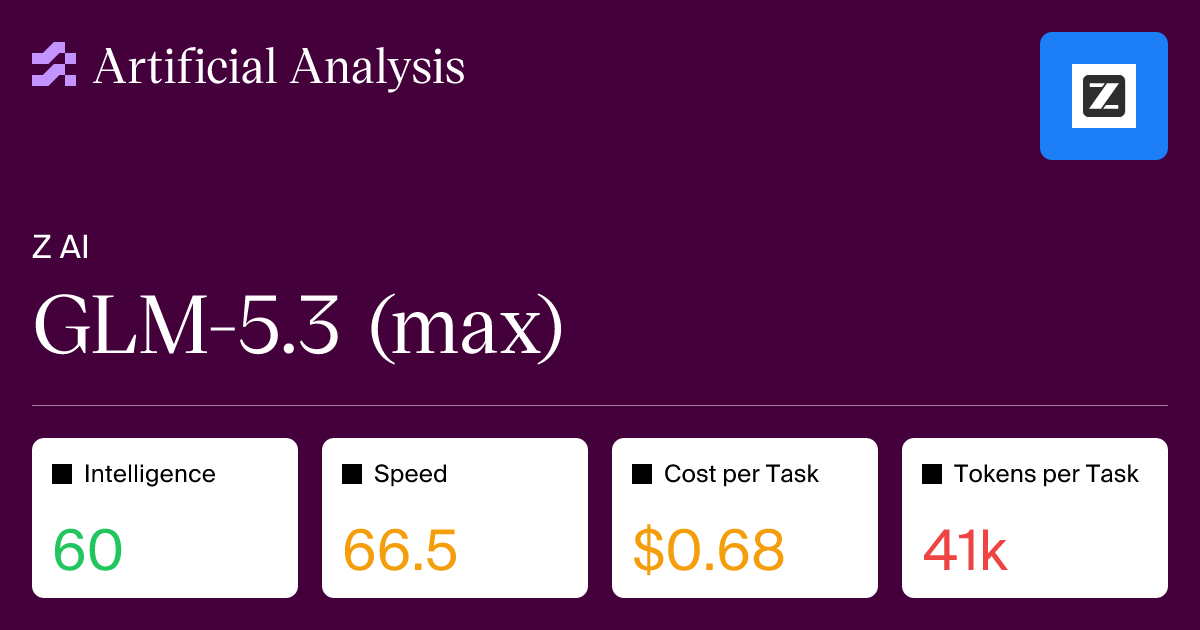
GLM-5 narrows the open versus proprietary gap and posts the lowest hallucination rate tested by abstaining more. Its BF16 weights (~1.5TB) raise self-hosting cost.
Key takeaways · AI-distilled
GLM-5 is Z.ai's first new architecture since GLM-4.5: it grows from 355B total/32B active parameters to 744B/40B and adds DeepSeek Sparse Attention, putting it in the size class of DeepSeek V3 and Kimi K2.
Artificial Analysis attributes the hallucinationWhen a model states something false with full confidence — inventing facts, citations, or APIs that don't exist.Full definition → gain to abstention: GLM-5 declines questions it cannot answer more often, cutting its hallucination rate by 56 points versus GLM-4.7 and lifting its AA-Omniscience score from -36 to -1.
GLM-5 used about 110M output tokens to run the Intelligence Index versus about 170M for GLM-4.7 despite higher scores, though Artificial Analysis says it is still less token-efficient than Claude Opus 4.6.
Third-party APIs serve GLM-5 in FP8 at launch, from $0.8/$2.56 per 1M input/output tokens on DeepInfra to $1/$3.2 on Novita and GMI Cloud; a full Intelligence Index run cost about $547 at median third-party prices.
It is text-only with a 200K context windowThe maximum amount of text a model can consider at once — its working memory for the current conversation or task.Full definition → and an MIT license, and Z.ai says pretrainingThe first, biggest phase of building a model: training it on enormous amounts of text so it learns language, facts, and reasoning in general.Full definition → data grew from 23T to 28.5T tokens; Kimi K2.5 remains the leading open-weights model with image input.
Terms in this piece · Glossary
mixture-of-experts — A model built from many specialist sub-networks where only a few activate per token, giving big-model capability at small-model running cost.
hallucination — When a model states something false with full confidence — inventing facts, citations, or APIs that don't exist.
context window — The maximum amount of text a model can consider at once — its working memory for the current conversation or task.
pretraining — The first, biggest phase of building a model: training it on enormous amounts of text so it learns language, facts, and reasoning in general.