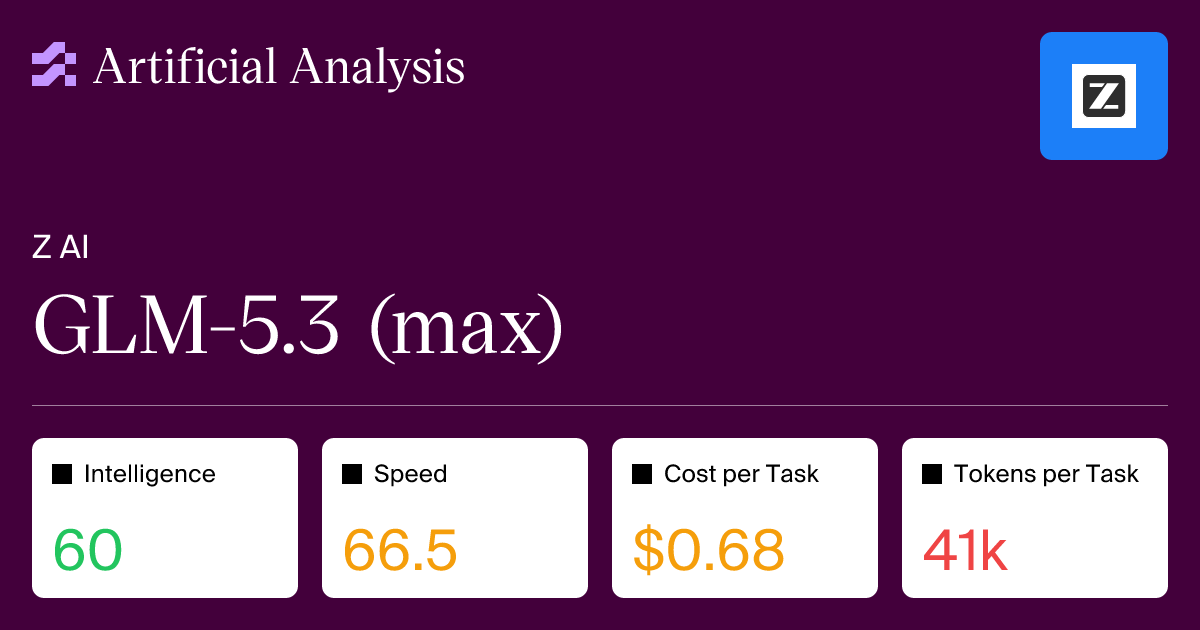
GLM-5.3 achieves 60 on the Artificial Analysis Intelligence Index, on par with K
- Source
- x.com
- Date
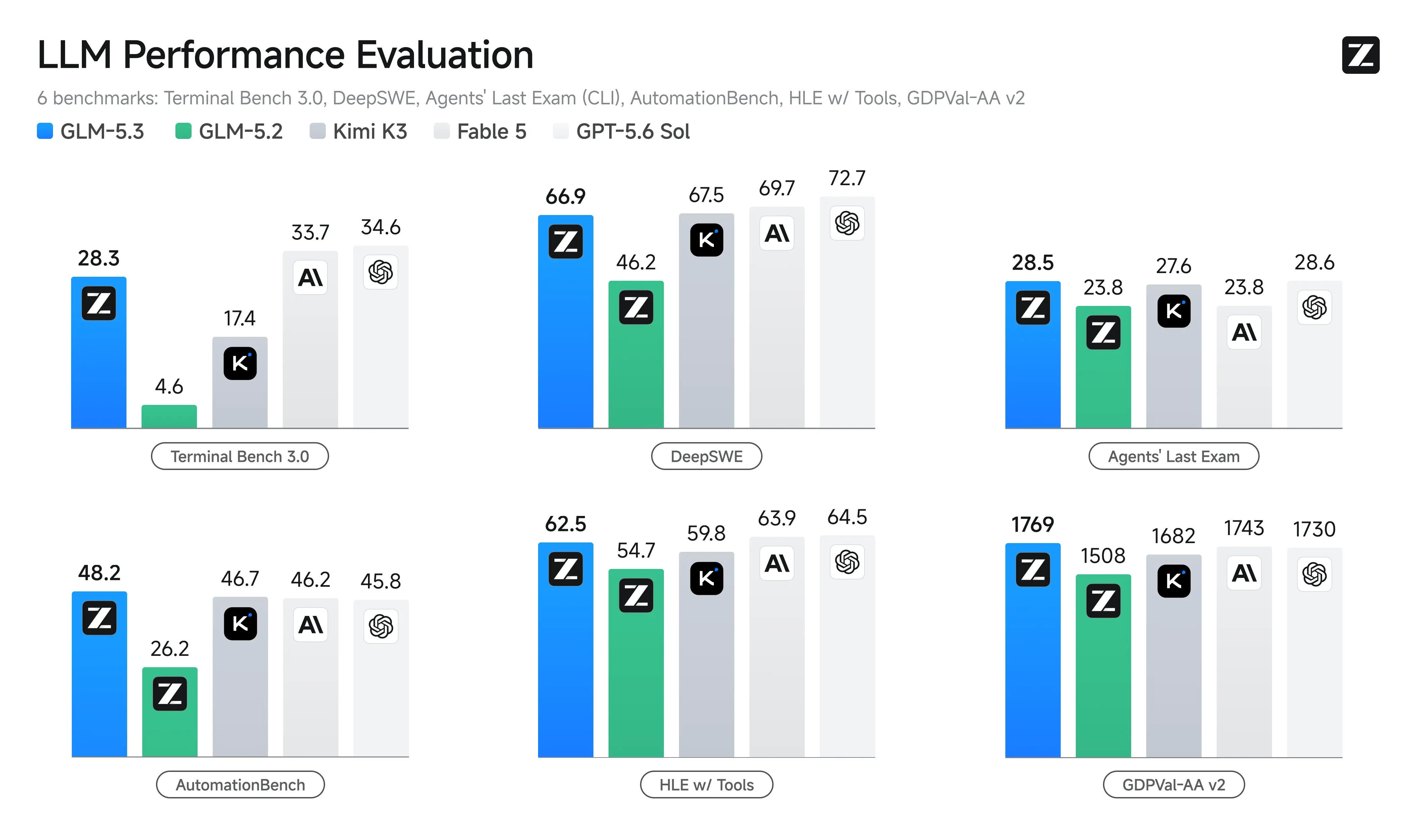
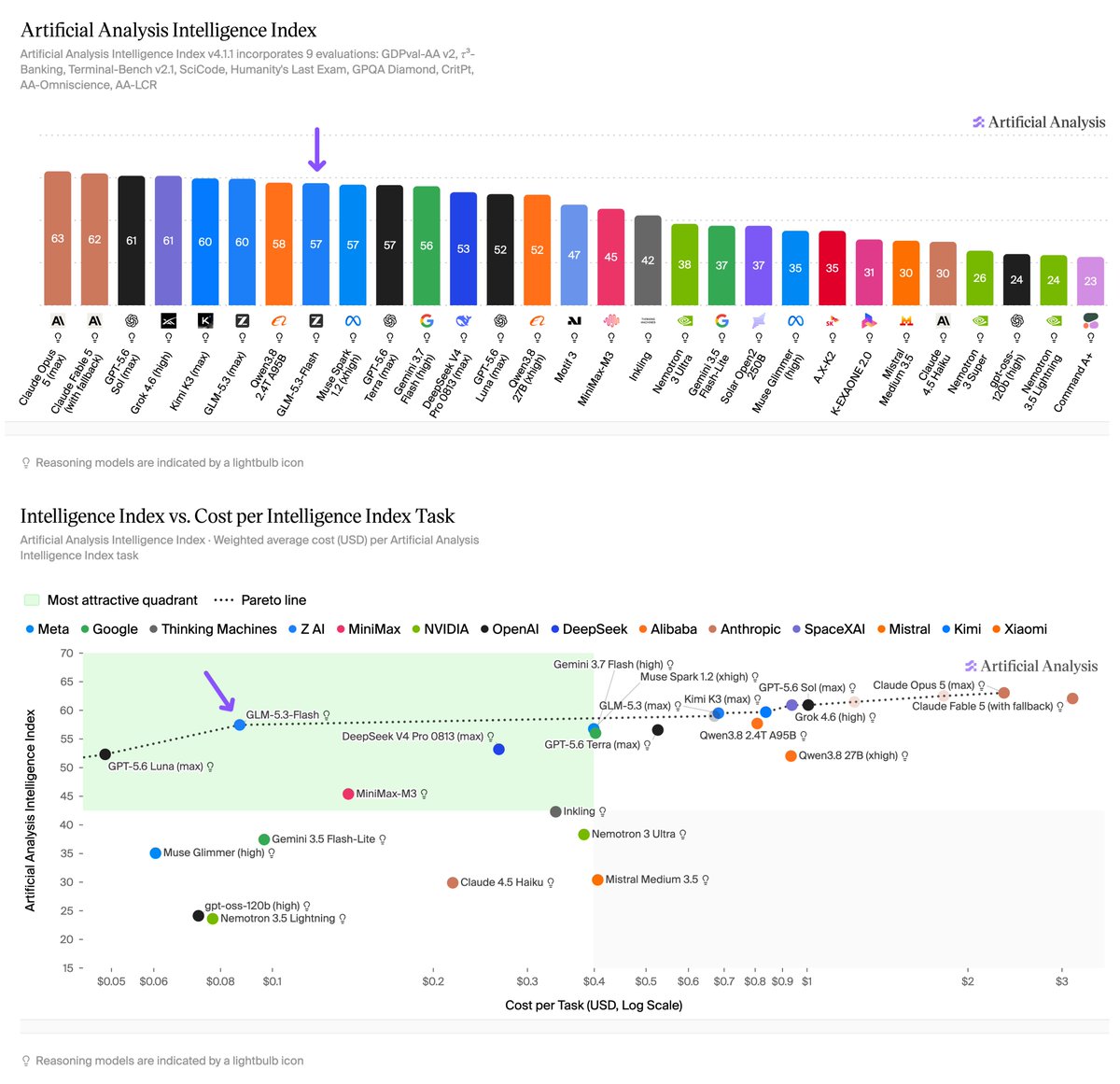
GLM-5.3 achieves 60 on the Artificial Analysis Intelligence Index, on par with Kimi K3 and up 7 points from GLM-5.2. Once the weights are released it will be tied as the leading open weights model @Zai_org has just launched GLM-5.3, which ties Kimi K3 (60) for the most intelligent open weights models on the Artificial Analysis Intelligence Index (assuming weights are released as per Z AI’s guidance). Between Kimi K3 and GLM-5.3, the open weights frontier is closer than ever to the proprietary frontier. GLM-5.3 keeps GLM-5.2's size at 753B total parameters and 40B active parameters. The Z AI team has shared that GLM-5.3’s weights are expected to be released within the next week. Key Takeaways: ➤ GLM-5.3 sees the largest gain in agentic capabilities, placing it amongst frontier models. The model's Elo rating in GDPval-AA v2, our real-world agentic knowledge work evaluation, rises from 1524 to 1770, a 246-point jump. That places GLM-5.3 second among all models, behind only Claude Opus 5 (1855), and surpassing the previous open weights leader on this evaluation, Kimi K3 (1668), by more than 100 points. ➤ GLM-5.3 is less token efficient than its predecessor. Across the Artificial…

Context
Artificial Analysis's August 18 verdict that Z AI's GLM-5.3 tied for best open-weights model, meaning a model whose trained weights anyone can download and run, came with a condition. On the firm's Intelligence Index, a composite score built from its own set of benchmarks, GLM-5.3 scored 60, level with Moonshot AI's Kimi K3 and 7 points above GLM-5.2. The weights were not yet public: the model was available only through Z AI's own API, and the tie assumed Z AI would publish the weights within about a week, as it had said it would (Artificial Analysis on X).
The post found the largest gain in agentic work. On GDPval-AA v2, Artificial Analysis's test of real-world knowledge-work tasks scored as an Elo rating, GLM-5.3 rose from 1524 to 1770, second only to Claude Opus 5 (1855) and more than 100 points ahead of Kimi K3. The model kept GLM-5.2's size, 753 billion parameters in total with 40 billion active, a design in which only part of the network runs for each . The gains cost tokens: about 18,700 output tokens per index task, roughly 20% more than GLM-5.2, and the post names that extra token use as part of why the cost of running the index rose to $0.68 per task from GLM-5.2's $0.44. That was still below Kimi K3 ($0.84) and GPT-5.6 Sol ($1.23). On the AA-Omniscience knowledge test its score rose from 4 to 14, though its rate also rose, from 26% to 30%. The post listed the license as MIT.
Those rankings belong to an index that has since been rebuilt. On October 27, Artificial Analysis launched Intelligence Index v5, which added benchmarks such as FrontierCode 2.0 and Terminal-Bench-Science and removed others, including GDPval-AA v2.1, a later version of the test behind GLM-5.3's biggest jump (Index v5 announcement). In the launch results, GLM-5.3 and DeepSeek V4.1 Flash 1017 shared the top score among models with released weights, 32, against 58 for the leader, Claude Opus 5.5, while Kimi K3.1 Pro, whose weights had not been released, led open-weights models at 46. A day later, Gemini 4 Carbon took first place at 59. The two GLM-5.3 scores are on different scales, because v5 uses a different set of benchmarks and weights, so the drop from 60 to 32 is not evidence that the model got worse. What Artificial Analysis does report is a wider gap between open-weights models and the top of the index: the best open-weights model trailed the leader by 12 points in v5, against 3 in the previous version. Z AI's eventual weights release is covered in a separate item.
- mixture-of-experts — A model built from many specialist sub-networks where only a few activate per token, giving big-model capability at small-model running cost.
- token — The chunk of text a model reads and writes in — roughly three-quarters of a word — and the unit AI usage is billed in.
- hallucination — When a model states something false with full confidence — inventing facts, citations, or APIs that don't exist.
Checking sign-in…
Loading comments…