Token Pooling-Aware Training for Multi-Vector Embedding Models
- Source
- huggingface.co
- Date

Context
A search model can be trained to expect the compression that will later be applied to its index, and in Tom Aarsen's experiment on the Hugging Face blog that recovered more than half of the search quality the compression had cost. The models in question are multi- models such as ColBERT, or those built with the Sentence Transformers library's `MultiVectorEncoder` (explained here earlier). Instead of turning a whole document into one vector, a list of numbers that encodes its meaning, they keep one vector per , roughly one per word piece. At search time each query token picks its best-matching document vector, a rule called MaxSim, and those best matches are added into the document's score. That lets one part of a query match one passage and another part match a different passage, but it makes indexes large. Aarsen's example: 200 vectors per document take 12.8 GB per million documents even with each coordinate stored in 4 bits, against 3.2 GB if each document is cut to 50 vectors.
Token pooling does that cutting by merging token vectors that are already similar. The method in Sentence Transformers uses Ward clustering, which starts with one group per vector and repeatedly merges the two groups whose combination keeps the groups most compact, then replaces each group with its average. With `pool_factor=4`, each document keeps about a quarter of its vectors, and queries are left unchanged. The weakness is that an ordinarily trained model never learned to work with merged vectors, so a distinction that mattered for retrieval can blur when its tokens are averaged together. Pooling-aware training adds that practice: every training batch computes the retrieval loss twice, once with full document vectors and once after pooling to a quarter, and averages the two, so the same encoder is corrected for mistakes it makes in both forms. The library packages this as `MultiVectorTokenPoolingLoss`, a wrapper around an existing retrieval loss. Because the clustering step makes yes-or-no grouping decisions that cannot be learned through directly, training passes the error from each merged vector straight back to the token vectors it was built from.
To measure the effect, Aarsen trained two models from the same starting model, ModernBERT-base, on the same 120,000 MS MARCO training examples with matching settings, so only the loss differed. He scored them on the NanoBEIR retrieval benchmark with nDCG@10, a measure of how well the top ten results are ordered. With pooling to a quarter, which stores 74.8% fewer document vectors than no pooling, the ordinary model scored 49.03 and the pooling-aware model 51.23. That is 94.6% against 97.8% of each model's own unpooled score. The pooling-aware model also scored slightly higher without pooling, 52.39 against 51.84, so the extra objective did not cost full-size quality in this run. The advantage held at settings the model was not trained on, including fixed caps per document and merge-distance thresholds to an average vector count. It was largest at the harshest cap of four vectors per document, 43.00 against 37.22.
This is one matched pair of runs with one random seed and no hyperparameter search, scored on one benchmark, so the size of the gain is an observation rather than a general rule. The post builds on earlier pooling-aware work by Stefan Josef and LightOn. Its practical contribution is that the method is now a few lines added to a standard training script. For a team whose index size is what limits a multi-vector deployment, with the pooled loss is a cheap experiment: the pooled version reuses the token vectors already computed, adding clustering and scoring work but no second pass through the model.
- Pooling-aware training averages two retrieval losses per batch: one on full document vectors and one after merging each document to about a quarter of its vectors. Tom Aarsen likens it to Matryoshka training, applied to the number of token vectors instead of their width.
- In Aarsen's comparison of two ModernBERT-base models trained once on the same 120,000 MS MARCO triplets, with no hyperparameter search, pool_factor=4 kept 97.8% of unpooled NanoBEIR nDCG@10 with pooling-aware training versus 94.6% ordinarily, with 74.8% fewer vectors.
- The gain was largest under heavy compression and carried over to settings never trained on: at a hard cap of 4 vectors per document, the pooling-aware model scored 43.00 nDCG@10 against 37.22, and calibrated adaptive thresholds gained 1.1 to 2.6 points.
- Sentence Transformers' HierarchicalTokenPooling merges similar token vectors with Ward clustering and averages each group, pooling only documents and keeping the first token by default. Cluster choices are discrete, so training passes gradients via a straight-through estimator.
- At 4-bit residuals, 200 vectors of 128 dimensions cost 12.8 KB per document, or 12.8 GB per million documents; pooling to 50 vectors cuts that to 3.2 GB. For index size, Aarsen would quantize first, then pool tokens, then consider Matryoshka dimension cuts.
- embedding — A list of numbers representing a piece of text's meaning, so that similar meanings end up numerically close and can be searched.
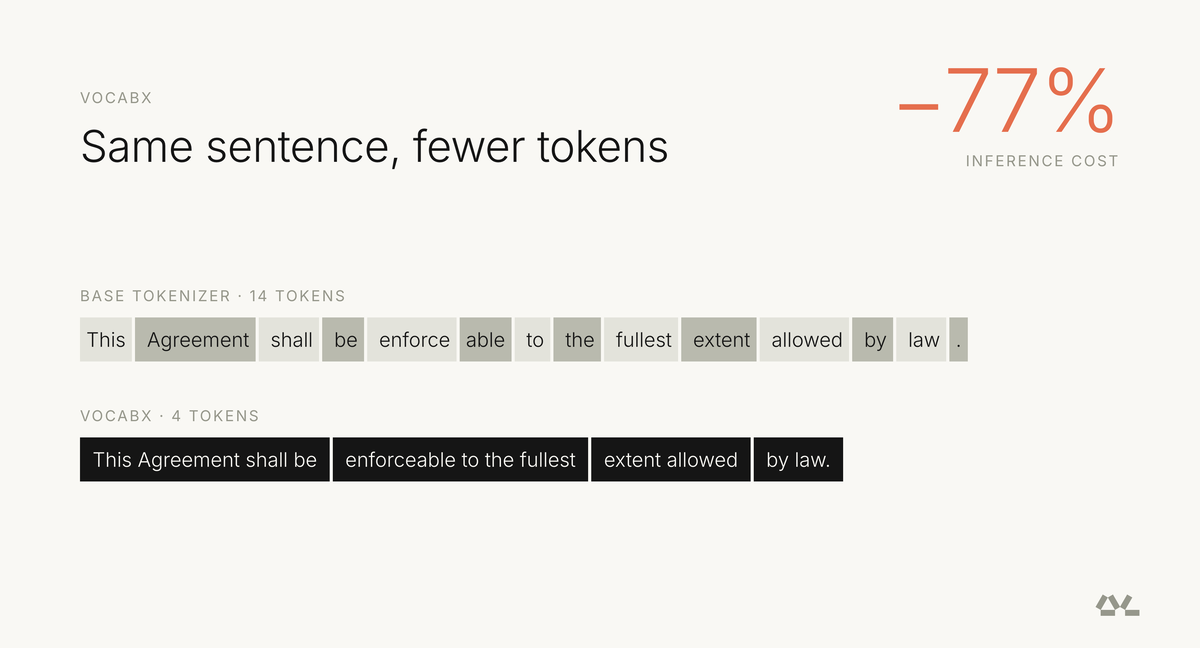
- token — The chunk of text a model reads and writes in — roughly three-quarters of a word — and the unit AI usage is billed in.
- calibration — How well a model's confidence matches reality — a calibrated model saying "90% sure" is right about 90% of the time.
- fine-tuning — Taking a trained model and training it a bit more on your own examples so it gets better at one specific job.
 articleTraining and Finetuning Multi-Vector Embedding Models with Sentence Transformershuggingface.co
 articleMulti-Vector (Late Interaction) Embedding Models with Sentence Transformershuggingface.co
 articleHow Specializing the Vocabulary of SLMs Can Cut Inference Cost by 77% in Real Applicationshuggingface.co
Checking sign-in…
Loading comments…