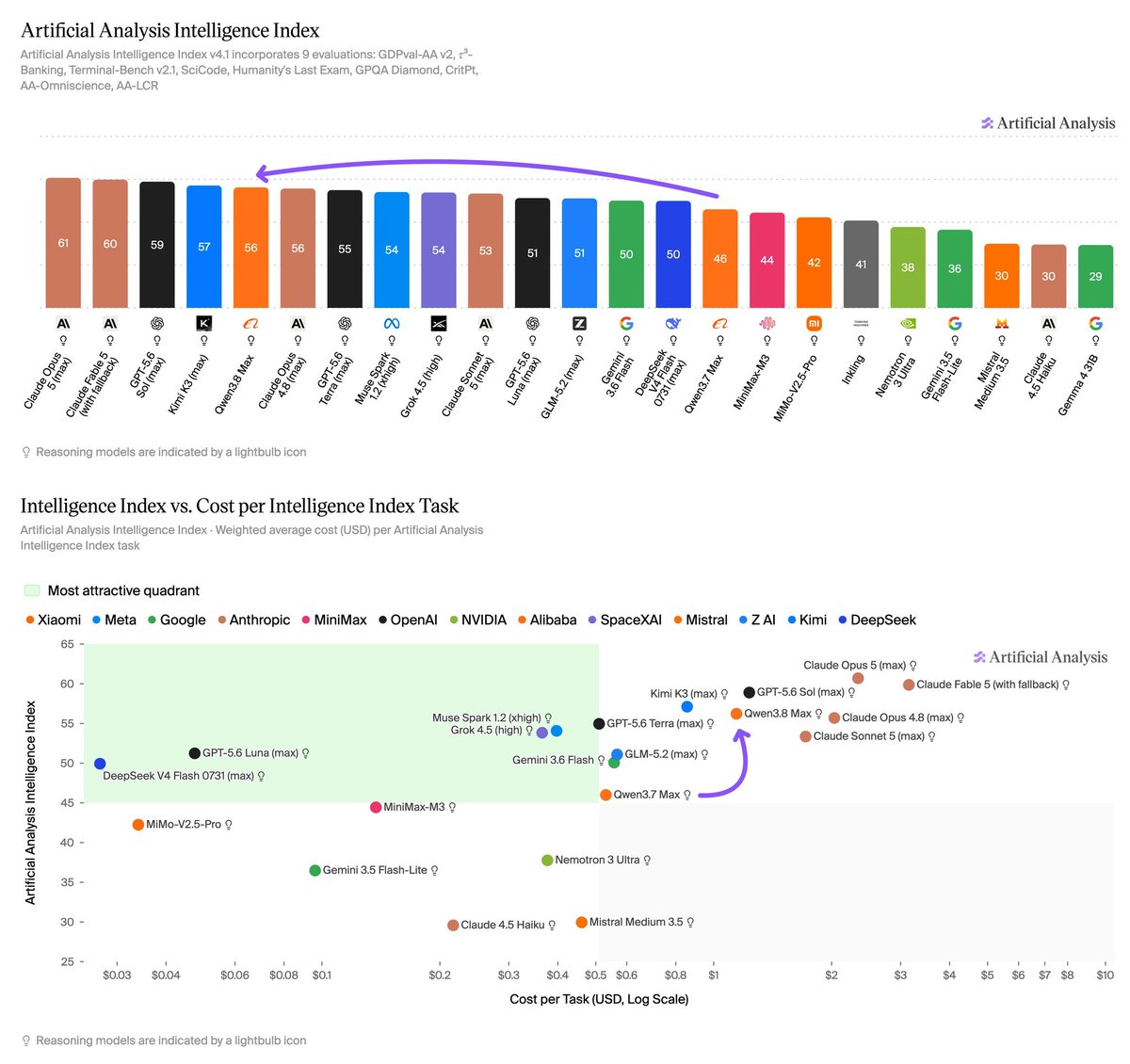
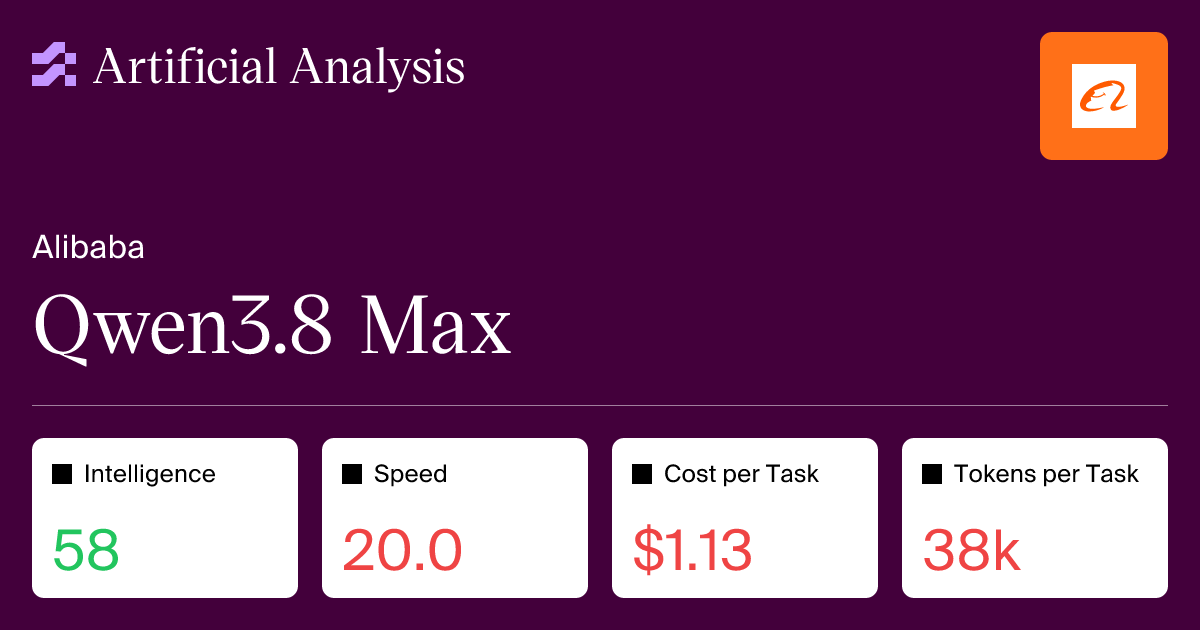
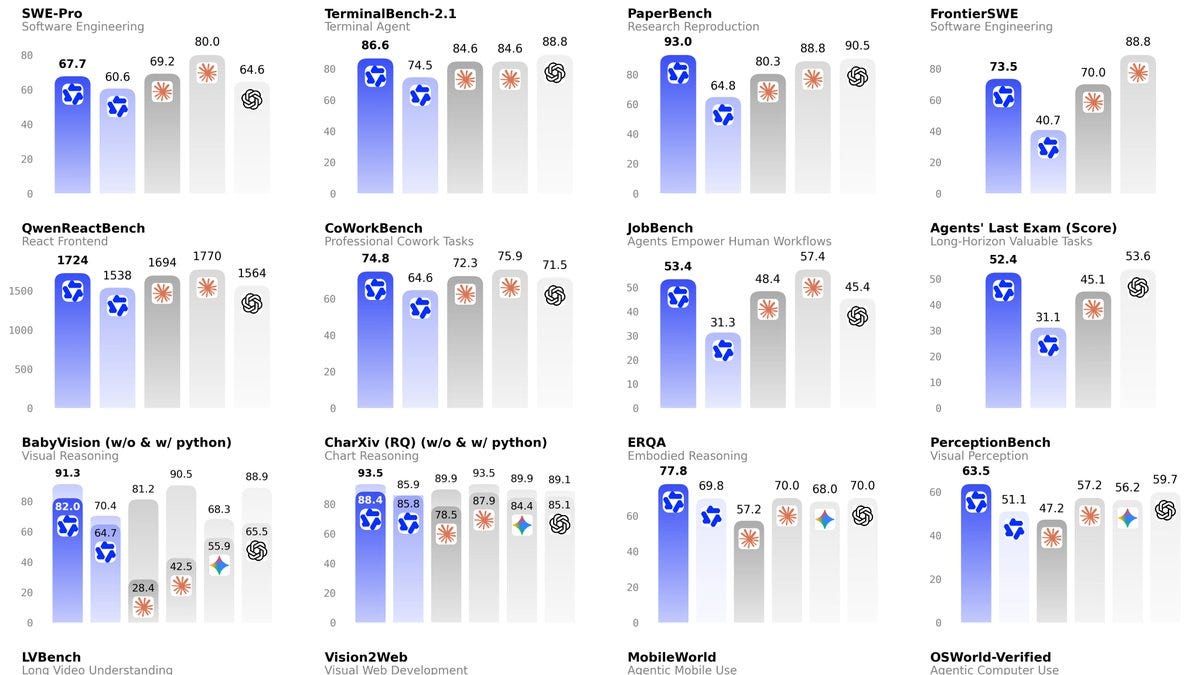
Qwen3-Max-Thinking scores 40 and is closed-weight, trailing open models like Kimi K2.5 at similar or lower cost. It helps decide whether the paid API is worth it.
Key takeaways · AI-distilled
Most of the 8-point gain over the Preview comes from general reasoning and instruction following: Humanity's Last Exam doubles to 26%, and IFBench rises from 54% to 71%, ahead of Kimi K2.5 (70%) and GLM-4.7 (68%).
On GDPval-AA, run with shell and web access through Artificial Analysis's open-source Stirrup agent harnessThe scaffolding around a model that turns it into a working agent — the loop, the tools it can call, and the rules for when to stop.Full definition →, its Elo rises from 958 to 1170, still behind GLM-4.7 (1192), DeepSeek V3.2 (1186) and Kimi K2.5 (1316).
tokenThe chunk of text a model reads and writes in — roughly three-quarters of a word — and the unit AI usage is billed in.Full definition → use nearly tripled from the Preview: 86M output tokens (79M of them reasoning) to run the Intelligence Index versus 30M, in line with Kimi K2.5 (89M) and well below GLM-4.7 (167M).
Pricing scales with input length: $1.2/$6 per 1M input/output tokens up to 32K input, $2.4/$12 for 32K-128K and $3/$15 for 128K-256K. It is text-only, with a 256K context windowThe maximum amount of text a model can consider at once — its working memory for the current conversation or task.Full definition →, via Qwen Chat and Alibaba Cloud.
Terms in this piece · Glossary
agent harness — The scaffolding around a model that turns it into a working agent — the loop, the tools it can call, and the rules for when to stop.
token — The chunk of text a model reads and writes in — roughly three-quarters of a word — and the unit AI usage is billed in.
context window — The maximum amount of text a model can consider at once — its working memory for the current conversation or task.