Compare Qwen3.8 Max with other leading models at:
- Source
- x.com
- Date
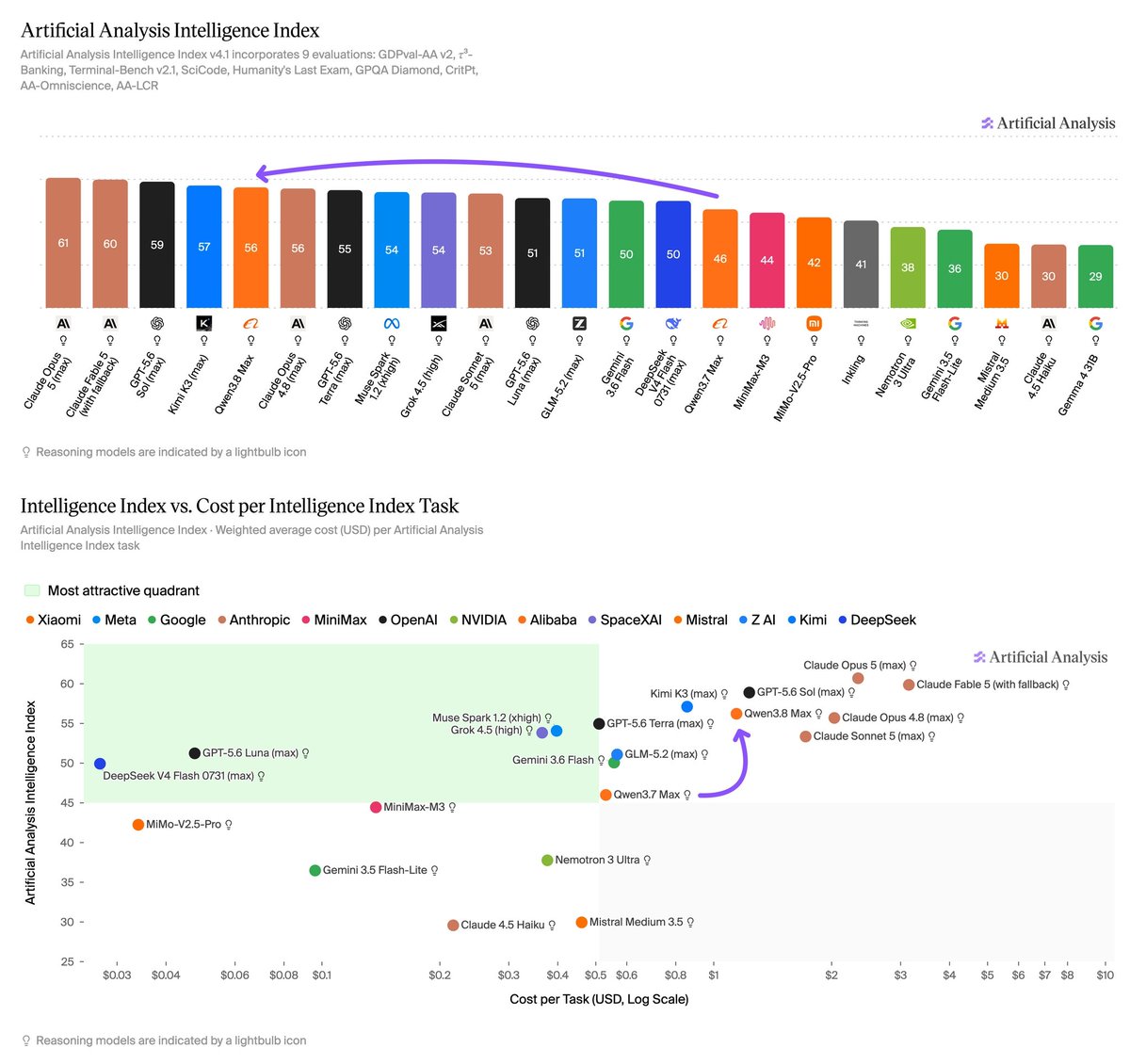
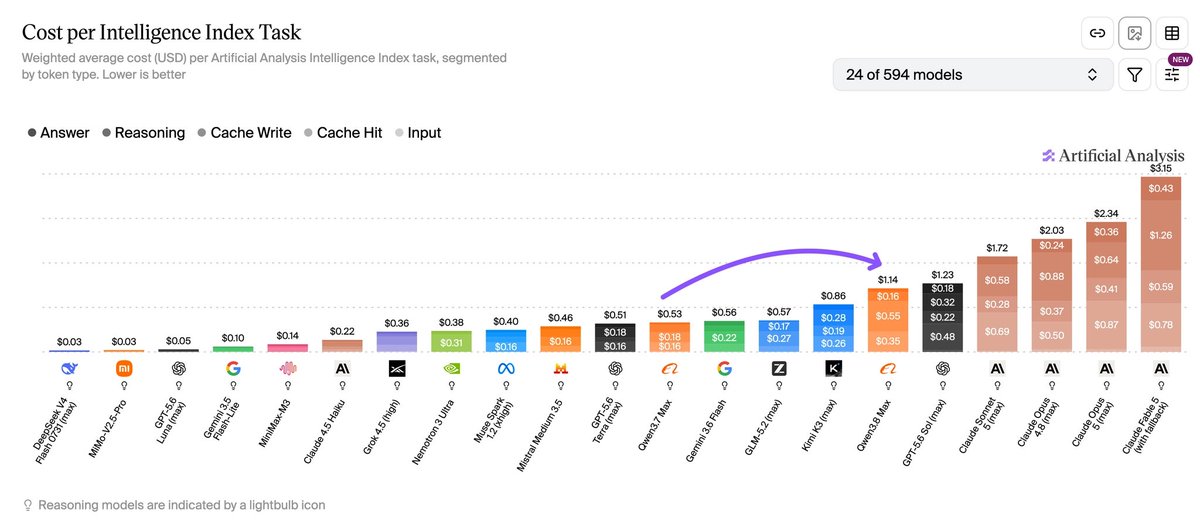
Alibaba's Qwen3.8 Max scores 56 on the Artificial Analysis Intelligence Index at $1.14 per task, but open weights leader Kimi K3 remains 1 point ahead at 25% lower cost per task ($0.86) @Alibaba_Qwen has released Qwen3.8 Max, which Alibaba states is a 2.4T total parameter MoE activating 95B parameters per forward pass. Alibaba has announced it plans to release the weights next week, a shift in strategy as it has typically kept its Max class of models proprietary. Once released, Qwen3.8 Max would be ~6x larger than Alibaba's largest open weights release to date (Qwen3.5 397B) and the second largest open weights model behind Kimi K3 (2.8T) Note: we earlier published results showing Qwen3.8 Max scoring 53 on the Artificial Analysis Intelligence Index. Those runs were affected by intermittent issues on the endpoint we were evaluating, and we have re-run all evaluations on Alibaba's public API endpoint Key takeaways: ➤ Qwen3.8 Max scores 56 on the Artificial Analysis Intelligence Index, up 10 points from Qwen3.7 Max (46). It is in line with Claude Opus 4.8 (max, 56) and sits second among labs from China, ahead of GLM-5.2 (max, 51) but behind Kimi K3 (max, 57) ➤ Qwen3.8 Max scores 1739 Elo on GDPval-AA, a 468 Elo gain over Qwen3.7 Max. This places it ahead of Kimi K3 (1685), effectively tied with Claude Fable 5 (1743) and GPT-5.6 Sol (max, 1730), and behind only Claude Opus 5 (max, 1852) ➤ Gains over Qwen3.7 Max span agentic evaluations, scientific reasoning and coding: Terminal-Bench v2.1 +6 points, CritPt +7 points, SciCode +4 points and HLE +3 points, with GPQA unchanged. AA-LCR (-2 points) and AA-Omniscience (-10 points, driven by a hallucination rate rising 23% to 40%) regress ➤ Qwen3.8 Max costs $1.14 per Intelligence Index task, more than double Qwen3.7 Max ($0.53), at ~1.3x Kimi K3 (max, $0.86) and ~2x GLM-5.2 (max, $0.57). Cost is driven in part by more turns on agentic evaluations, with GDPval-AA input tokens rising ~15x over Qwen3.7 Max, and output token usage up 45% to 145M ➤ The 𝜏³-Bench Banking result (42%) appears out of distribution. It is a 32 point gain over Qwen3.7 Max and places Qwen3.8 Max ahead of models that outscore it on other evaluations Key model details: ➤ Size: 2.4T total parameters, ~95B active per forward pass (MoE) ➤ Context window: 1M tokens ➤ Multimodal: text, image and video input with text output ➤ Pricing: $2.00/$6.00 per 1M input/output tokens on the @alibaba_cloud first-party API, with a $0.25 cache hit price. This is lower than Qwen3.7 Max across the board ($2.50/$7.50, with a $0.50 cache hit price) ➤ Availability: Alibaba Cloud first-party API. Alibaba states the weights will be released next week

Compare Qwen3.8 Max with other leading models at: https://t.co/huhhuqIAX8
Context
Alibaba's Qwen3.8 Max made a large jump in measured capability at launch, but it cost more than twice as much as its predecessor to run Artificial Analysis's tests, even though its per-token prices went down. In an August 6 thread, the firm scored the model 56 on its Intelligence Index, a composite of evaluations, up 10 points from Qwen3.7 Max. That matched Anthropic's Claude Opus 4.8 and placed it second among labs from China, one point behind Moonshot AI's Kimi K3. The 56 is a corrected figure: an earlier published run gave 53, which the firm put down to intermittent problems with the endpoint it had tested, so it re-ran every evaluation on Alibaba's public .
The largest gain was in agentic knowledge work. On GDPval-AA, where AI judges compare models' output files from tasks across 44 occupations, Qwen3.8 Max rose 468 Elo points to 1739, behind only Claude Opus 5 and level with Claude Fable 5 and OpenAI's GPT-5.6 Sol. -Bench, the CritPt physics test, SciCode and Humanity's Last Exam also improved. Two tests went backwards: a long- reasoning test fell 2 points, and AA-Omniscience, a factual-knowledge test that penalizes wrong answers, fell 10 points as the rate rose from 23% to 40%. Artificial Analysis also flagged the model's 42% on a banking customer-support test, a 32-point jump, as out of line with its other results.
The extra capability came with much heavier usage. Alibaba lowered the price to $2.00 per million input tokens and $6.00 per million output tokens, from $2.50 and $7.50, yet the cost of an average Intelligence Index task rose from $0.53 to $1.14, about 1.3 times Kimi K3's $0.86. Artificial Analysis attributes the rise in part to the model taking more turns on agentic evaluations: its input tokens on GDPval-AA rose about fifteenfold, and its output token usage rose 45% to 145 million. A per-token price is therefore a poor guide to what this model costs on agentic work, because the cheaper rate is spread over many more tokens.
Two things changed after the thread. Alibaba said it would release the weights the following week, unusual for its Max models, and NVIDIA's later post on serving Qwen3.8-2.4T-A95B describes them as released. And the thread's comparison link now opens a page for a later snapshot, Qwen3.8 Max (0902), released September 2 and scored 34 on version 5.0.1 of the index, which Artificial Analysis rebuilt in October with a different set of evaluations. That figure measures a different snapshot on a different suite, so it says nothing about whether the August model's 56 held up.
- API — Application programming interface: the agreed set of operations, inputs and outputs through which one piece of software uses another.
- Terminal — A program that shows text and accepts typed text.
- Context and context window — Context is the information available for a generation; the context window is the capacity available to hold it.
- Hallucination — Generated content that is false or unsupported, even when it sounds plausible.
Checking sign-in…
Loading comments…