Liquid AI Brings Speculative Decoding to LFM2.5-VL-3B
- Source
- x.com
- Date

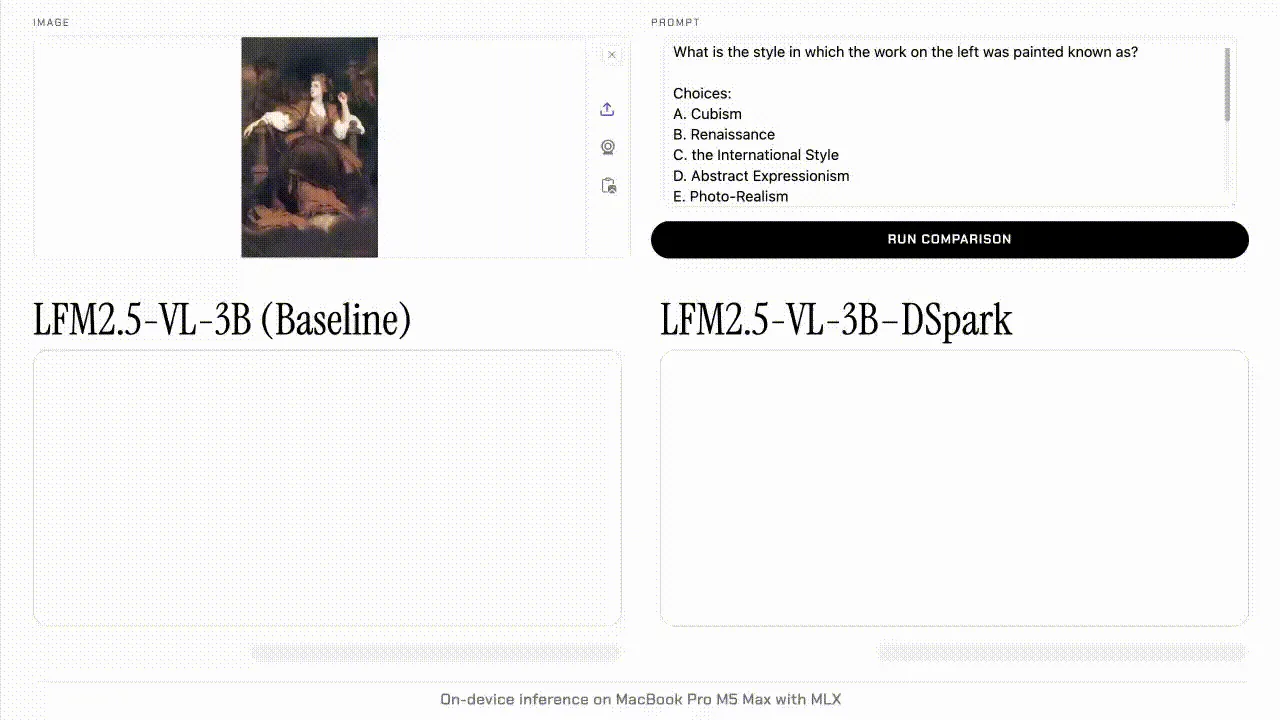
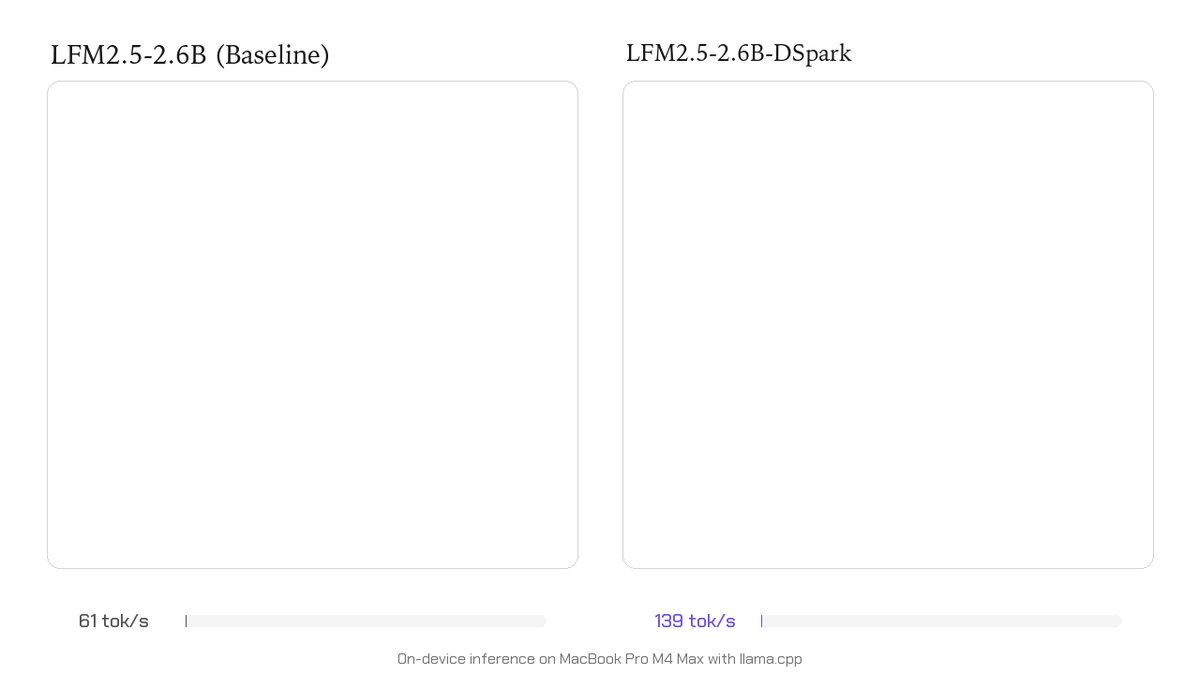
Today, we release an experimental DSpark draft model for LFM2.5-VL-3B, bringing speculative decoding to our vision-language models. A lightweight drafter proposes multiple tokens ahead, and the target model verifies them together in a single pass. This accelerates generation without changing output quality. Across six vision-language task categories at batch size 1 and temperature 0: > MLX on M5 Max: up to 3.13x faster decoding and 2.62x end to end > llama.cpp on M3 Ultra: up to 2.14x faster decoding and 1.77x end to end > SGLang on H100: up to 2.66x faster decoding and 2.27x end to end All evaluations were collected using Pipette, the benchmarking infrastructure behind Liquid AI's public device-performance data. 🧵

Context
Liquid AI has made its vision- LFM2.5-VL-3B, which reads images as well as text, generate answers faster without, Liquid says, lowering output quality. Liquid released an experimental DSpark draft model for it, which brings a technique called to its vision-language models. A model normally produces its answer one , roughly a word fragment, at a time. With speculative decoding, a lightweight drafter guesses several tokens ahead and the full model checks them together in a single pass. Because the full model still verifies every token, Liquid says output quality is unchanged.
Liquid measured the gain across six vision-language task categories, one request at a time, known as batch size 1, and with temperature 0, the setting where the model always picks its most likely next token. It reports up to 3.13x faster decoding and 2.62x end to end with MLX on an M5 Max, up to 2.14x and 1.77x with llama.cpp on an M3 Ultra, and up to 2.66x and 2.27x with SGLang on an H100 GPU. The end-to-end figures cover the whole request rather than only token generation, and they are lower in every case, so the speedup a user notices is smaller than the headline decoding number.
This extends DSpark drafts that Liquid released for three LFM2.5 models in August. Liquid collected the numbers with Pipette, its evaluation suite for on-device models built in partnership with Artificial Analysis. They are still Liquid's own measurements of a release it labels experimental, and they are reported as maximums.
- LLM — A large language model — the neural network behind tools like Claude and ChatGPT, trained on huge amounts of text to predict what comes next.
- speculative decoding — A speed trick where a small model drafts several tokens ahead and the big model verifies them in one pass, often doubling generation speed.
- token — The chunk of text a model reads and writes in — roughly three-quarters of a word — and the unit AI usage is billed in.
- eval — A repeatable test for AI quality — a set of tasks plus scoring — used the way software teams use test suites, because model output is too variable to judge by eyeballing.
Checking sign-in…
Loading comments…