SERPO: Self-Evolving Rubric Policy Optimization for Open-Ended Test-Time Reinforcement Learning
- Source
- arxiv.org
- Author
- Jianze Wang, Kunwang Zheng, Ying Liu, Yu Cao, Qilong Zhang, Jinlong Chen, Hua Yang, Qianglong Chen
- Date
Context
SERPO studies how an AI model can improve on open-ended questions when there is no single answer to vote for. It organizes its generated responses into quality groups, develops question-specific criteria that distinguish those groups, and uses the resulting scores to update the model's parameters. New responses then refresh both the examples and the criteria, creating a repeated loop. Method abstract.
Across two model configurations and six benchmarks, the authors report an improvement of up to 8.06 points in the average score over the corresponding base models. The result supports self-generated criteria as a possible training signal for open-ended tasks. Those scores measure benchmark performance, not independent confirmation that the model's own judgments are always correct. Reported evaluation.
- Training — The process that adjusts a model using examples and a measure of how well it performs.
- Benchmark — A fixed set of tasks with a stated way of scoring them, used to compare models or setups.
- eval — A repeatable test for AI quality — a set of tasks plus scoring — used the way software teams use test suites, because model output is too variable to judge by eyeballing.
- Token — A piece of text, such as a word, part of a word or a punctuation mark, that a language model represents as numbers and handles as a unit.
 articleInducing Reward-Free Judging Rubrics that Reduce Over-Crediting in Agent EvaluationDarragh Quinn, David Dylan, Roisin Healy, Fionn Carroll, Maeve Donnelly, Cormac Sheehan
- postSDPO Trains Models With Natural-Language Feedback Instead of Scalar RewardsStanford AI Lab
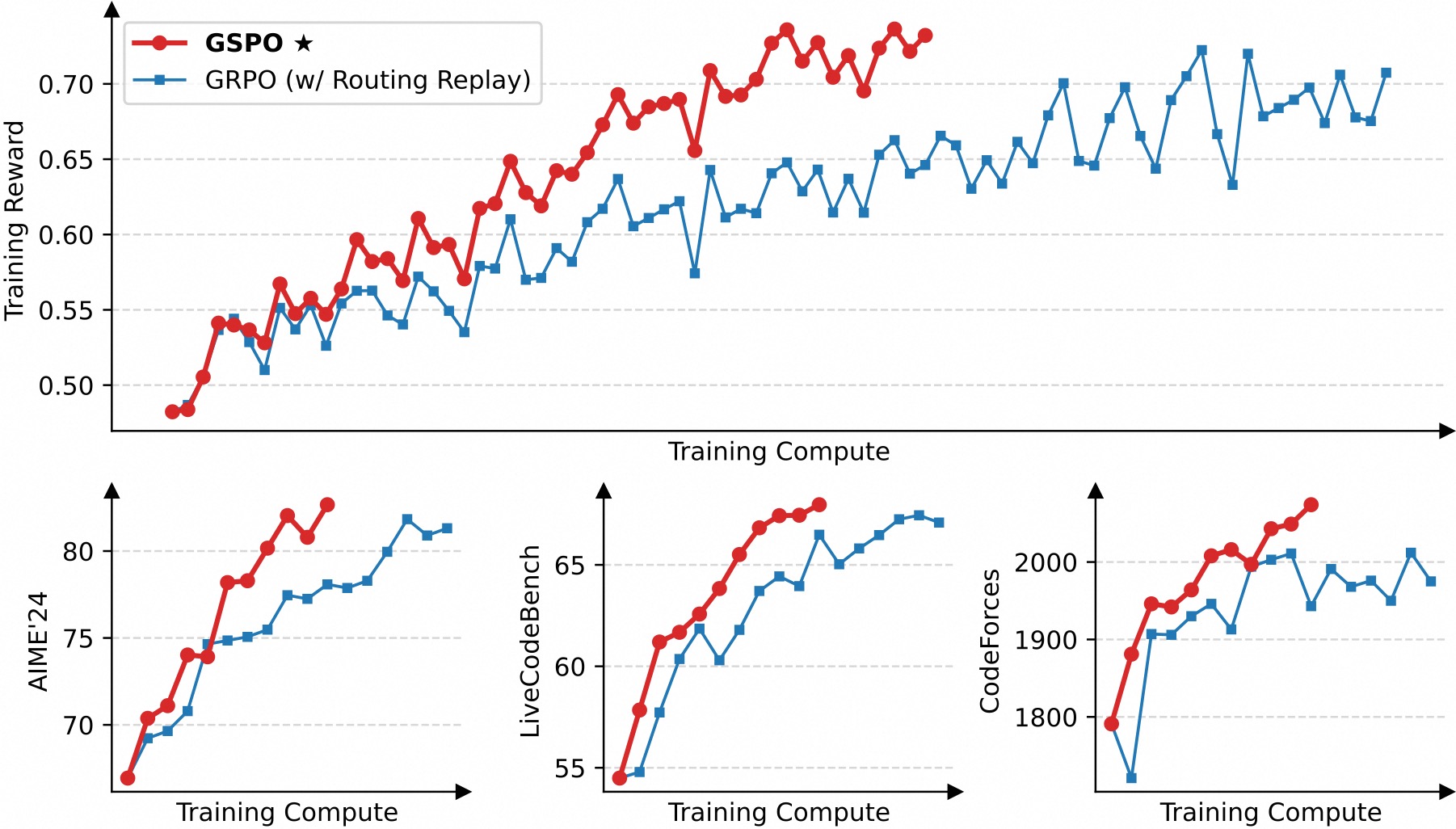 articleGSPO: Towards Scalable Reinforcement Learning for Language ModelsQwen Team