tokenizers v1: encode, decode and scaling, measured
Source
huggingface.co
Date
Key takeaways · AI-distilled
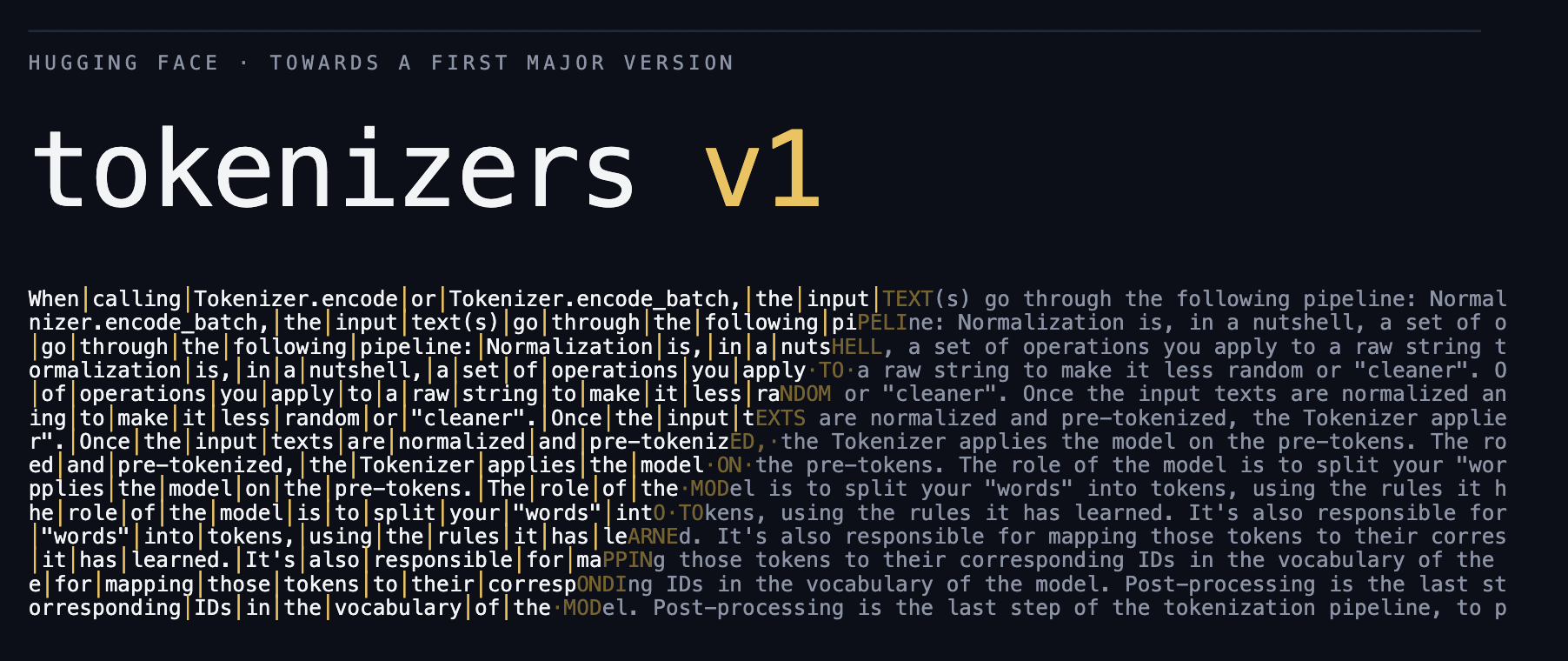
The speedup comes from 'bitcannon': a hand-written splitter using SIMD bitstream operations (covering GPT-2, cl100k, o200k, Tekken, DeepSeek patterns) replaces the regex engine used to find pre-tokenThe chunk of text a model reads and writes in — roughly three-quarters of a word — and the unit AI usage is billed in.Full definition → boundaries, deciding 64 bytes per register operation.
A thread-local word cache maps each pre-token's bytes to its finished token IDs so a repeated word is merged only once; the benefit scales with how many pre-tokens actually repeat in the input, so it helps less on inputs with few repeats.
The merge loop was rewritten around a caller-owned scratch buffer and an intrusive doubly-linked list, avoiding per-call allocator hits; each candidate pair is packed into one 64-bit value so 'no merge here' becomes a branchless integer comparison.
Across ten model families, v1 encodes 3 to 30 times faster than v0.23 single-threaded on an Apple M4 Max (t5-base slowest, gpt2 fastest), scaling at 76% of linear across eight workers, while producing byte-identical token IDs to the old release.
Training support is behind a default-on Cargo feature that pulls in a C++ dependency; encode-only users can drop it with 'cargo add tokenizers --pre --no-default-features --features http' to avoid that dependency entirely.
Terms in this piece · Glossary
LLM — A large language model — the neural network behind tools like Claude and ChatGPT, trained on huge amounts of text to predict what comes next.
token — The chunk of text a model reads and writes in — roughly three-quarters of a word — and the unit AI usage is billed in.