Eleven Sakana AI papers at ICML 2026, from sparse memory to agent benchmarks
- Source
- x.com
- Date

Sakana AI is heading to #ICML2026 in Seoul (July 6–11)! 🐟🇰🇷 Our team will present 11 papers spanning multi-agent coordination, sparse and efficient LLMs, test-time scaling, long-term memory, and agent benchmarks. A thread of everything we're presenting:

"How Small Can a Tandem Speech Front-End Be? Diagnosing Front-End Capacity with Layer Removal" will be presented at the Workshop on Machine Learning for Audio on July 10 at #ICML2026 Link: https://t.co/5KC0s6vln7 Recent tandem speech-to-speech (S2S) dialogue systems delegate knowledge and reasoning to a back-end LLM, leaving a front-end S2S transformer to handle low-latency spoken interaction. This raises a practical capacity question: how small can the front-end become, what performance is preserved, and how does its behavior change as layers are removed? To diagnose this, we randomly remove different numbers of layers from a KAME-style front-end transformer, fine-tune each variant on the same data, and evaluate on speech MT-Bench.

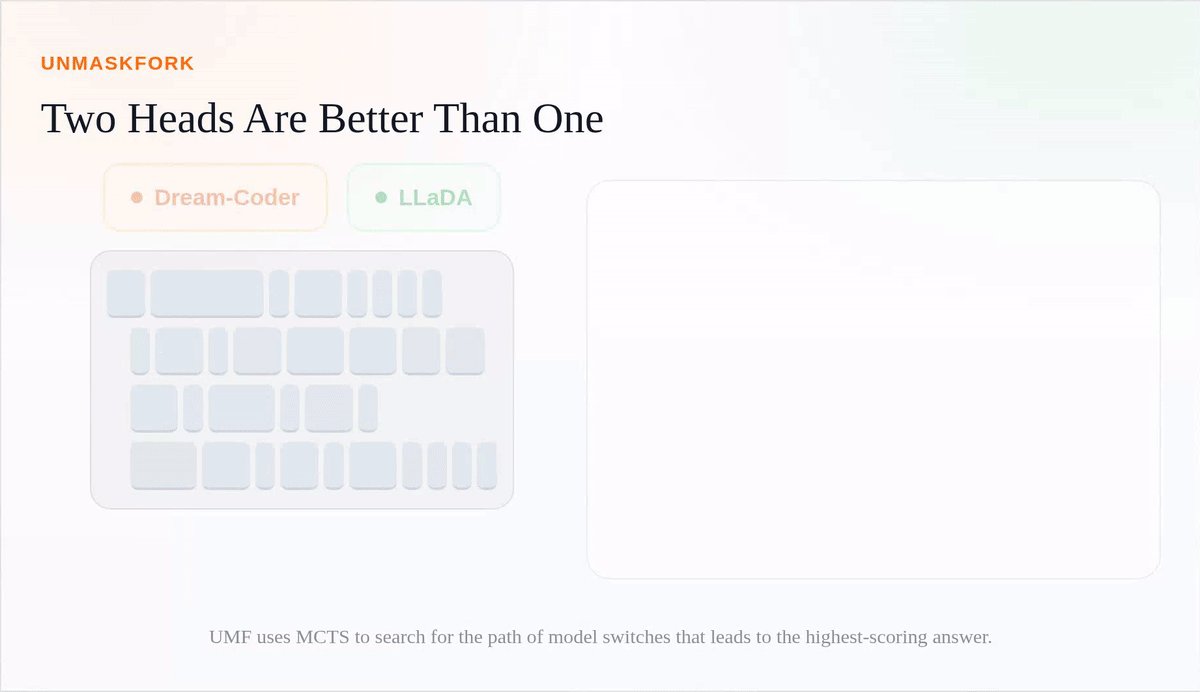
"UnMaskFork: Test-Time Scaling for Masked Diffusion via Deterministic Action Branching" will be presented at #ICML2026 Paper: https://t.co/4JC9SYdTyX We introduce UnMaskFork, a test-time scaling framework for Masked Diffusion Language Models (MDLMs). Using Monte Carlo Tree Search, it explores diverse generation paths by dynamically switching between multiple pre-trained MDLMs to collaboratively generate the text. Evaluations on coding and mathematical reasoning tasks show that UnMaskFork consistently outperforms standard Best-of-N and other tree search baselines. The results demonstrate that deriving search space diversity from multiple distinct models is a highly effective test-time scaling strategy for MDLMs.

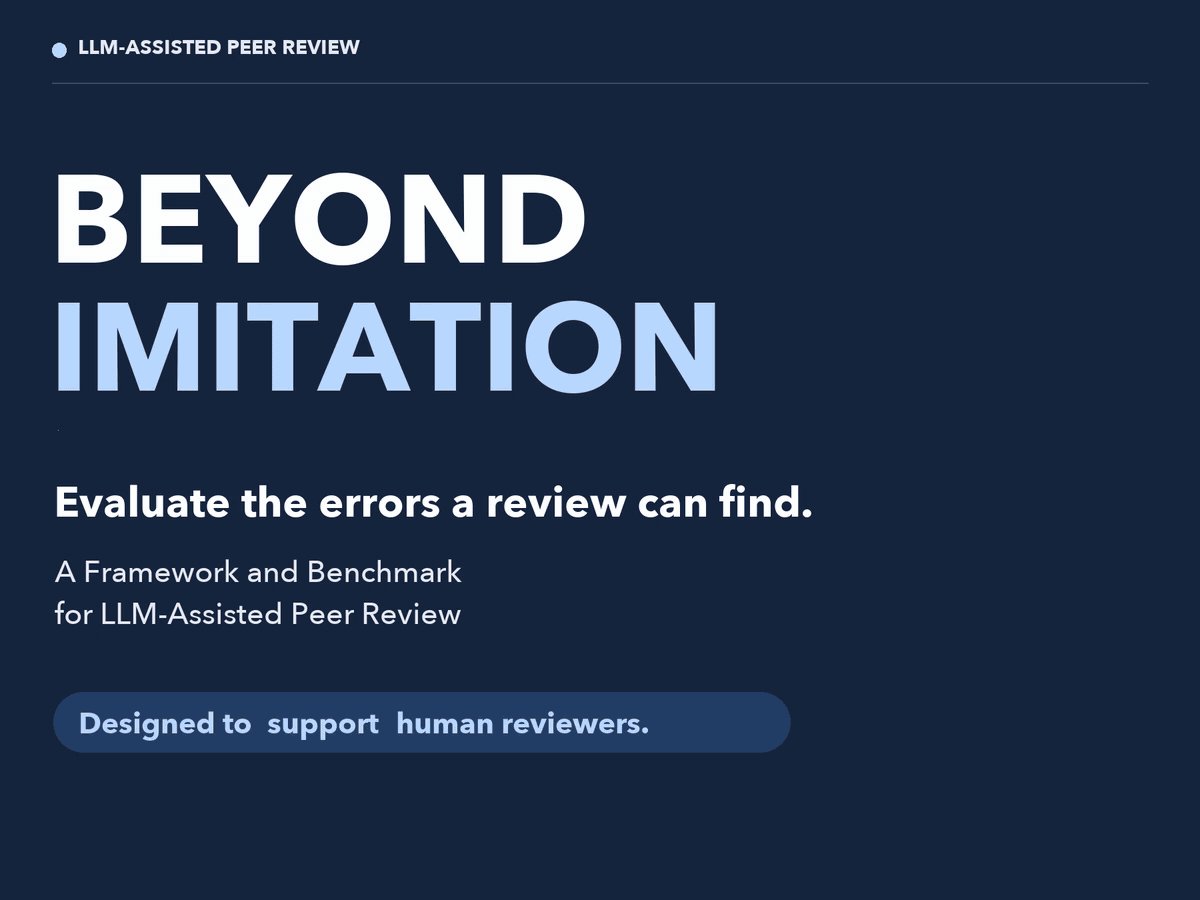
"Feedback-to-Rubrics: Can We Extract Expert Criteria from Inline Comments?" will be presented at the Workshop on Human-AI Co-Creativity: Advances, Opportunities, and Challenges on July 11 at #ICML2026 Paper: https://t.co/MPfNX6l2z1 (Extended full-paper version) LLMs are increasingly used for writing and review support, but their usefulness depends on context-dependent criteria, such as expert preferences or organization-specific conventions, that are often tacit, undocumented, and difficult to elicit directly. We propose a problem setting for learning reusable natural-language rubrics from accumulated inline comments on artifacts such as human-written or LLM-generated drafts.

Context
One practical question in Sakana AI's 11-paper ICML 2026 announcement concerns how writing assistants could learn standards that reviewers rarely document explicitly. The program included Feedback-to-Rubrics, a workshop contribution that starts with comments attached to drafts and tries to extract reusable written criteria.
The method compares comments predicted from those criteria with the original reviewer comments, then revises the criteria where they disagree. The paper's abstract says the rubrics are evaluated on predicting comments, on whether the rubrics can be understood, and on automatic revision of drafts. The aim is to make accumulated feedback reusable across later drafts as written criteria that people can read. This explanation rests on the abstract's description of the setup, not on reported scores.
- eval — A repeatable test for AI quality — a set of tasks plus scoring — used the way software teams use test suites, because model output is too variable to judge by eyeballing.
- inference — Running a trained model to get answers — the phase where AI is actually used, as opposed to trained.
- token — The chunk of text a model reads and writes in — roughly three-quarters of a word — and the unit AI usage is billed in.

Checking sign-in…
Loading comments…