When Can LLMs Replace Humans in A/B Tests?
- Source
- engineering.atspotify.com
- Publisher
- Spotify
- Author
- Spotify Engineering
- Date
Context
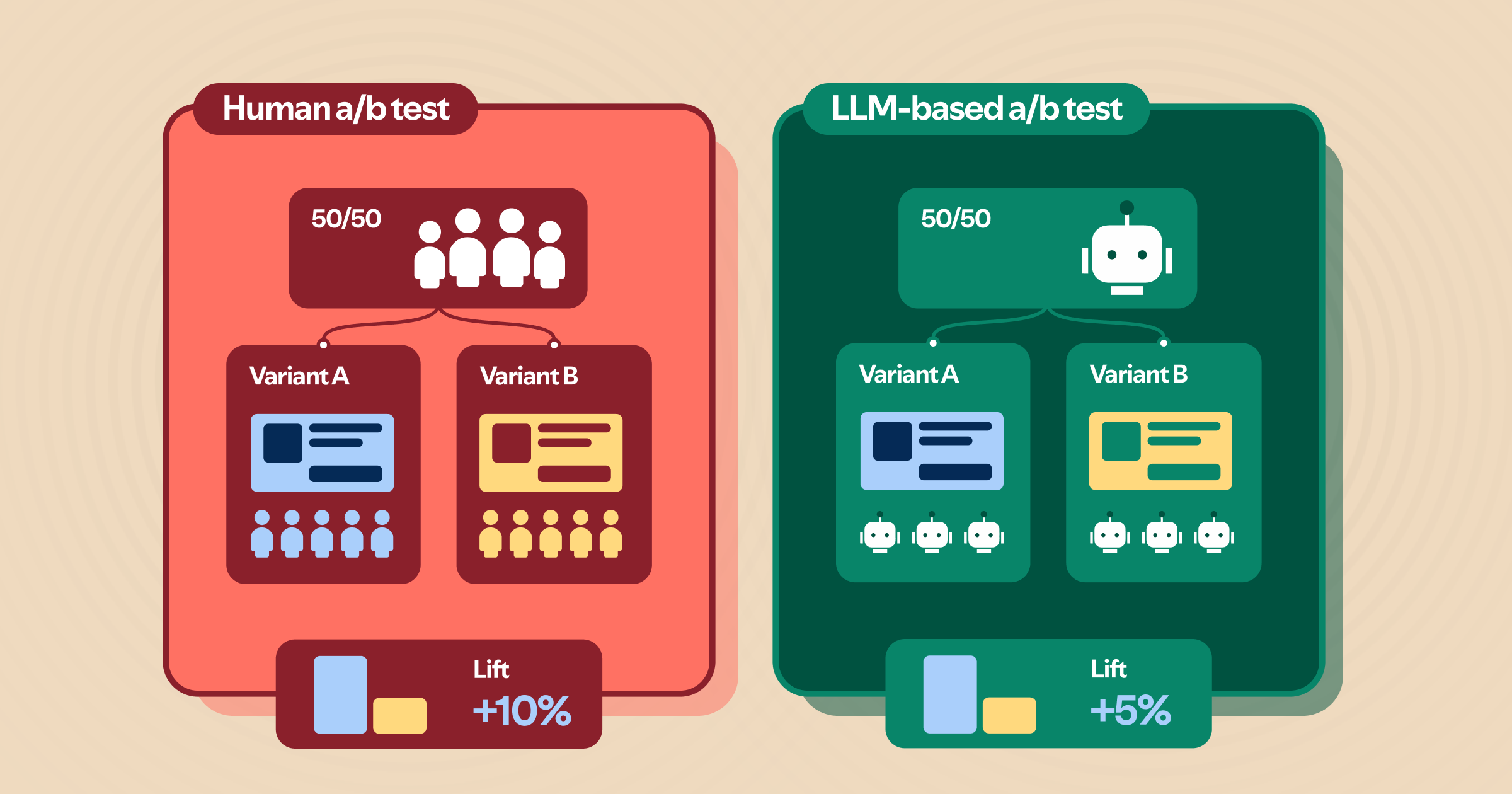
Replacing people with model-generated responses changes what an A/B test measures. In Spotify's analysis of headline experiments, raw language-model predictions recovered only 39% of the observed human treatment effect. That percentage describes the estimated effect of changing headlines, rather than prediction accuracy.
Flexible against historical human experiments brought estimates within the human 's sampling uncertainty. But transfer requires the model to capture what matters about the change and the relationship between predictions and human behavior to remain stable. Historical agreement therefore supports a narrower use: estimating outcomes for sufficiently similar experiments, with human data still needed to establish and check that relationship.
- calibration — How well a model's confidence matches reality — a calibrated model saying "90% sure" is right about 90% of the time.
- Benchmark — A fixed set of tasks with a stated way of scoring them, used to compare models or setups.
- State — Information describing a system at a particular moment, such as its current text, settings or saved records.
- Large language model — A model trained on large amounts of data to process and generate language.
 articleWhen Can You Ship on Offline Evals Alone?
 articleAI Changed How Spotify Builds. What We Learned (and Fixed) About Quality at Higher Velocity
- articleSpotify’s Backstage Portal cut my Claude Code token usage by 90%
 articleCoding Is No Longer the Constraint: Scaling Developer Experience to Teams and Agents at Spotify