A diffusion LLM at 1,000+ tokens per second with 1M context lowers per-step latency for browser agents and voice apps. Priced at $0.20/$0.70 per 1M tokens, with launch discounts.
Key takeaways · AI-distilled
Inception says Mercury 3, a diffusion-based LLMA large language model — the neural network behind tools like Claude and ChatGPT, trained on huge amounts of text to predict what comes next.Full definition →, matches or beats GPT-6 Luna and Claude Haiku 5.5 on its benchmarks while generating 1,068 tokens per second on NVIDIA GPUs, which it puts at 4-8x faster.
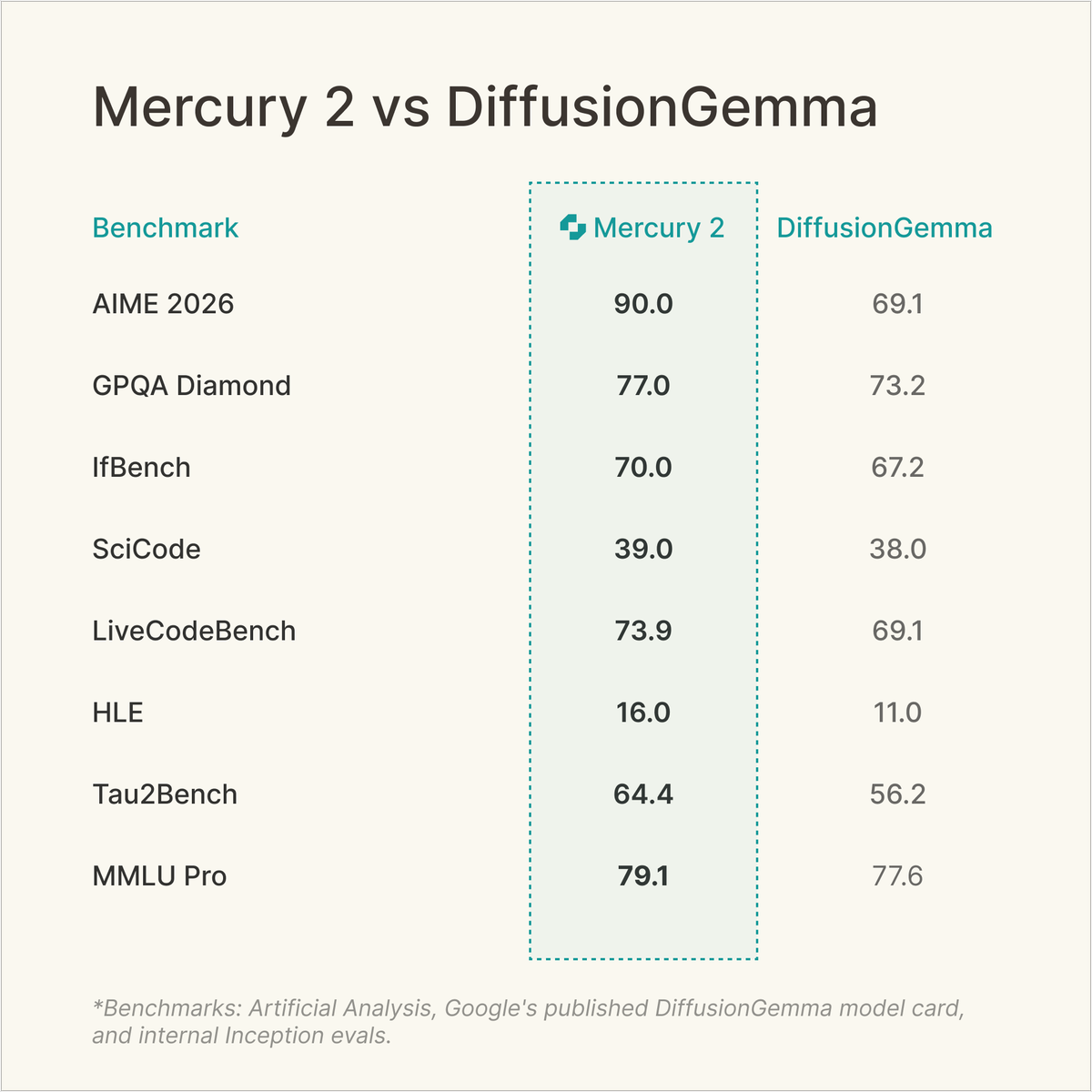
Mercury 3 is more than 40x larger than Mercury 1 in total parameters, and Inception reports benchmarkA standard public test set for comparing AI models — the shared scoreboards behind every "model X beats model Y" claim.Full definition → intelligence up 3x, which it presents as evidence that scaling laws hold for text diffusion as they did for autoregressive models.
List price is $0.20 per million input and $0.70 per million output tokens, 50% off at launch, with cached input 90% off; context windowThe maximum amount of text a model can consider at once — its working memory for the current conversation or task.Full definition → grows to 1M tokens from 260K in Mercury 2.5.
In a test by partner TinyFish AI on 50 live Mind2Web navigation tasks, Mercury 3 completed half, which the partner says is significantly more than GPT-6.1-Sol, using the same token volume and number of AI agentAn AI system that doesn't just answer once but works toward a goal in a loop — taking actions, reading the results, and deciding what to do next.Full definition → steps.
Octen AI reports a 0.9-second median generation time and 2.2-second median end-to-end response for Mercury 3 in its smart-glasses search tests, where its own search step took about 80ms.
Terms in this piece · Glossary
LLM — A large language model — the neural network behind tools like Claude and ChatGPT, trained on huge amounts of text to predict what comes next.
context window — The maximum amount of text a model can consider at once — its working memory for the current conversation or task.
benchmark — A standard public test set for comparing AI models — the shared scoreboards behind every "model X beats model Y" claim.
AI agent — An AI system that doesn't just answer once but works toward a goal in a loop — taking actions, reading the results, and deciding what to do next.