← All IntelIntel / article
Introducing Mercury Voice
- Source
- inceptionlabs.ai
- Author
- Inception editorial sitemap
- Date
Why it matters
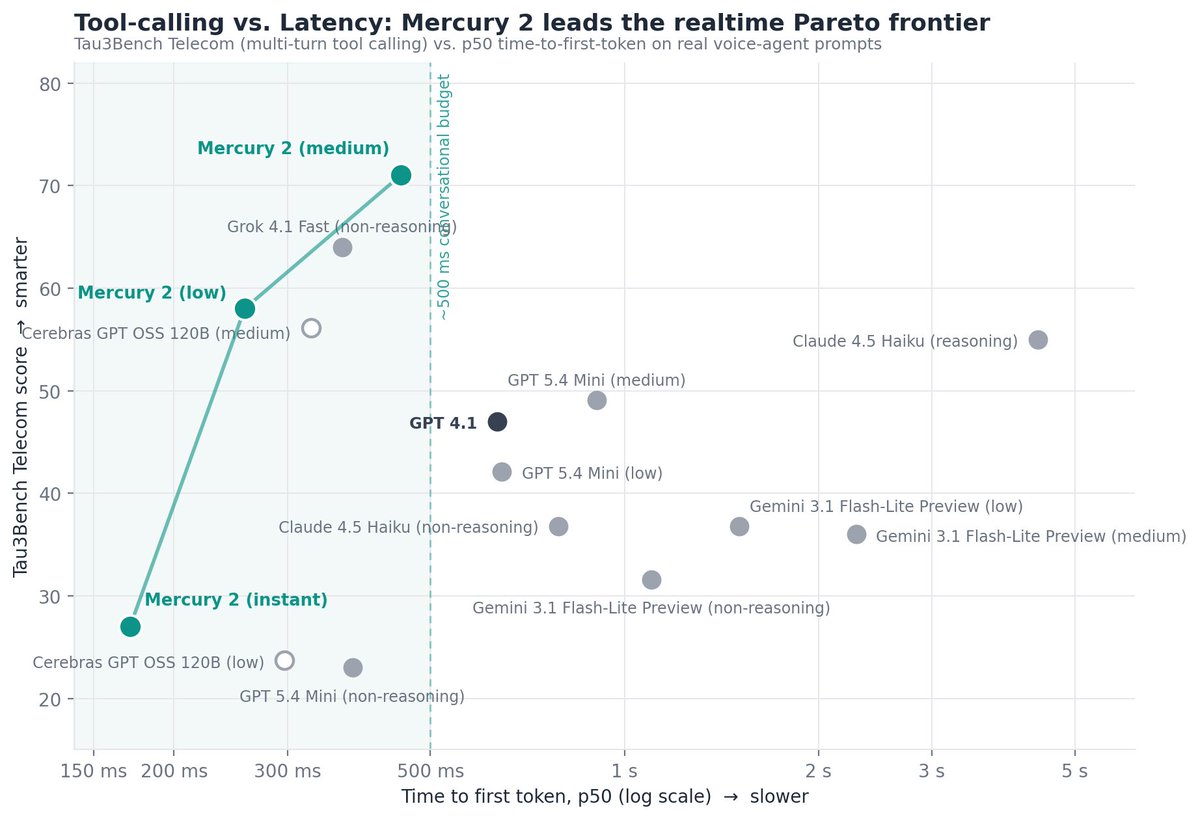
Voice agents need a response within about 500 ms, which forced a choice between slow reasoning models and fast non-reasoning ones. Mercury Voice reports reasoning with a 320 ms median first-token time, at $0.40/$1.50 per million tokens.
Key takeaways · AI-distilled
- Inception says Mercury Voice, a diffusion tuned for voice agents, returns its first answer in a median 320 ms (p95 750 ms) on production customer-service prompts, which it calls 5.9x faster than GPT-6 Luna without reasoning.
- Inception optimizes for time to first answer token, measured after reasoning finishes, because callers notice pauses beyond roughly 500 ms; it claims Mercury Voice at low effort is the only tested model with a median under that budget.
- On a composite of τ³-bench Telecom, Retail and Airline, IFBench and BFCL v4, Inception reports Mercury Voice beating GPT-6 Luna, GLM-5.3-Flash and Gemini 3.5 Flash-Lite, arguing voice builders no longer must choose fast non-reasoning models.
- The model offers low, medium and high reasoning effort, 128K with up to 50K output tokens, and costs $0.40/$1.50 per million input/output tokens, discounted 50% at launch.
Terms in this piece · Glossary
- LLM — A large language model — the neural network behind tools like Claude and ChatGPT, trained on huge amounts of text to predict what comes next.
- token — The chunk of text a model reads and writes in — roughly three-quarters of a word — and the unit AI usage is billed in.
- context window — The maximum amount of text a model can consider at once — its working memory for the current conversation or task.
- benchmark — A standard public test set for comparing AI models — the shared scoreboards behind every "model X beats model Y" claim.
Read the source www.inceptionlabs.ai
Recommended reads
Comments
Checking sign-in…
Loading comments…