SemiAnalysis on Jalapeno: OpenAI's chip, measured in tokens per megawatt
- Source
- youtu.be
- Publisher
- SemiAnalysis
- Author
- SemiAnalysis
- Date
Context
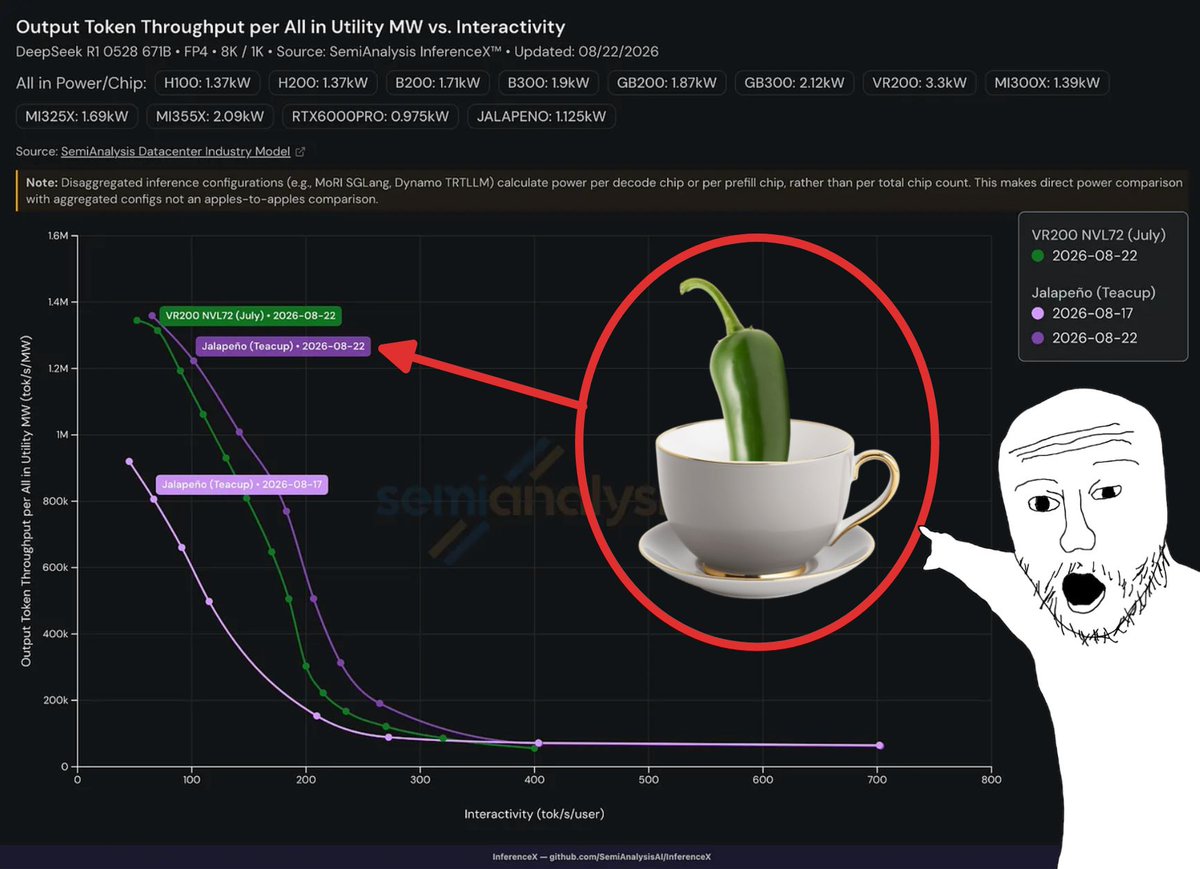
In this SemiAnalysis Weekly episode, three SemiAnalysis analysts discuss their written analysis of Jalapeño, the chip OpenAI designed for its own use, and explain why they rank it by tokens per megawatt: how much model output a system produces for each unit of electrical power it draws. Their reasoning is that data centers are now limited by power more than by money. A site with 100 megawatts can hold only so many chips, so a more expensive chip can still pay off if it turns that power into more tokens. OpenAI also runs Jalapeño only for itself rather than selling it, so output per megawatt matters more to it than output per chip. They add that per-chip figures are easy to inflate, since a vendor can package two chips together and claim double the performance.
On that measure, the analysts say Jalapeño beats NVIDIA's GB300 and the July results for NVIDIA's newer Vera Rubin system. On a DeepSeek model at a fixed response speed per user, they describe Jalapeño producing about twice the tokens per megawatt of GB300, and at small batch sizes reaching 700 per user where the others peak at 350. Its paper specifications are modest: less than half of Rubin's FP4 compute, less memory capacity, and roughly a third of its power rating per chip. The analysts trace the result to memory bandwidth per watt, 15.4 terabytes per second of high-bandwidth memory on a 700-watt chip, about double Rubin's ratio, and to a design that moves less data around so more of that bandwidth is actually used.
The comparison has limits the analysts themselves. They chose Rubin's July numbers because both systems' software was at a similar stage, and they expect Rubin to have improved since, as Jalapeño has. The main test, DeepSeek R1 with 8K input and 1K output tokens, uses random data rather than agent workflows, and OpenAI's team did not run SemiAnalysis's AgentX benchmark, which exercises features such as prefix caching. Jalapeño also ran without , a technique that guesses several upcoming tokens and checks them in one step, which Rubin used. The analysts say they were told OpenAI's internal speculative decoding method gives a three to five times improvement on production models, a claim they had no way to check. This account comes from the episode's spoken transcript; figures shown only in its charts are not included.
- Inference — Using a trained model to produce an output from a supplied input.
- throughput — How much model output a provider can generate over time, commonly measured in output tokens per second.
- State — Information describing a system at a particular moment, such as its current text, settings or saved records.
- speculative decoding — A speed trick where a small model drafts several tokens ahead and the big model verifies them in one pass, often doubling generation speed.