OpenAI's Jalapeño Chip: Architecture and Benchmarks vs Rubin
- Source
- newsletter.semianalysis.com
- Author
- SemiAnalysis
- Date

Context
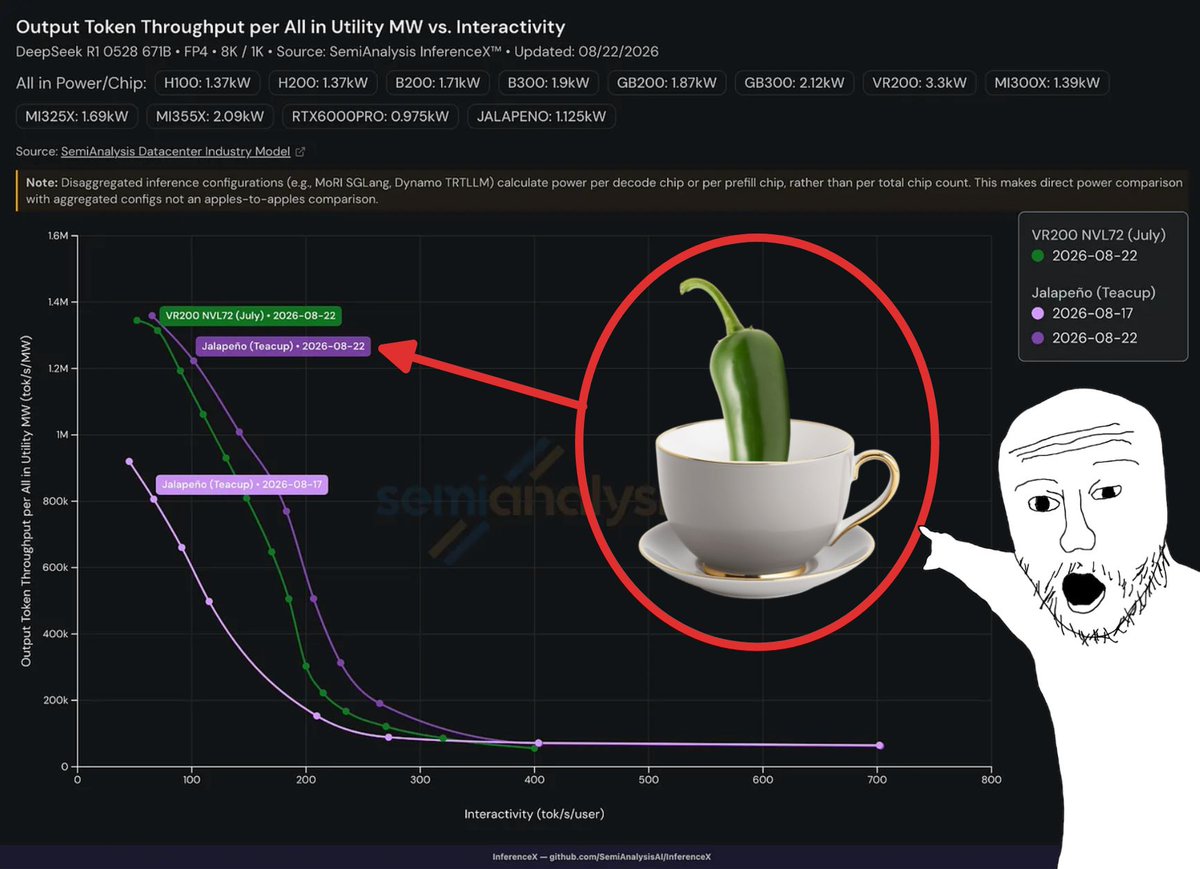
SemiAnalysis, a chip research firm, says OpenAI's first in-house chip, Jalapeño, beats every Nvidia, AMD and Google chip it has tested on output tokens per megawatt of power. Its article explains the result less by raw horsepower than by a set of design choices. Several of them remove fixed delays that make other accelerators slow when a request is small. OpenAI designed for performance per watt because, in SemiAnalysis's account, the company is limited by data-center power rather than by budget or floor space.
The chip's memory and cores are split into slices, each with a fast local view of its own share of the HBM memory, instead of routing every access through a deep shared memory system as GPUs do. Each core is an out-of-order design with an ordinary cache rather than the software-managed scratchpad other accelerators use, and its matrix engine accepts small matrix shapes that large systolic arrays such as TPUs handle poorly. OpenAI also chose not to split the two phases of a request, reading the (prefill) and generating the answer (decode), across separate pools of chips, a technique SemiAnalysis says helps Nvidia and AMD GPUs significantly. SemiAnalysis argues that a fixed split strands hardware whenever the mix of traffic changes, while a single pool keeps every chip available. The cost of this design is that performance depends on good data prefetching, which is hard to tune by hand. SemiAnalysis reports that OpenAI's kernels, some about 3,000 lines long, were increasingly written by an internal version of Codex, and it believes this is how OpenAI brought up DeepSeek R1, Kimi K2.5 and GPT-OSS so quickly.
The evidence is weaker than the headline. SemiAnalysis says all numbers came from OpenAI. Its analysts watched the runs in OpenAI's lab, but they did not run their full benchmark suite and saw no results from AgentX, their long-, multi-turn test that resembles agent traffic. The tested workload was 8,000 input tokens and 1,000 output tokens per request, which the authors call much easier to tune for. The results came from the first (A0) silicon. A revised B0 version, which SemiAnalysis says adds roughly 25% better performance per watt, was still in the fab, and production is scheduled to ramp gradually over 2027. Against Nvidia's newer Vera Rubin, which SemiAnalysis considers the fair comparison, Jalapeño leads on per megawatt and is roughly level on output per dollar. That comparison is unpacked in SemiAnalysis's companion thread. The fair reading is a credible early lead on a narrow workload, with the long, multi-turn agent workloads that SemiAnalysis treats as closest to real production traffic still untested. The article's closing section on what this means for Nvidia, AMD and Cerebras is behind a paywall and was not read.
- Inference — Using a trained model to produce an output from a supplied input.
- Prompt — Information or instructions supplied to a model; in a chat, the request you type is often called your prompt.
- Context and context window — Context is the information available for a generation; the context window is the capacity available to hold it.
- throughput — How much model output a provider can generate over time, commonly measured in output tokens per second.

Checking sign-in…
Loading comments…