DeepSeek V4 Pro 0813 scores 53 on the Artificial Analysis Intelligence Index, 8
- Source
- x.com
- Date

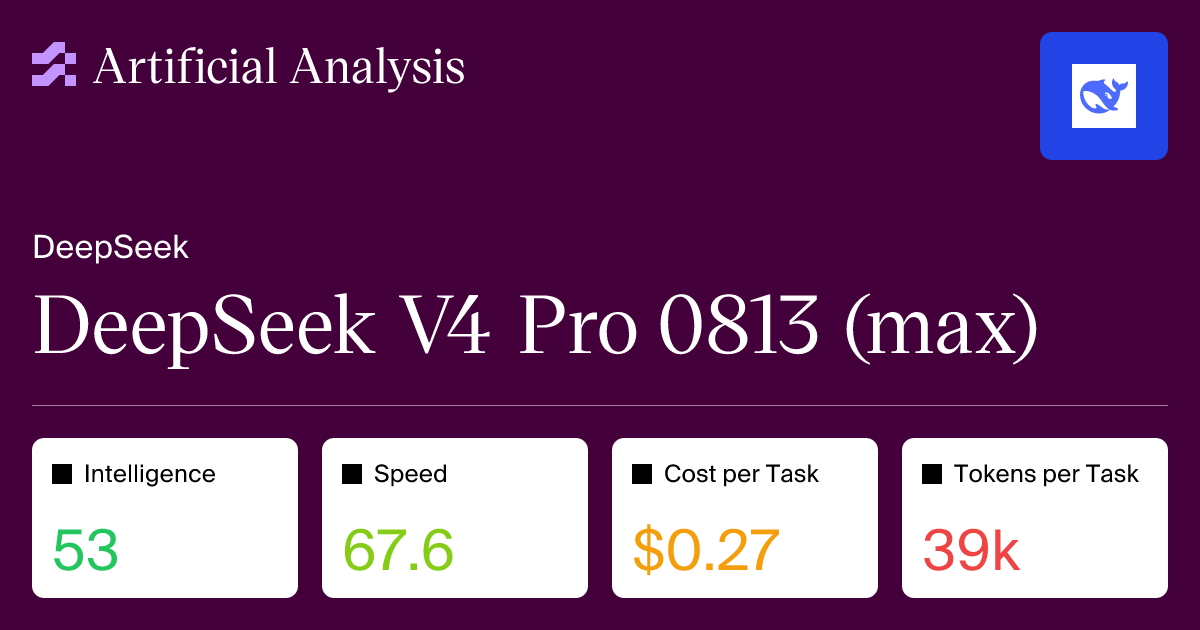
DeepSeek V4 Pro 0813 scores 53 on the Artificial Analysis Intelligence Index, 8 points above April's DeepSeek V4 Pro - but with a 3.6x price increase and only 1 point above DeepSeek V4 Flash 0731 @deepseek_ai has released DeepSeek V4 Pro 0813, its new flagship model, along with updated pricing. With the new pricing, it still sits on our Pareto frontier for Intelligence vs. Cost, but by a smaller margin than previous DeepSeek releases. Under the new pricing, DeepSeek’s first-party API will charge $1.32 / 1M input tokens and $3.96 / 1M output tokens - an increase of +264% on the blended price. Cached input tokens receive a ~97% discount (rather than the previous 99%): cache hits are priced at $0.044 / 1M tokens, 12x higher than previous cache-hit pricing. Off-peak pricing is discounted by 50%. This new pricing takes effect on August 16, 2026 - until then DeepSeek is offering V4 Pro 0813 at the same pricing as the earlier V4 Pro model. DeepSeek published the model weights under the MIT license, making it the second most intelligent open weights model we have benchmarked; however, weights for Qwen3.8 2.4T A95B have recently been released and will be evaluated on the Intelligence…

Context
DeepSeek's new flagship, V4 Pro 0813, scores higher and writes less than the April V4 Pro, but under new pricing each task costs about five times as much to run. That is the central finding of Artificial Analysis's evaluation. The model scores 53 on the group's Intelligence Index, a composite of its benchmark results, which is 8 points above the April version. Artificial Analysis says most of the gain is in agentic work, where a model carries out multi-step tasks: on its GDPval-AA v2 knowledge-work test, the model's Elo rating rose from 1306 to 1590, which the group says implies an expected win rate of about 84% against the April release. It also generated 128M output (the text a model produces) to complete the index, about 30% fewer than its predecessor.
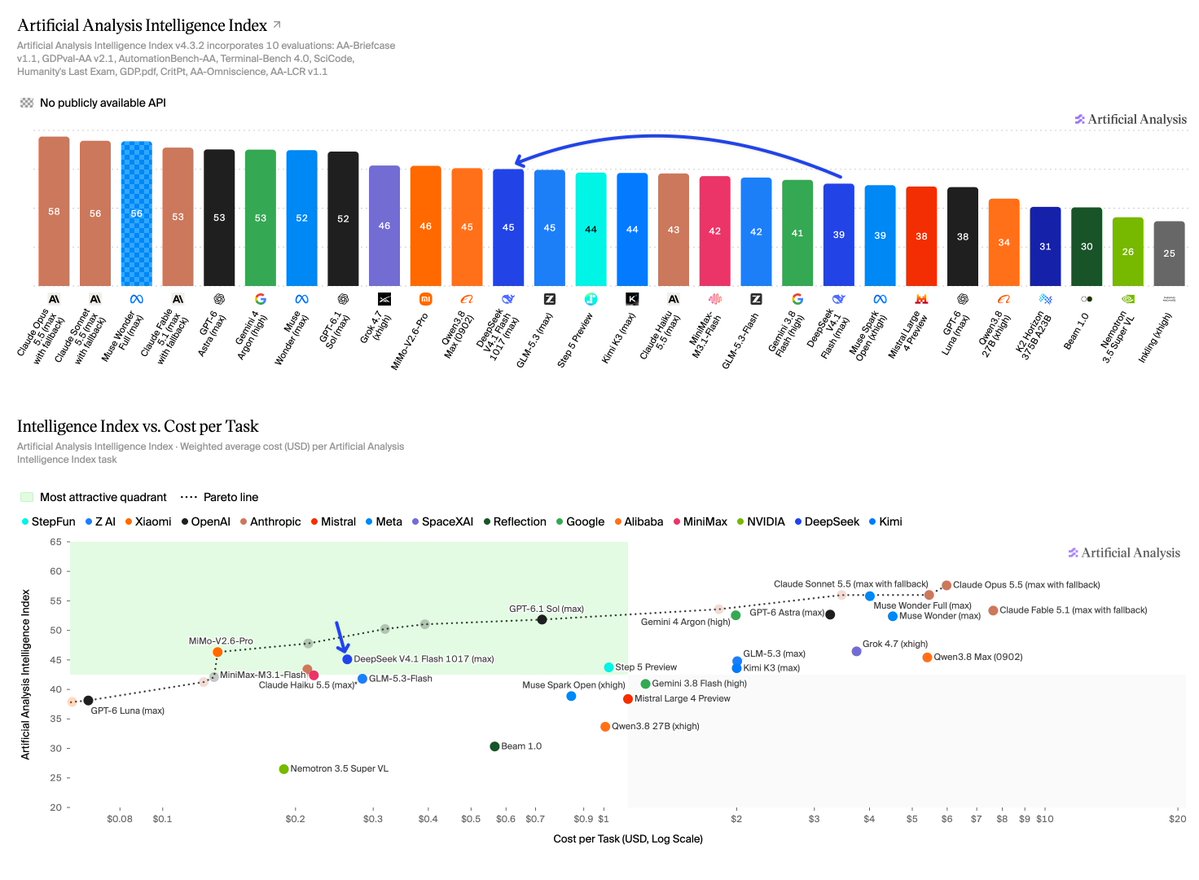
Price is what reverses the picture. Under pricing DeepSeek set to take effect on August 16, its own API charges $1.32 per million input tokens and $3.96 per million output tokens, which Artificial Analysis calculates as a +264% increase in the blended price. Cached input, meaning repeated prompt text the service has already processed, gets a discount of about 97% instead of 99%, so cache hits cost $0.044 per million tokens, 12x the previous rate. Off-peak use is discounted by 50%. Combining those prices with its own runs, Artificial Analysis puts the cost per task at $0.25, against $0.05 for the April model. The model still sits on the group's Pareto frontier for intelligence versus cost per task, meaning no model it has tested scores higher for less, but only by one cent against Gemini 3.7 Flash (medium). It is about 20% cheaper per task than GLM-5.2 ($0.32).
The comparison with DeepSeek's smaller model is less flattering. V4 Pro 0813 is only 1 point ahead of DeepSeek V4 Flash 0731 on the index, although it has about 3.8x the active parameters, the share of its 1.6T total parameters that does work at each step (49B for V4 Pro 0813). The two tie at 79% on Terminal-Bench 2.1, and Artificial Analysis says the smaller model performed at around the same level on agentic and coding benchmarks.
The scores and per-task costs all come from Artificial Analysis's own test suite, so the costs describe its workloads at DeepSeek's first-party prices, not every use. The open-weights ranking may also move. DeepSeek released the weights under the MIT license, and Artificial Analysis calls it the second most intelligent open-weights model it has benchmarked, 7 points behind Kimi K3, but Qwen3.8 2.4T A95B had not yet been evaluated.
- benchmark — A standard public test set for comparing AI models — the shared scoreboards behind every "model X beats model Y" claim.
- eval — A repeatable test for AI quality — a set of tasks plus scoring — used the way software teams use test suites, because model output is too variable to judge by eyeballing.
- token — The chunk of text a model reads and writes in — roughly three-quarters of a word — and the unit AI usage is billed in.

Checking sign-in…
Loading comments…