Tencent opens Hy4 preview: 770B sparse MoE with a 1M-token window
- Source
- github.com
- Publisher
- Tencent
- Author
- Tencent Hy
- Date
Context
Tencent's Hy4 preview pairs a very large network with two mechanisms that keep the work per token far smaller than its size suggests. The first is expert routing. According to the model README, 77 of its 78 layers are layers, each holding 256 routed experts plus one shared expert. Every token is sent to the eight best-matching routed experts and the shared one, so only 49 billion of the 770 billion total parameters are active for any token. A separate prediction layer (10 billion parameters, 0.7 billion active) is built in for , a technique for speeding up generation.
Expert routing does not address the other cost of a one-million-token : , where each new token looks back over everything before it. For that, Hy4 uses a gated form of DeepSeek Sparse Attention combined with IndexCache. In DeepSeek Sparse Attention, introduced with DeepSeek-V3.2, a small, cheap "lightning indexer" scores earlier tokens, and full attention runs only over the top-k it picks. Hy4's specification sets that k at 2,048. The IndexCache paper notes that the indexer itself still scales with the square of the length and runs at every layer, even though neighbouring layers choose very similar tokens. IndexCache therefore lets most layers reuse the selection from a nearby layer that ran its own indexer. Its authors report removing 75% of indexer computation on a 30B model with negligible quality loss. The Hy4 README gives no speed figures for its own configuration and does not explain what the gating adds.
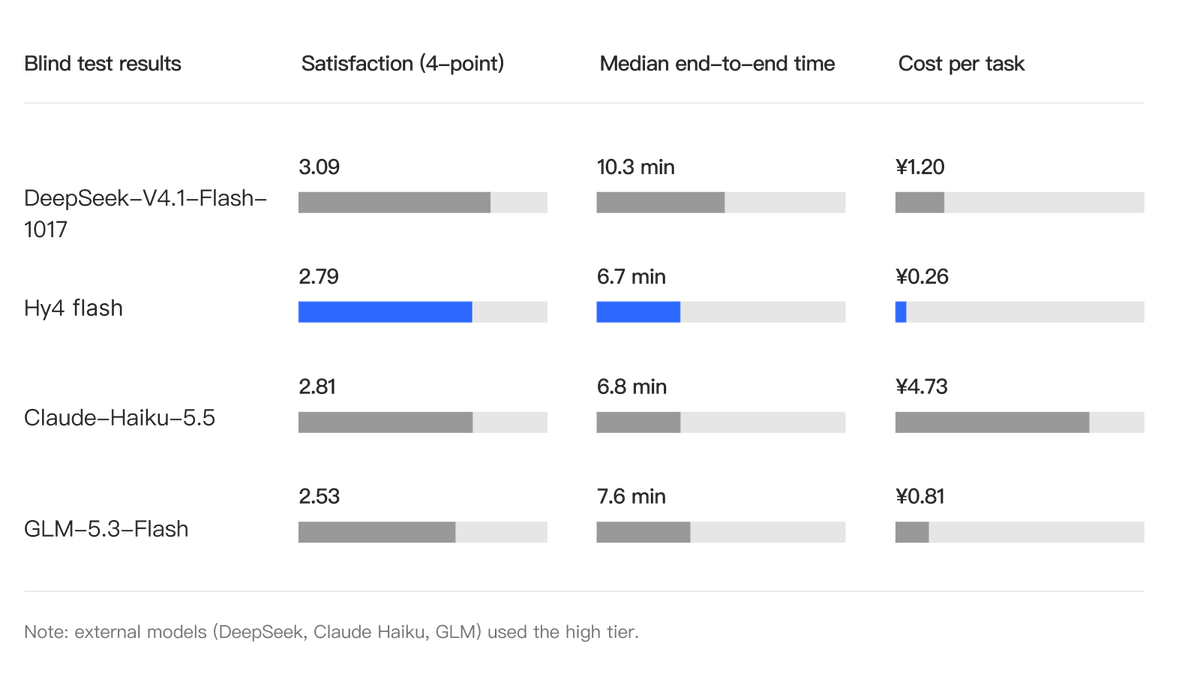
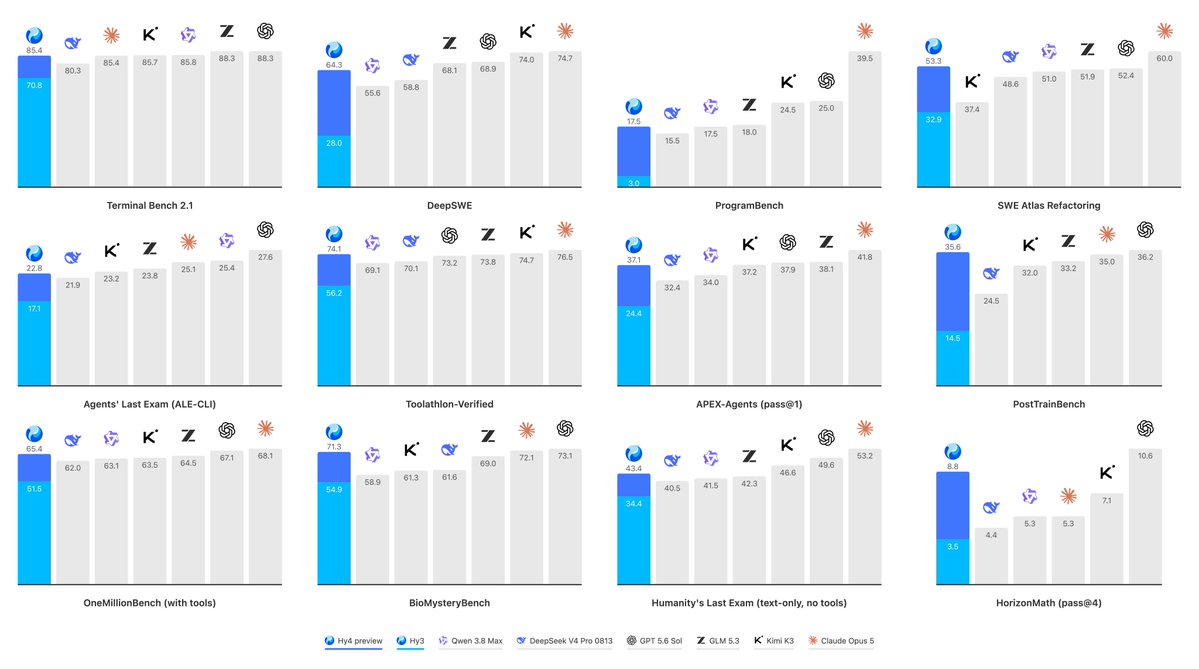
Tencent's main quality evidence in the README is internal. In a blind side-by-side test, 163 Tencent experts rated outputs on 203 engineering tasks, and Hy4 preview scored slightly ahead of GLM 5.3 (2.99 vs. 2.92) and Kimi K3 (2.99 vs. 2.94). The team calls this an early version that reasons longer than necessary on complex tasks and tends to over-verify its own work. The weights, including an FP8 variant, are released under Apache 2.0.
- mixture-of-experts — A model built from many specialist sub-networks where only a few activate per token, giving big-model capability at small-model running cost.
- speculative decoding — A speed trick where a small model drafts several tokens ahead and the big model verifies them in one pass, often doubling generation speed.
- Context and context window — Context is the information available for a generation; the context window is the capacity available to hold it.
- attention — The mechanism that lets a model weigh which earlier words matter for the word it's currently processing — the core operation of a transformer.