Deep Dive: Anthropic S-1 Myths and Mythos — Jamin Ball, Altimeter
- Source
- youtube.com
- Author
- Latent Space
- Date
Context
Anthropic reported an $80.7 billion net loss for the first half of 2026 while generating $3.9 billion of cash from operations, and Jamin Ball, a partner at the investment firm Altimeter, argues the two fit together because the loss is almost entirely an accounting charge, not money spent. Ball made that case to swyx in this Latent Space episode, recorded October 29 as Anthropic prepares to list its shares. We have not heard the episode itself. This explanation follows its published description and the essay Ball posted the next day, which the description points to as his explanation of the convertible notes. Both disclose that Altimeter is an Anthropic investor, and Ball writes that the views are his own.
The charge comes from convertible notes, a way startups raise money in which an investor hands over cash now in return for a promise of shares later at a price set at the time. Ball writes that strategic investors such as Amazon and Google put much of their early money in this way, and that about $6 billion of those notes has not yet turned into shares. Because the shares are owed but not issued, the company carries the promise as a liability, and Ball explains that it is valued at the current share price rather than the original one, a practice called marking to market. As Anthropic's valuation climbed, the recorded liability climbed with it, and the accounting has to run that increase through the income statement as a loss. Nothing is paid out when this happens, which is how a large reported loss can sit beside positive operating cash. Ball adds that if Anthropic had raised that money by issuing stock instead of notes back then, the loss would not have appeared.
By Ball's breakdown, about $72 billion of the loss comes from Amazon's notes: $6.2 billion of them, which he says convert into roughly 1.8 billion shares at $2 to $5 a share, sold cheaply in 2023 and 2024 and now recognized all at once because the company became more valuable. Another $9 billion, he says, comes from commitments Anthropic made in March and April 2026 to sell Google and Amazon $15 billion of preferred stock at $259 a share, the January price. A later round priced at $589 weeks afterward, and the accounting books that gap as an expense. The filing supports his central point: as earlier Intel on the S-1 reported, it attributes a $72.4 billion change in the value of convertible notes, derivative liabilities and SAFEs primarily to the rising value of the outstanding notes. That filing line groups the instruments differently from Ball's two figures, so his split should be read as his own account rather than a line-for-line match.
With those marks set aside, Ball points to a positive 8% operating margin in the second quarter under standard US accounting rules, meaning the business earned more from its operations than they cost. He does not expect that to last. He calls Anthropic "accidentally" profitable, guessing it has not added computing capacity as fast as it wanted while earning more than expected from the chips it already has, and he expects profitability to turn negative in coming quarters as it buys compute to meet demand. Nikunj Kothari's reading of the compute contracts shows the scale of that buildout, with hundreds of billions of dollars of purchase commitments and leases payable over years. By Ball's account, then, the headline loss says little about how the business runs today, and the episode description says he watches the cost of serving Claude alongside revenue growth.
- context window — The maximum amount of text a model can consider at once — its working memory for the current conversation or task.


 article[AINews] Anthropic files for $2T IPO in 2 weeks: 1400% growth rate, 48% of revenue through cloud partners, 85% margin, $1B op profit in Q2, $134B cash in bank and $10B lifetime burnswyx .ai
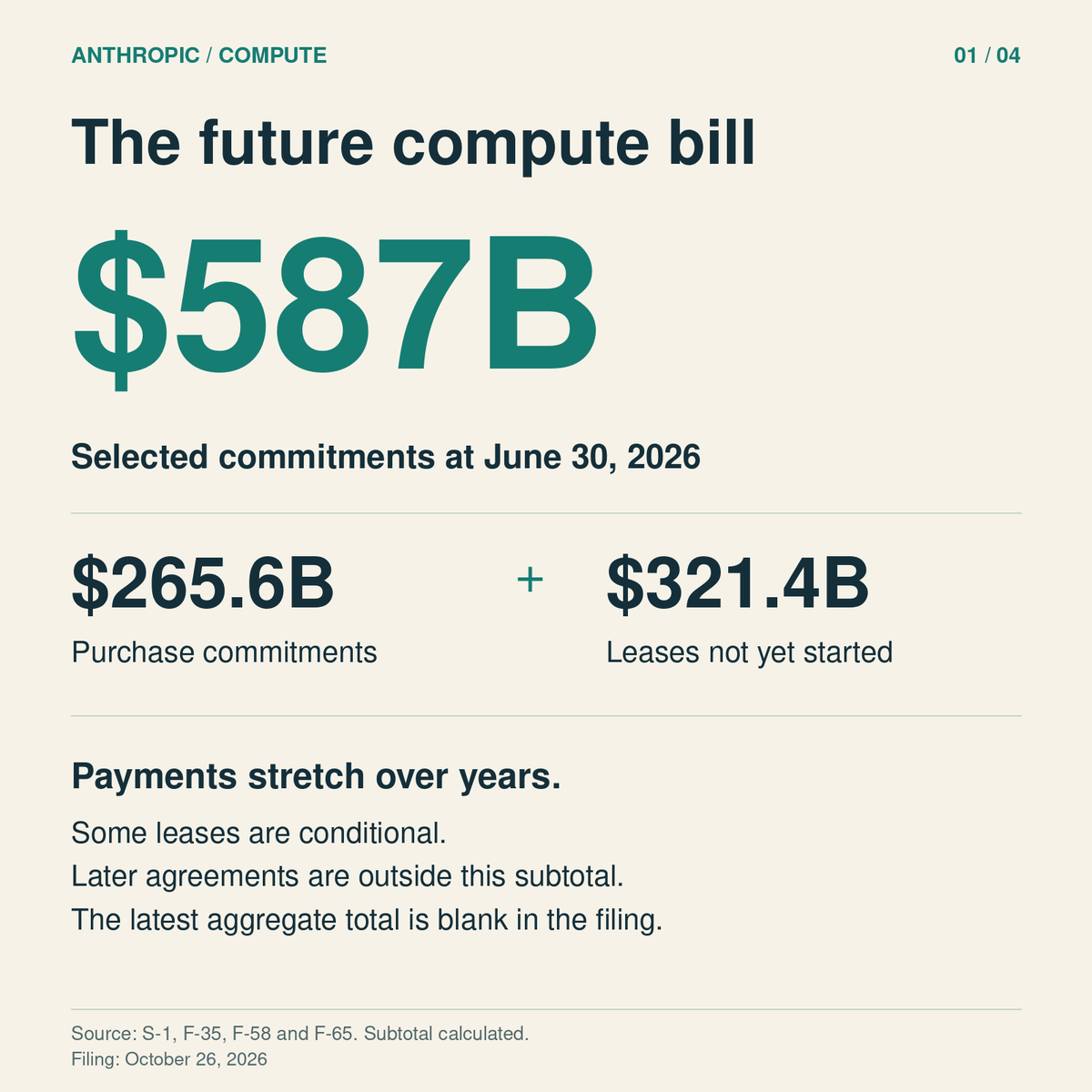 postWhat Anthropic's S-1 reveals about its compute contractsNikunj Kothari
 podcastAnthropic’s first technical PM on token maxing, the jagged edge, and living in the future | Dianne PennLenny Rachitsky
Checking sign-in…
Loading comments…