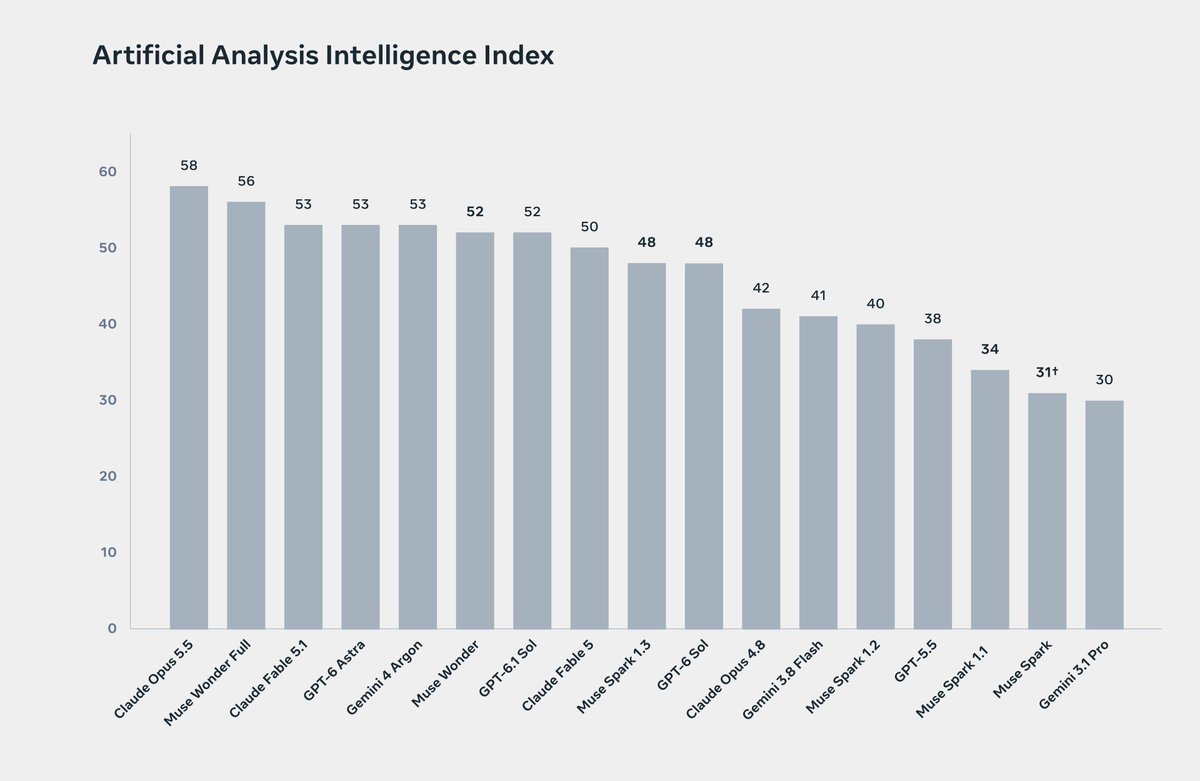
Meta's Muse Wonder models jump on agentic evals, Artificial Analysis finds
- Source
- x.com
- Publisher
- Artificial Analysis
- Date

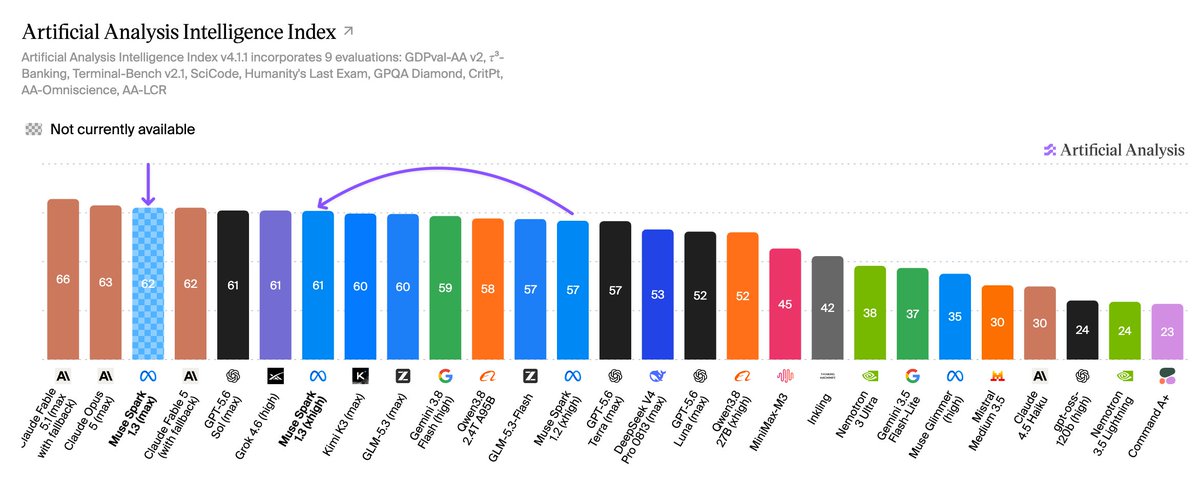
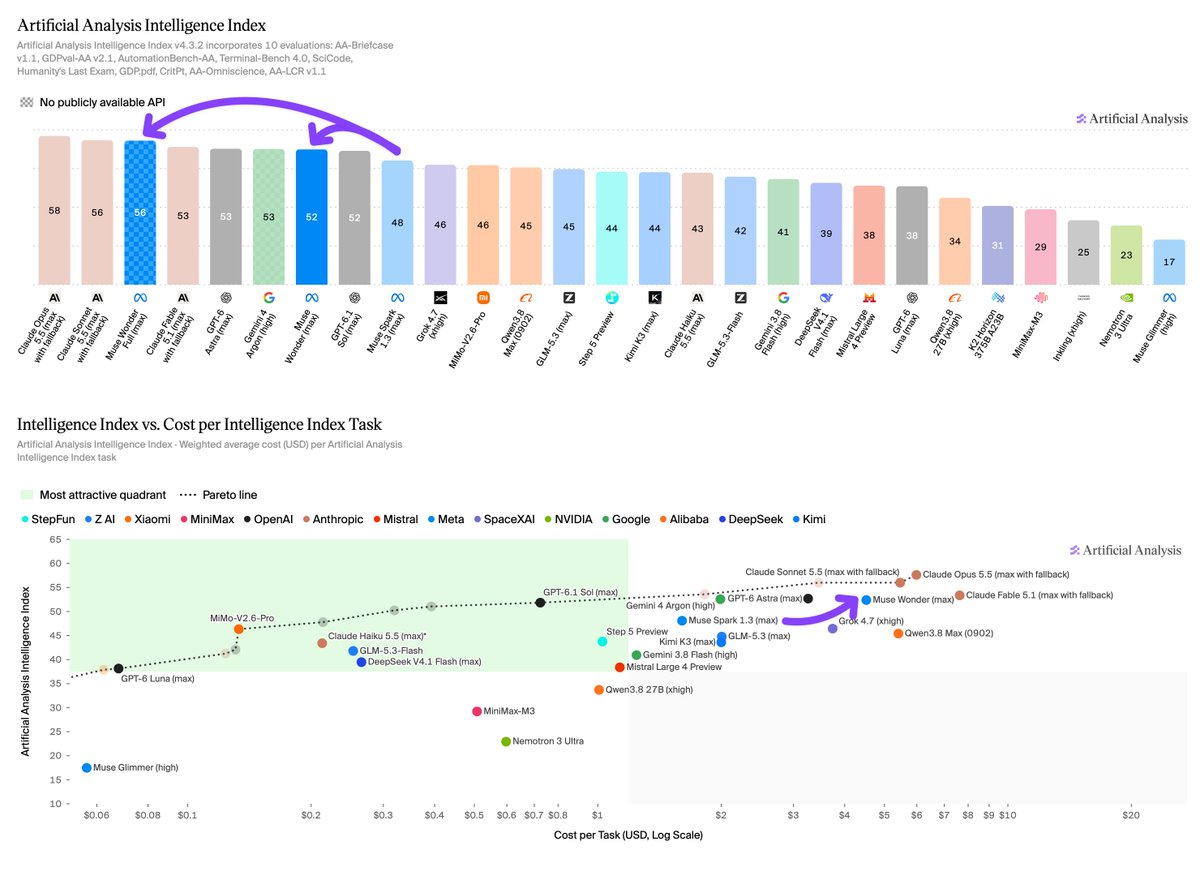
Meta has released Muse Wonder and Muse Wonder Full, achieving Artificial Analysis Intelligence Index v4.3 scores of 52 and 56 at max reasoning effort - each a material gain over Muse Spark 1.3 (max) at 48, with a release gap of only 6 weeks Muse Wonder is available for users on Meta’s first-party API, while Muse Wonder Full is currently only available for Muse Code users. Meta notes that each model is designed for personal and professional agent use Congratulations to @AIatMeta, @finkd, and @alexandr_wang on the release! Key Takeaways: ➤ Both models exhibit a material jump in overall Intelligence Index score. Muse Wonder Full (max) improves on Muse Spark 1.3 (max) across all ten Intelligence Index evaluations, gaining 8 points to 56. The largest gains were seen in agentic evaluations: Terminal-Bench 4.0 (+24 points, 33% to 57%), GDPval-AA v2.1 (+176 Elo, 1681 to 1857), and AA-Briefcase (+148 Elo, 1581 to 1729). Muse Wonder (max) gains 4 Intelligence Index points and lands at 52, with notable improvements vs. Muse Spark 1.3 (max) in Terminal-Bench 4.0 (33% to 52%) and AutomationBench-AA (58% to 68%) ➤ Muse Wonder Full (max) places in the top three on six of the ten…
Context
Artificial Analysis, which runs its own model benchmarks, reports that Meta's two new Muse Wonder models are a clear step up from Muse Spark 1.3, released six weeks earlier. Its Intelligence Index v4.3 combines ten evaluations into one score. At maximum , Muse Wonder scores 52 and Muse Wonder Full scores 56, against 48 for Muse Spark 1.3. Wonder Full improved on all ten evaluations, and the largest gains came on agentic ones, where the model works through a multistep task instead of answering a single question. On -Bench 4.0 it went from 33% to 57%. On GDPval-AA v2.1, which rates models against each other on an Elo scale, it rose from 1681 to 1857.
The stronger model is also the harder one to get. Wonder Full is available only inside Muse Code, Meta's , and Meta has not announced a per-token price for it, so Artificial Analysis could not estimate its cost. In Muse Code it scores 68 on the firm's Coding Agents Index, level with Claude Code running Sonnet 5.5. Developers using Meta's API get Muse Wonder, the smaller gain of the two: four index points, with Terminal-Bench 4.0 rising from 33% to 52% and AutomationBench-AA from 58% to 68%. Meta's own announcement describes the same split between the API and Muse Code.
The API model also costs more to run. At $4 per million input tokens and $20 per million output tokens, Artificial Analysis puts Muse Wonder at $4.52 per Intelligence Index task, compared with $1.60 for Muse Spark 1.3. It uses about 10% fewer output tokens than its predecessor, but the firm attributes the higher cost to premium pricing and heavy input use, about 7.69 million input tokens per task. That is cheaper than Claude Fable 5.1, Opus 5.5 and Sonnet 5.5 on the same measure and more expensive than GPT-6 Astra, Gemini 4 Argon and GPT-6.1 Sol. For an API user, the measured upgrade is four points on the index at nearly three times the predecessor's cost per task.
- Reasoning effort — The inference-time budget a reasoning model spends before answering.
- Terminal — A program that shows text and accepts typed text.
- Agent mode — A mode in which one agent can inspect, edit, run commands, and iterate toward an outcome.
- Context and context window — Context is the information available for a generation; the context window is the capacity available to hold it.