FrontierPhysics leaderboard: agents on physics research tasks
- Source
- x.com
- Publisher
- Artificial Analysis
- Date

Launching our leaderboard for FrontierPhysics, including 54 physics research tasks written by physicists. Claude Fable 5.2 leads at 32%, 6 points ahead of GPT-6.2 Astra FrontierPhysics is a physics research benchmark from @benchflow_ai, and we run 54 of the 56 tasks (excluding two GPU tasks). Each task is written by physicists and requires the agent to review the literature, run simulations and analyses, and submit its results with a manuscript. Tasks span 9 physics domains, from condensed matter to astrophysics, and are private to avoid contamination. A run passes only if its results pass the task's numeric checks and LLM agent reviewers find no flaw that would prevent publication. A failed run scores 0, and a passing run scores the share of rubric points the reviewers award. Key takeaways: ➤ Claude Fable 5.2 (max) leads by 6 points, and the next five models score between 22% and 26%: GPT-6.2 Astra (max) 26%, Gemini 4 Neon (xhigh) 25%, Claude Opus 5.5 (max) 24%, Claude Sonnet 5.5 (max) 23% and GPT-6.2 Sol (max) 22% ➤ Nearly half of Gemini 4 Neon (xhigh)'s runs that pass the numeric checks fail review: Neon passes numeric checks 54% of the time, the most of any model, but…
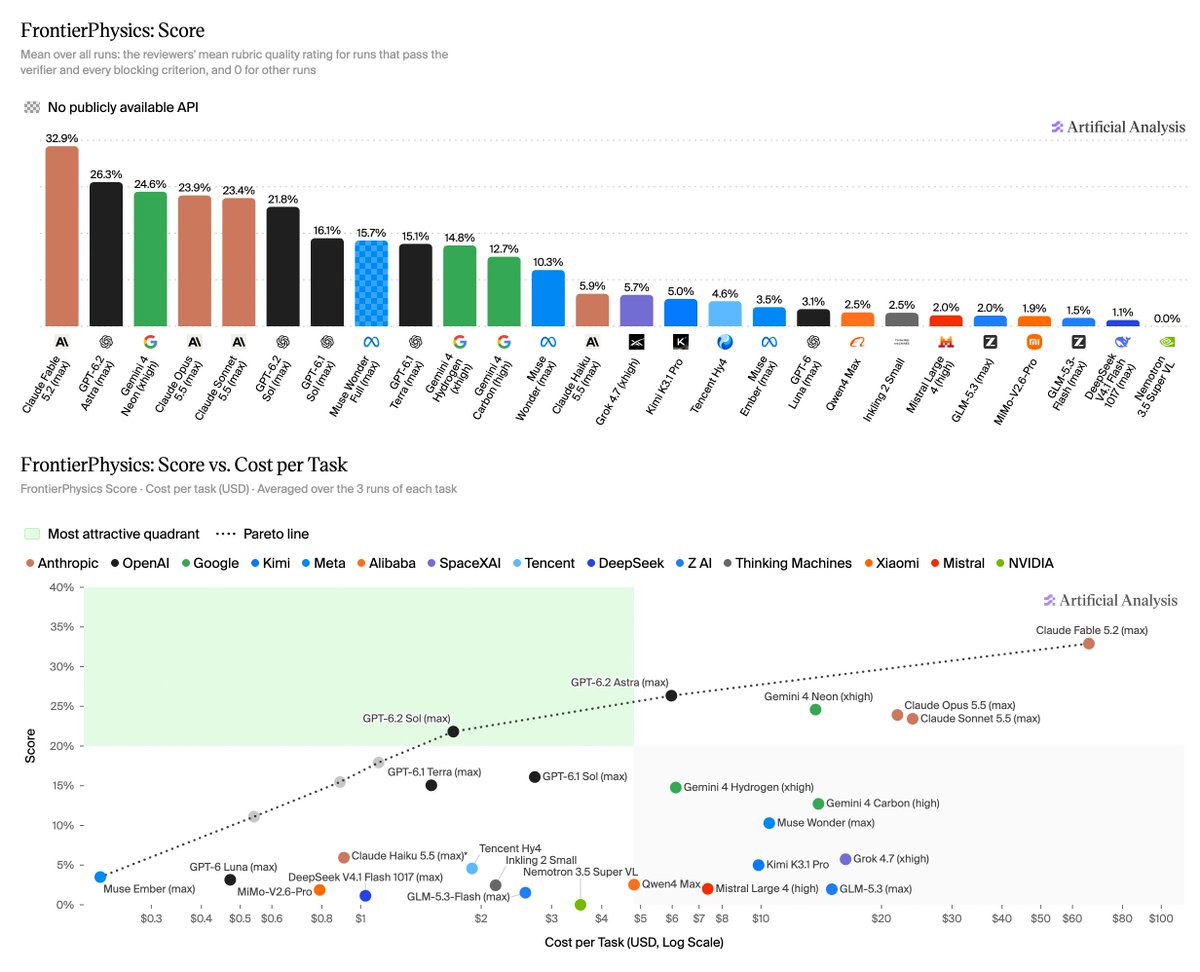
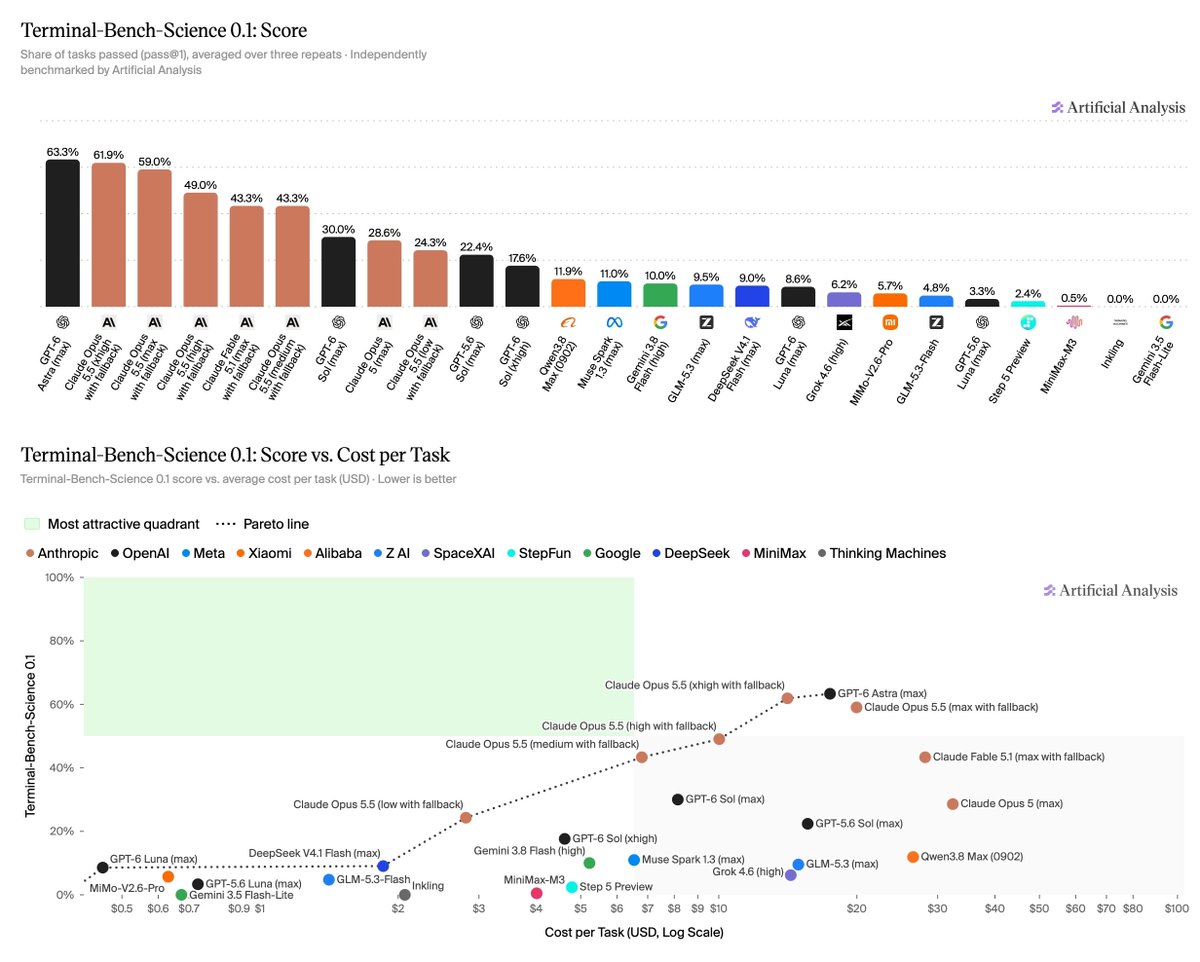
It measures agents on end-to-end physics research (literature, simulation, manuscript), where the top score is 32%. It also shows that passing numeric checks often hides publication-blocking flaws, and gives score versus cost data per .
- Large language model — A model trained on large amounts of data to process and generate language.
- Model — A computational system that uses learned patterns to produce an output from information supplied to it.