Gives dated Epoch Capabilities Index scores for current frontier models and an open-versus-closed weight lag estimate (about 6 to 7 months on cybersecurity), useful when choosing models.
Key takeaways · AI-distilled
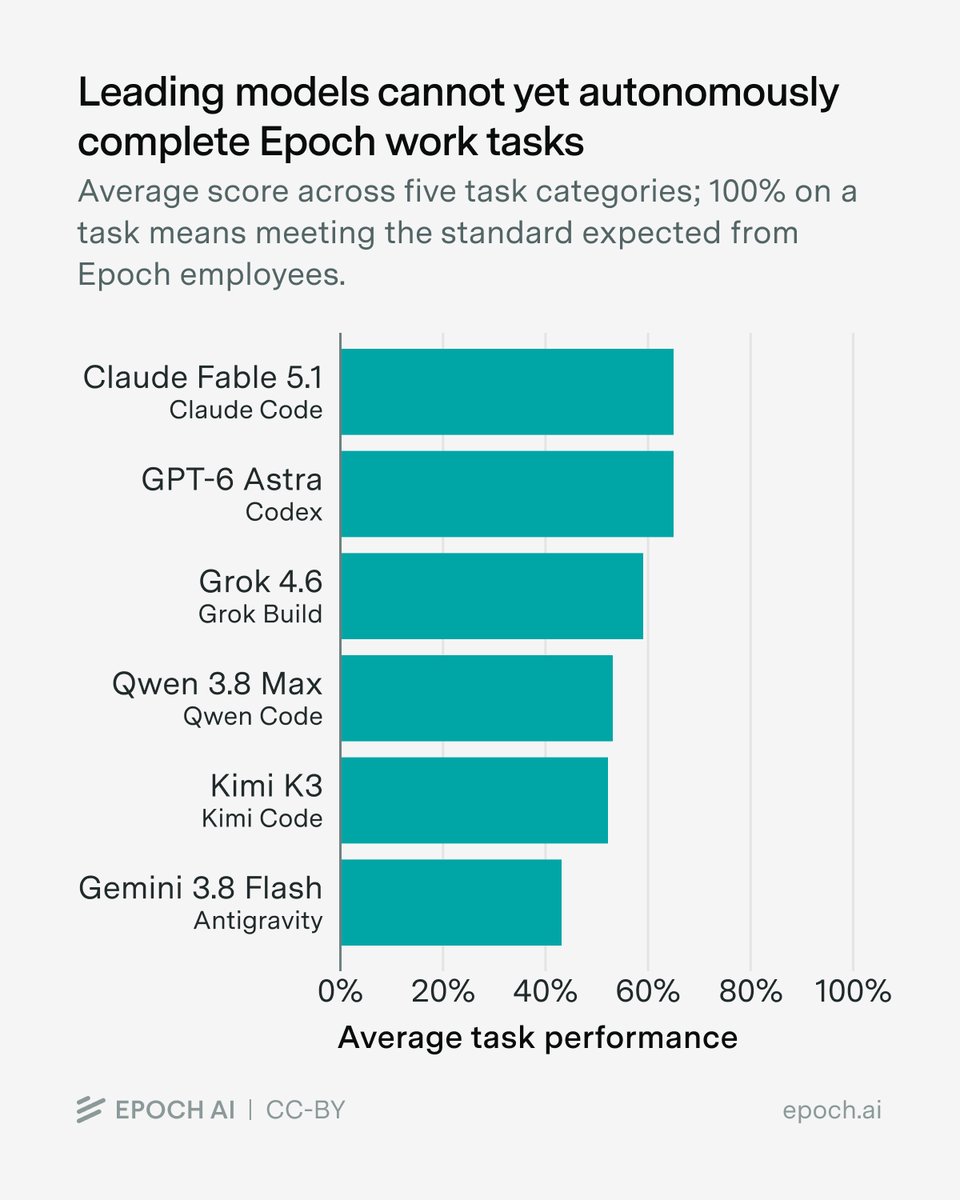
Epoch gave six models one unaided attempt at 11 realistic tasks from its own work. Claude Fable 5.1 and GPT-6 Astra roughly tied for the lead, but none reliably met Epoch's bar. Frontier closed models did best on well-defined coding and data work, worst on open-ended judgment.
On Epoch's SpireClimb benchmarkA standard public test set for comparing AI models — the shared scoreboards behind every "model X beats model Y" claim.Full definition →, frontier models went from struggling to beat Slay the Spire to winning over 90% of base-difficulty runs in six months. At the hardest difficulty GPT-6.1 Sol wins 20% and GPT-6 Astra 17%, against an estimated 85% for top human players.
To test whether memorized game knowledge drove those scores, Epoch also ran this year's Slay the Spire 2. Astra won 35% at its hardest setting, which is easier than the original's, and the researchers read this as showing scores did not come solely from prior knowledge.
Gemini 4 Argon scores 166 on the Epoch Capabilities Index, tying Claude Fable 5.1 and just behind Claude Opus 5.5 and GPT-6 Astra (169) and GPT-6.1 Sol (168). It is strongest on knowledge, agentic tasks and image understanding, and ranks 8th on Epoch's math index.
On Epoch's cybersecurity index, the top open weightsA model whose trained parameters are published for anyone to download and run — unlike API-only models you can access but never possess.Full definition → model, Z.ai's GLM-5.3, scores 160, close to GPT-5.5's 162 from April, while Claude Opus 5.5 and GPT-6 Astra lead at 171. Epoch cautions that some model scores come from only a few tests.
Terms in this piece · Glossary
open weights — A model whose trained parameters are published for anyone to download and run — unlike API-only models you can access but never possess.
benchmark — A standard public test set for comparing AI models — the shared scoreboards behind every "model X beats model Y" claim.