Terminal Tasks Open – What we built after auditing Terminal-Bench 4.1
- Source
- vetto.ai
- Author
- dvaplima
- Date

Context
Vetto, a company that builds evaluation tasks for AI agents, has released Tasks Open: 30 jobs an agent must complete from a , each graded by a hidden test the agent never sees. Most of Vetto's post is about the pipeline that makes these tasks. A person writes a short seed describing a job and what should make it hard. An agent then writes the , the working files, the hidden grader and a reference solution. Every candidate is run: the reference solution must pass every time, an agent that does nothing must fail every time, and separate agents try to pass without doing the work. A judge model that Vetto fine-tuned for terminal tasks then reads the task and every trial run on it, looking for three kinds of defect: correct work that fails, incorrect work that passes, and jobs no real requester would ask for. A task is accepted only if the judge finds no defect and frontier models fail most of their trials. Vetto says 157 of the 415 tasks it started were accepted, and the 30 released tasks come from those. It used the same judge in its review of Terminal-Bench 4.1, a benchmark of terminal tasks, where it recorded 60 findings in 23 of 66 tasks.
On Vetto's own runs, the new set spreads the strongest models further apart than Terminal-Bench 4.1 does. Each model was paired with an agent program, the lab's own (such as Claude Code or Codex CLI) where one exists, and given up to three trials per task in a container with no network access and up to 24 hours. OpenAI's GPT-6.2 Astra passed 66.7% of its trials (averaged per task), Anthropic's Claude Fable 5.2 passed 56.7% (from one trial per task, because of cost) and Google DeepMind's Gemini 4 Carbon passed 54.4%, with frontier models ranging from 42% to 67%. Vetto compares that with the top ten models on Terminal-Bench 4.1's leaderboard on 20 November, which all scored between 60% and 66%. The low scores are partly by design: the tasks were built from mid-October to mid-November against the models available then, and the best of those, GPT-6.1 Sol, passes 43%. One task, a detector that infers whether anyone is home from neighbouring Wi-Fi signal strength, has not been passed in any of its 43 trials. With four hints that Vetto says add no new requirement, GPT-6.1 Sol at medium effort passed one of five trials.
Vetto's analysis of why models fail shows what the set actually tests. It labelled every one of 980 failed trials. Among failures caused by the model's own work, 52% were overfitting: the solution fit the examples supplied with the task and broke on hidden cases. Another 31% were misjudgements, where the model had evidence of a problem and decided it did not matter, and 9% were lost to mishandling the terminal or the agent program. In about three quarters of failed trials the evidence of the mistake was already on screen, and in about as many the model reported the job done. In one case Gemini 4 Carbon wrote a solver, a random test generator and a brute-force checker that agreed on 270 cases, but all three came from the same misreading of the rules, so on one hidden case it reported a balance range of 8835 to 10335 where the answer is exactly 8835. Running the same analysis on published Terminal-Bench 4.1 trials for four of these models, Vetto found the same patterns in a different form: there, overfitting usually meant picking one reading of an unclear instruction, while here it usually meant tuning on the shipped examples. Vetto excluded 79 trials whose failure was not the model's own work, most of them because a provider's content filter stopped the run or a fallback model took the decisive step; most were Claude Opus 5.5 and Sonnet 5.5 trials, and Vetto says this explains part of those models' lower scores. The tasks are published on GitHub and Hugging Face, and every counted trial on Hugging Face, so others can check the results instead of relying on Vetto's account.
- Terminal — A program that shows text and accepts typed text.
- Terminal and shell — A text interface for navigating files and running programs.
- Program — A set of instructions stored so that a computer can run it.
- Instruction — A statement in the context that tells the model how to behave or what to do; module 3's first layer.

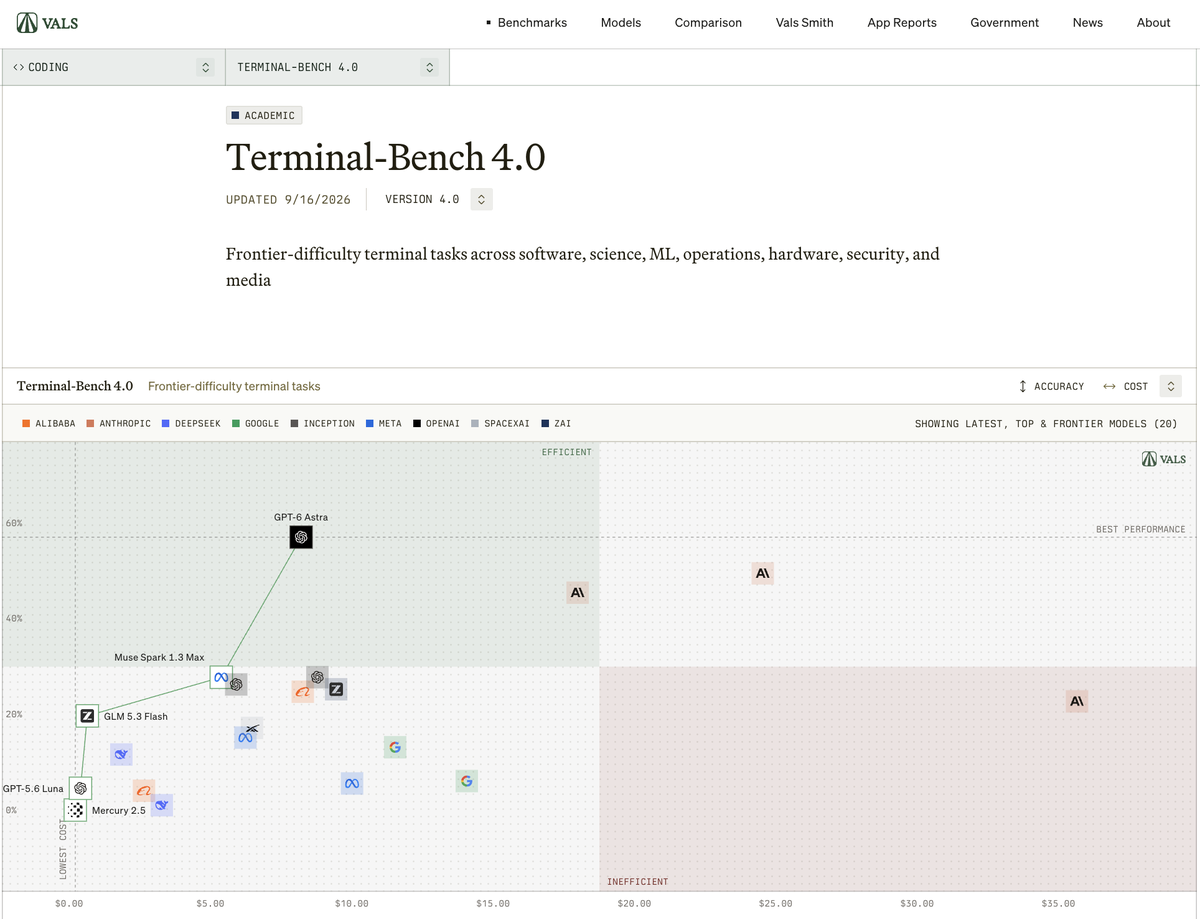 postVals AI Launches Terminal-Bench 4.0 With Strict Pass/Fail GradingVals AI
 videoTerminal-Bench 2.0: the most impt coding agent benchmark of 2025 gets a v2! Launch + Q&A w/ foundersLatent Space
 articleLong-Horizon-Terminal-Bench 2.0: Automating Diverse Task Construction and Measuring Sustained Agent ProgressZongxia Li, Zhongzhi Li, Yucheng Shi, Ruhan Wang, Junyao Yang, Chengsong Huang, Zhichao Liu, Xiyang Wu, Anhao Li, Yue Yu, Ergan Shang, Fuxiao Liu, Tong Zheng, Ninghao Liu, Lichao Sun, Haitao Mi, Leowei Liang
Checking sign-in…
Loading comments…